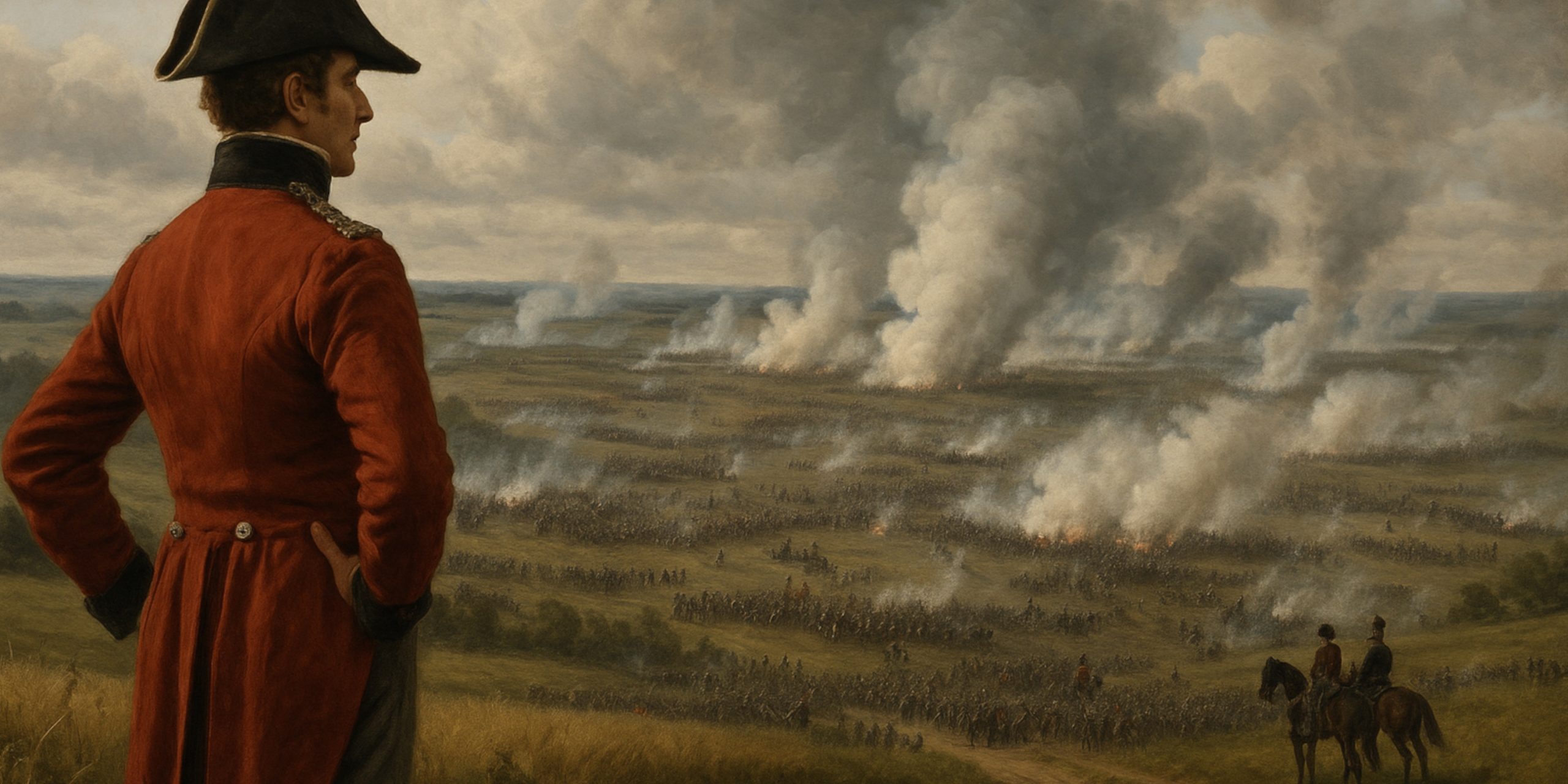
Arthur Wellesley, 1st Duke of Wellington, remains one of Britain’s most formidable military leaders and a central figure in 19th-century European history. Born in Dublin in 1769, his career spanned from soldier to statesman, culminating in the defeat of Napoleon at Waterloo and a subsequent role as Prime Minister. His legacy is not only etched into the annals of military history but also preserved through artefacts, memorials, and archaeological discoveries that continue to illuminate his life and campaigns.
Arms and Armour
Wellington was never one for ostentation on the battlefield, often choosing practicality over display. His typical dress in campaign was relatively modest compared to other commanders of the age. He was often seen wearing a blue field marshal’s uniform with gold braid, accompanied by a bicorne hat. In contrast to Napoleon’s more flamboyant appearance, Wellington’s military bearing came from discipline, not theatre.
He typically carried a sabre or light cavalry sword, in keeping with officers of the time. His personal firearms would have included a flintlock pistol, though he seldom took part in direct combat. During his time in India and the Peninsular War, he encountered a wide range of enemy weaponry, from Indian tulwars to French bayonets and muskets.
Battles
Wellington’s career was defined by his ability to adapt to a variety of battlefronts, from the subcontinent of India to the rain-slicked fields of Belgium. He rarely lost an engagement, and his careful attention to terrain, logistics, and discipline shaped each of his campaigns.
Key Battles:
| Battle | Year | Opponents | Result |
|---|---|---|---|
| Assaye | 1803 | Maratha Empire | British Victory |
| Vimeiro | 1808 | French Empire | British Victory |
| Talavera | 1809 | French Empire | British Victory |
| Salamanca | 1812 | French Empire | British Victory |
| Vitoria | 1813 | French Empire | British Victory |
| Waterloo | 1815 | French Empire (Napoleon) | Decisive Allied Victory |
Each of these battles showcased a different element of Wellington’s tactical nous. At Assaye, he used fast manoeuvres against a numerically superior Indian force. At Salamanca, he exploited a gap in the French line with remarkable timing. Waterloo, his most famous victory, was a masterpiece of endurance and coordination with Prussian forces under Blücher.
Military Genius
Wellington’s military success lay in meticulous preparation and strategic patience. He placed enormous emphasis on logistics, knowing that a well-supplied army could outlast even the most aggressive foe. Unlike many of his contemporaries, he avoided reckless frontal assaults and made excellent use of defensive terrain, particularly the reverse slope tactic where infantry were shielded from artillery before engagement.
He also maintained strict discipline. His Peninsular Army was known for its cohesion and obedience, in contrast to the often unruly French forces. Wellington was no sentimentalist when it came to command; he was stern, occasionally cold, but always focused on the outcome.
His despatches reveal a sharp, observant mind, and his ability to keep coalition forces united through difficult campaigns demonstrates his skills extended beyond the battlefield.
Artefacts and Memorials
Numerous artefacts tied to Wellington’s life can be seen across Britain and Europe.
- Wellington Arch in London stands near Hyde Park Corner as a monumental tribute to his victories.
- Apsley House, also known as Number 1, London, was Wellington’s residence and is now a museum containing his swords, uniforms, and a grand dining service gifted by European powers after Waterloo.
- Wellington Monument in Somerset, an imposing obelisk, was erected to honour his achievements.
Visitors to Horse Guards Museum in London can also view various artefacts relating to the British Army during his command.
Recent Archaeology
While much of Wellington’s legacy has long been preserved, recent archaeology has focused on the landscapes of his campaigns rather than his personal possessions. At Waterloo, ongoing digs led by the Waterloo Uncovered project have revealed mass graves, musket balls, and personal items belonging to both Allied and French soldiers.
Findings include:
- Scattered British musket balls on the reverse slope of Mont-Saint-Jean
- Prussian equipment on the eastern flank, confirming the timing and direction of Blücher’s advance
- Medical tools and limb saws near field hospital sites, painting a grim picture of battlefield surgery
There is increasing interest in battlefield archaeology from the Peninsular War as well, particularly around sites such as Vitoria and Salamanca, although less excavation has occurred compared to Waterloo.
Contemporary Reflections
Wellington was a man of contradictions: conservative in politics yet modern in military thinking, austere in personality yet admired across Europe. His famous remark after Waterloo, “It has been a damned nice thing — the nearest run thing you ever saw in your life,” captures the mix of precision and danger that characterised his career.
He did not romanticise war, nor did he seek it. His genius lay in turning necessity into advantage and holding firm when others faltered. In the long shadow of Napoleon, it was Wellington who stood unbroken.
Watch the documentary: