Belief in vampires did not begin with capes and candlelit castles. It began in villages, in sickrooms, in graveyards where something felt wrong. Across Eastern Europe, the Balkans and beyond, communities developed practical, sometimes brutal methods to prevent the dead from returning.
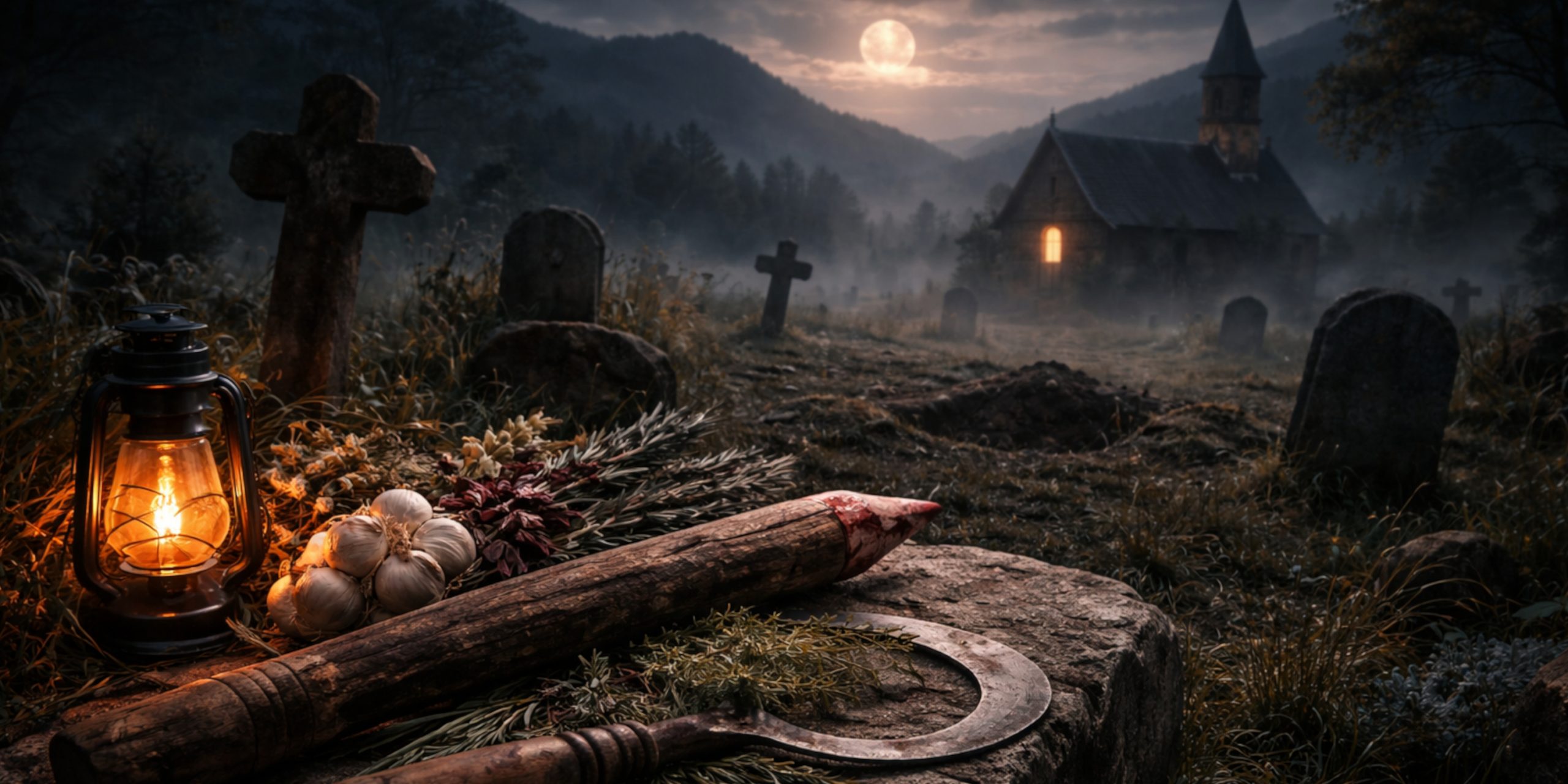
As a historian, I find these rituals revealing. They tell us less about monsters and more about fear, disease, grief and the need to impose order on death. Still, the details are vivid. Garlic hung in doorways. Bodies pinned to the earth. Graves reopened under a nervous moon.
Below is what we know about the most common historical protections against vampires.
The Stake Through the Heart
The image is familiar for a reason. In regions such as present-day Romania, Serbia and Bulgaria, staking was considered one of the most reliable ways to stop a suspected vampire.
The logic was straightforward. The heart was the seat of life. Drive a wooden stake through it and you pin the corpse to the grave, preventing it from rising. Oak, ash and hawthorn were common choices, each with local symbolic weight.
Archaeology supports the folklore. Excavations in Eastern Europe have uncovered skeletons with iron rods or wooden stakes driven through the chest. In some cases, stones were placed in the mouth. The intention was not theatrical. It was preventative.
What strikes me is the grim practicality. These were not grand rituals. They were community actions born of desperation, often after outbreaks of disease when bodies showed natural signs of decomposition that villagers misread as proof of undead activity.
Decapitation and Dismemberment
In parts of the Balkans and Greece, staking alone was not always deemed sufficient. Suspected vampires might be beheaded, with the head placed between the legs or removed entirely from the burial site.
This practice appears in records from Greece, where the vrykolakas was feared as a bloated, wandering corpse. Removing the head symbolically and physically disrupted its ability to act.
Other methods included cutting tendons, burning limbs or scattering body parts. These acts were harsh, yet in context they were framed as protective measures for the living.
From a modern standpoint, it is easy to recoil. Yet we must remember that communities confronting unexplained deaths or epidemics often turned to the body itself as the source of danger.
Fire and Cremation
Fire purifies. That idea runs deep in many cultures. When staking and decapitation failed, burning the corpse was considered final.
In Slavic regions, cremation was occasionally used to ensure total destruction of the suspected vampire. Ashes might be scattered in running water. Sometimes the heart alone was removed and burned, then mixed with water and consumed by afflicted individuals as a kind of folk remedy.
The symbolism is clear. Fire removes corruption. It reduces flesh to something harmless. In societies where burial was the norm, cremation carried weight precisely because it was exceptional.
Garlic, Herbs and Apotropaic Plants
Garlic is perhaps the most famous defence. In areas of Romania and Hungary, garlic cloves were hung in windows, rubbed on door frames or placed in coffins.
Its strong scent and medicinal associations made it a natural ward. In pre-modern medicine, garlic was believed to repel disease and evil influences alike.
Other plants included:
- Hawthorn
- Wild rose
- Juniper
- St John’s wort
These were placed in graves, worn as charms or burned in homes. The line between herbal medicine and spiritual protection was thin. A plant that healed could also guard.
As a historian, I find this particularly telling. When people lacked germ theory, they still observed that certain substances seemed to keep illness at bay. Over time, that practical knowledge blended with supernatural belief.
Holy Water, Crosses and Christian Ritual
With the spread of Christianity, vampire defences absorbed religious meaning. Holy water, crucifixes and consecrated ground became central to protection.
In Catholic and Orthodox regions, suspected vampires might be exhumed and subjected to prayers, blessings or reburial in sanctified soil. Churches were seen as safe spaces. Bells were rung to repel evil.
The cross, especially, gained prominence in later folklore. Its power derived from Christ’s victory over death, making it symbolically potent against the undead.
It is worth noting that earlier Slavic traditions did not always involve crosses. This detail reminds us that vampire belief evolved over centuries, shaped by shifting religious landscapes.
Counting Compulsions and Seeds
One of the more curious protections involved scattering seeds, grains or small objects around a grave or doorway. The belief held that a vampire, driven by obsessive tendencies, would stop to count each item, delaying it until sunrise.
This motif appears in parts of Eastern Europe and later in Western adaptations. Poppy seeds were a favourite. Millet and sand also appear in accounts.
To modern ears it sounds whimsical. Yet it reflects a consistent theme in folklore worldwide: binding a supernatural being through rules, patterns and compulsion.
Burial Practices Designed to Prevent Return
Sometimes prevention began at burial. Archaeological finds in places like Poland reveal graves where bodies were interred face down. The idea was simple. If the corpse attempted to rise, it would dig deeper instead of upward.
Other methods included:
- Placing sickles or iron blades across the throat
- Weighing down the body with heavy stones
- Binding limbs
Iron itself was widely believed to repel malevolent forces. A blade at the neck served both symbolic and physical restraint.
These practices often targeted individuals who were outsiders, suicides or those who died unexpectedly. In other words, those who unsettled social norms even in death.
Running Water and Thresholds
Folklore across Eastern Europe suggested that vampires could not cross running water. Rivers marked boundaries between safety and danger. Bridges were liminal spaces, uneasy places at night.
Thresholds mattered too. Many traditions insisted that a vampire could not enter a home without invitation. This detail, later popularised in literature, likely evolved from older ideas about household spirits and protective boundaries.
The home was sacred. Doorways were guarded with charms, herbs and religious symbols. Protection focused less on hunting the vampire and more on securing the living space.
From Folklore to Literature
By the time vampire lore reached Western European literature, many of these defences were already centuries old. Works like Dracula by Bram Stoker codified garlic, crucifixes and stakes for a global audience.
Stoker drew on travel accounts from the Balkans, particularly tales associated with Romania and figures such as Vlad III Dracula. Literature did not invent the defences, but it refined and popularised them.
Modern horror films have layered on additional rules. Sunlight, for instance, was not always fatal in early folklore. It became so in twentieth-century cinema.
This evolution fascinates me. It shows how belief transforms when it leaves the village and enters the printing press.
What These Defences Really Reveal
At their core, vampire protections are about control. Communities confronted decomposition, plague, tuberculosis and unexplained wasting diseases. When bodies appeared fresh or bloated after burial, fear filled the gaps in medical understanding.
Staking, burning and binding were attempts to restore order. Garlic and holy water offered daily reassurance. Counting seeds turned terror into something procedural.
As a historian, I see these rituals not as superstition alone but as coping mechanisms. They created a script for action when reality felt unstable. In that sense, the true power of these defences was psychological.
The vampire was a story told in the dark. The stake, the herb, the cross were answers crafted in the light of day.