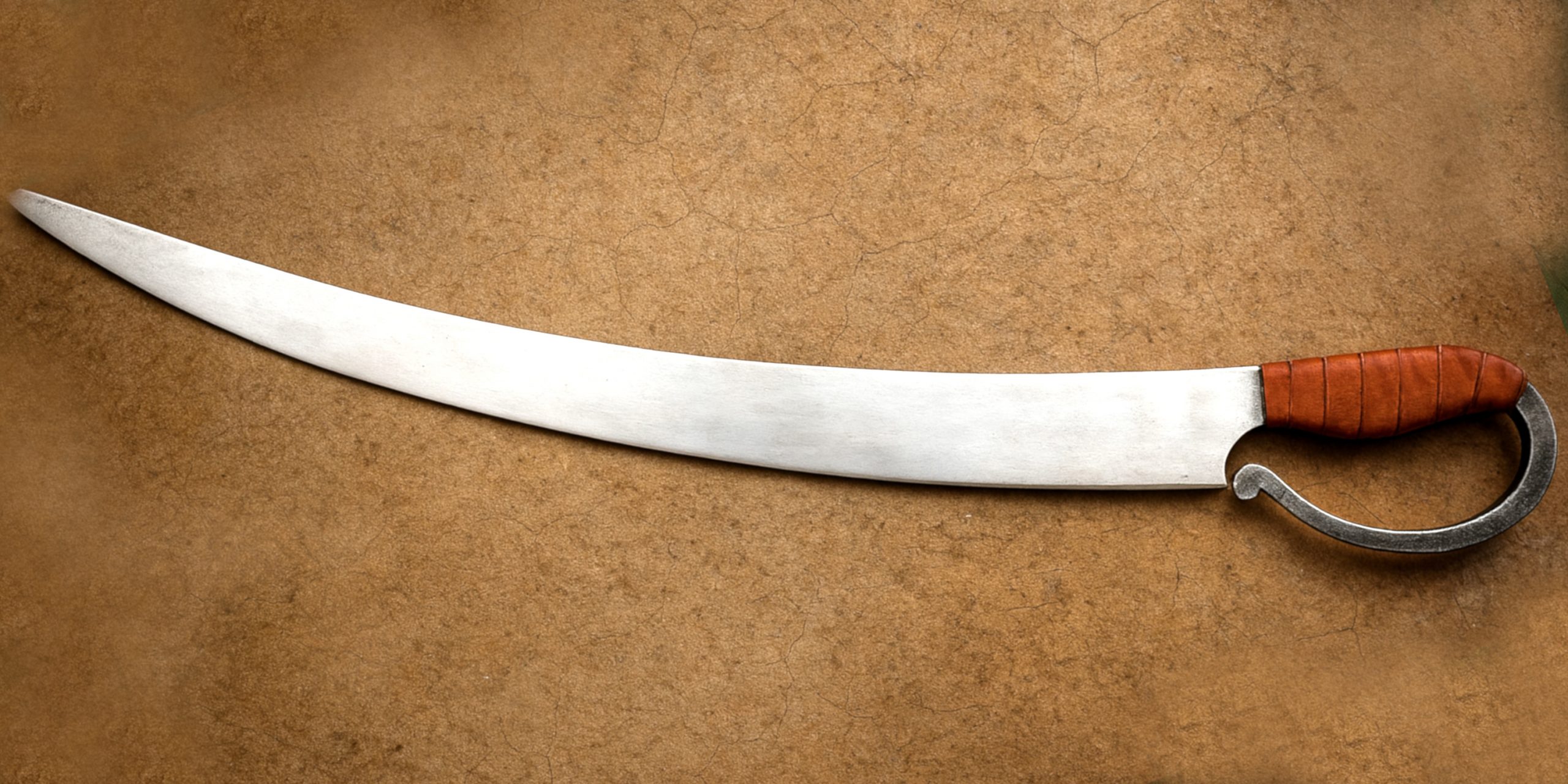
The Czech dussack sometimes called dusák in period sources sits in a fascinating space between weapon and training tool. It is iconic within Central European fencing traditions, yet still far less understood by the wider public than longswords or sabres. What makes it particularly interesting is the way it bridges rustic utility with refined martial culture. This guide unpacks every major part of its story
The dussack was a one handed cutting sword associated with the Czech lands and wider Central Europe from the late Middle Ages through the early modern period. It is closely linked to fencing guilds and burgher militias. While some examples were wooden or leather for training, others were fully serviceable steel weapons.
The design favours powerful forehand cuts, agile wrist movement and practical self defence in bustling towns. It became a symbol of local martial identity, recorded in fencing manuscripts and militia inventories.
Specification
Although surviving examples vary, the table below gives typical measurements for a steel Czech dussack.
| Feature | Typical Specification |
|---|---|
| Overall length | 70 to 90 cm |
| Blade length | 55 to 75 cm |
| Blade type | Single edged, slight curve or straight, wide at the chopping end |
| Weight | 0.8 to 1.2 kg |
| Grip | Simple straight grip, sometimes with thumb cut outs or small guards |
| Guard | Minimal crossguard, sometimes an enclosed knuckle bow on later forms |
| Intended use | Civilian defence, militia training, fencing guild practice |
Key features include a pronounced cutting edge, a forward weighted feel and a minimal guard that allows rapid transitions.
History and Evolution
The roots of the dussack stretch into medieval Central Europe. Its development reflects the needs of townsfolk who wanted a reliable personal defence weapon that did not demand knightly training.
• Medieval origins
Early proto dussack forms appear in the fifteenth century as simple single edged weapons used by burghers, hunters and travellers.
• Rise in fencing guilds
By the sixteenth century the Czech and German fencing guilds used the dussack extensively. Wooden versions became standard training tools for students learning cuts, parries and timing.
• Transition to steel fighting versions
While many associate the dussack with wood, steel dussacks continued to exist for militias and armed escorts. These often appear in museum inventories from Bohemia and Moravia.
• Decline and dispersal
By the seventeenth century the dussack was overshadowed by curved sabres and more sophisticated sidearms. Its fencing influence lived on in Central European sabre techniques.
Advantages and Disadvantages
Advantages
• Affordable to make, especially wooden or leather forms
• Excellent for teaching cutting mechanics and hand protection drills
• Quick to wield and well balanced for civilian defence
• Simple grip and guard encourage strong fundamentals rather than reliance on heavy hand protection
• Historically authentic for Central European martial reenactment and guild interpretation
Disadvantages
• Limited thrusting capability compared to double edged weapons
• Minimal guard exposes the hand in serious combat
• Shorter reach than many contemporary sidearms
• Wooden versions cannot replicate steel contact in advanced practice
• Less prestige than rapiers or sabres in early modern urban culture
Comparison with Similar Weapons
| Weapon | Similarities | Differences |
|---|---|---|
| German dusack | Near identical in purpose and appearance | German examples often emphasise guild training over combat use |
| Falchion | Single edged cutting weapon | Falchion is heavier, more blade centric and knightly in origin |
| Messers | Civilian oriented and popular in Germanic regions | Messer has a full hilt with nagel guard and more refined construction |
| Sabre | Strong cutting profile and Central European identity | Sabre has pronounced curvature, more hand protection and cavalry roots |
| Short arming sword | Common for town defence | Arming sword offers thrusting versatility but lacks the dussack’s raw chopping power |
The dussack sits somewhere between a training implement and a practical defensive blade, making it unique in the European sword family.
Legacy
The Czech dussack left a long imprint on martial culture in Central Europe. Its techniques influenced later sabre fencing traditions and preserved a distinctly regional approach to personal combat. Modern HEMA groups studying Central European sources often begin students on wooden dussacks for fundamentals. Museums and collectors value the weapon for its ties to guild identity and commoner self defence.
Although not as glamorous as rapiers or longswords, the dussack represents the lived martial world of townsmen rather than noble elites.
Where to See Czech Dussacks Today
You can find surviving dussacks in several museums across Central Europe.
• National Museum, Prague. Collections include civilian sidearms and wooden training dussacks.
• Moravian Museum, Brno. Holds militia weapons and regional fencing artefacts.
• Vienna Museum of Military History. Includes single edged sidearms from the Czech and German speaking lands.
• Regional museums in Plzeň and Olomouc often display wooden practice dussacks used by guild members.
Check exhibition rotations since many pieces appear in temporary displays.
Collectors Guide
Dussacks appeal to collectors who enjoy regional weapons or HEMA history. The market splits into two categories: steel combat dussacks and wooden or leather training versions.
What Collectors Look For
• Provenance within the Czech lands
• Clear guild markings or maker stamps
• Intact grips and guards
• Minimal wood warping for training versions
• Blade geometry that aligns with sixteenth century examples
• Documentation from museums or old private collections
Typical Auction Prices
| Type | Condition | Price Range |
|---|---|---|
| Steel Czech dussack | Good museum level provenance | 2,000 to 4,000 GBP |
| Steel Czech dussack | Average private collection | 1,200 to 2,000 GBP |
| Wooden training dussack | Excellent condition | 400 to 800 GBP |
| Wooden training dussack | Worn or partial | 150 to 300 GBP |
| Leather training dussack | Rare and well preserved | 600 to 1,200 GBP |
Prices fluctuate depending on rarity, historical documentation and auction house reputation. Items linked to fencing guilds often sell at a premium since they offer cultural as well as martial significance.