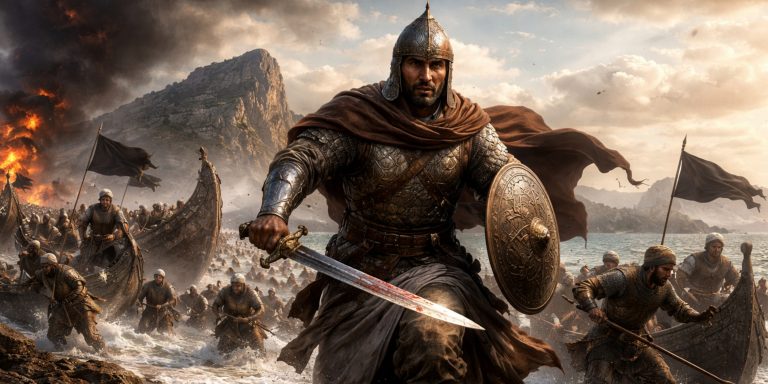
Constantine II, King of Alba, ruled for an extraordinary forty-three years between 900 and 943. In a period when kings rarely enjoyed the luxury of dying in their own bed, Constantine somehow survived Viking invasions, bitter warfare with the kings of Northumbria, shifting alliances, internal rivals and the constant possibility of assassination by somebody with a grudge and a spear.
He was not a king of easy victories. In truth, Constantine lost some notable battles and made more than one political miscalculation. Yet by the end of his reign the kingdom of Alba was stronger, more recognisable and rather closer to what would eventually become medieval Scotland. If Kenneth MacAlpin laid the foundations, Constantine was one of the men who kept the walls standing when everyone else was trying to pull them down.
Who Was Constantine II?
Constantine mac Áeda, better known as Constantine II, was born into the royal house of Alpín. He was the son of Áed, King of the Picts, and became king of Alba in 900 after the death of his cousin Donald II.
At the time, Alba was still a fragile kingdom. It was less a united Scotland than an uneasy collection of Pictish lands, Gaelic elites, old loyalties and stubborn local rulers who probably preferred being left alone. Constantine inherited a realm under pressure from every direction:
- Viking armies were active across northern Britain
- Northumbria remained aggressive and ambitious
- Rival kings in Strathclyde and Ireland watched closely
- Internal succession disputes never entirely disappeared
Despite this, Constantine endured. Medieval chroniclers remembered him as a deeply significant ruler. Later tradition even claimed that he retired as king and became a monk at St Andrews. Given the chaos of his reign, one suspects the monastery may have seemed wonderfully peaceful.
The Kingdom of Alba Under Constantine
By Constantine’s reign, the old Pictish kingdom had largely merged with the Gaelic-speaking kingdom of Dál Riata. The resulting kingdom, Alba, stretched across much of eastern and central Scotland.
Constantine’s rule appears to have strengthened royal authority and encouraged a more unified identity. One of the most important moments came in around 906, when Constantine and Bishop Cellach met at the Hill of Belief near Scone and agreed to govern according to “the laws and disciplines of the faith”.
Historians still debate exactly what this meant. It may have represented an attempt to unite church and crown under a more distinctly Gaelic and Christian kingship. It was also an early sign that Alba was becoming something more organised than a collection of warlords sharing a family tree.
Early Reign and Viking Pressure
The greatest immediate threat to Constantine came from the Vikings. Scandinavian settlers and warlords had established themselves across northern England, the Isles, Dublin and the western seaboard. They were not one united force, which was both helpful and unhelpful. If there had been a single Viking king to negotiate with, Constantine might have had a clearer target. Instead there were many ambitious men with ships and very poor manners.
In 904 Constantine won an early success against the Norse at the Battle of Strathearn. The battle is poorly recorded, but later accounts suggest he defeated a Viking force and killed their leader, perhaps the Norse ruler Ímar grandson of Ímar.
This victory gave Constantine breathing space and helped establish his authority.
Battles and Military Acumen
Constantine as a Military Leader
Constantine was not a brilliant battlefield commander in the mould of later figures such as Robert the Bruce. He was something rather more useful for his own age: resilient, adaptable and difficult to remove.
He fought throughout his reign and repeatedly rebuilt his position after setbacks. That ability mattered in a tenth-century king. A ruler who lost one battle might lose his throne. Constantine lost several and still managed to reign for decades.
His strengths appear to have been:
- Maintaining alliances with neighbouring rulers
- Recovering after defeats
- Preserving the kingdom during long periods of pressure
- Using diplomacy when battle offered little chance of success
His weaknesses were equally clear:
- He sometimes struggled against larger Viking armies
- He could be outmanoeuvred by the kings of Wessex and Northumbria
- Several of his campaigns ended in retreat or compromise
Still, survival is itself a kind of victory. Medieval kingship was less about winning every battle than about remaining alive, relevant and sufficiently intimidating that nobody fancied replacing you.
The Battle of Corbridge, 918
One of Constantine’s most important military moments came at the Battle of Corbridge in 918.
Constantine joined forces with:
- Ragnall ua Ímair, Norse ruler of York
- Owen I of Strathclyde
Together they fought against the Anglo-Saxon forces of the Northumbrians and their allies.
The battle itself appears to have been chaotic and indecisive. Contemporary sources disagree about who won. Ragnall eventually secured York, suggesting the alliance achieved at least part of its objective.
For Constantine, Corbridge showed a recurring pattern in his reign. He was willing to work with former enemies if it helped protect Alba. There was little room for sentiment in tenth-century politics. Yesterday’s raider could become today’s ally, and tomorrow’s corpse.
Submission to Athelstan and the Battle of Brunanburh
In 927 Constantine faced the growing power of Athelstan (Æthelstan), king of the English. Æthelstan forced Constantine and other northern rulers to submit at Eamont.
This submission did not last.
By 937 Constantine had joined a grand alliance against Æthelstan. His coalition included:
- Olaf Guthfrithson of Dublin
- Owen of Strathclyde
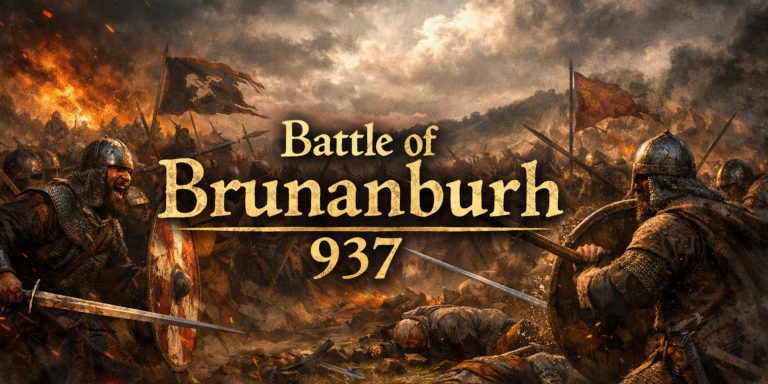
Together they fought the English king at the Battle of Brunanburh, one of the most famous battles in early British history.
The battle ended in disaster for Constantine’s side. Æthelstan won a crushing victory. Constantine’s son, Cellach, was killed during the fighting.
The defeat at Brunanburh was severe, but Constantine himself survived and remained king. That fact alone says much about his resilience. Lesser rulers vanished after defeats of this scale. Constantine endured, retired only a few years later, and left the throne to Malcolm I.
Arms and Armour
What Constantine and His Warriors Wore
No contemporary portrait of Constantine survives, but archaeology and contemporary descriptions allow a reasonably clear reconstruction.
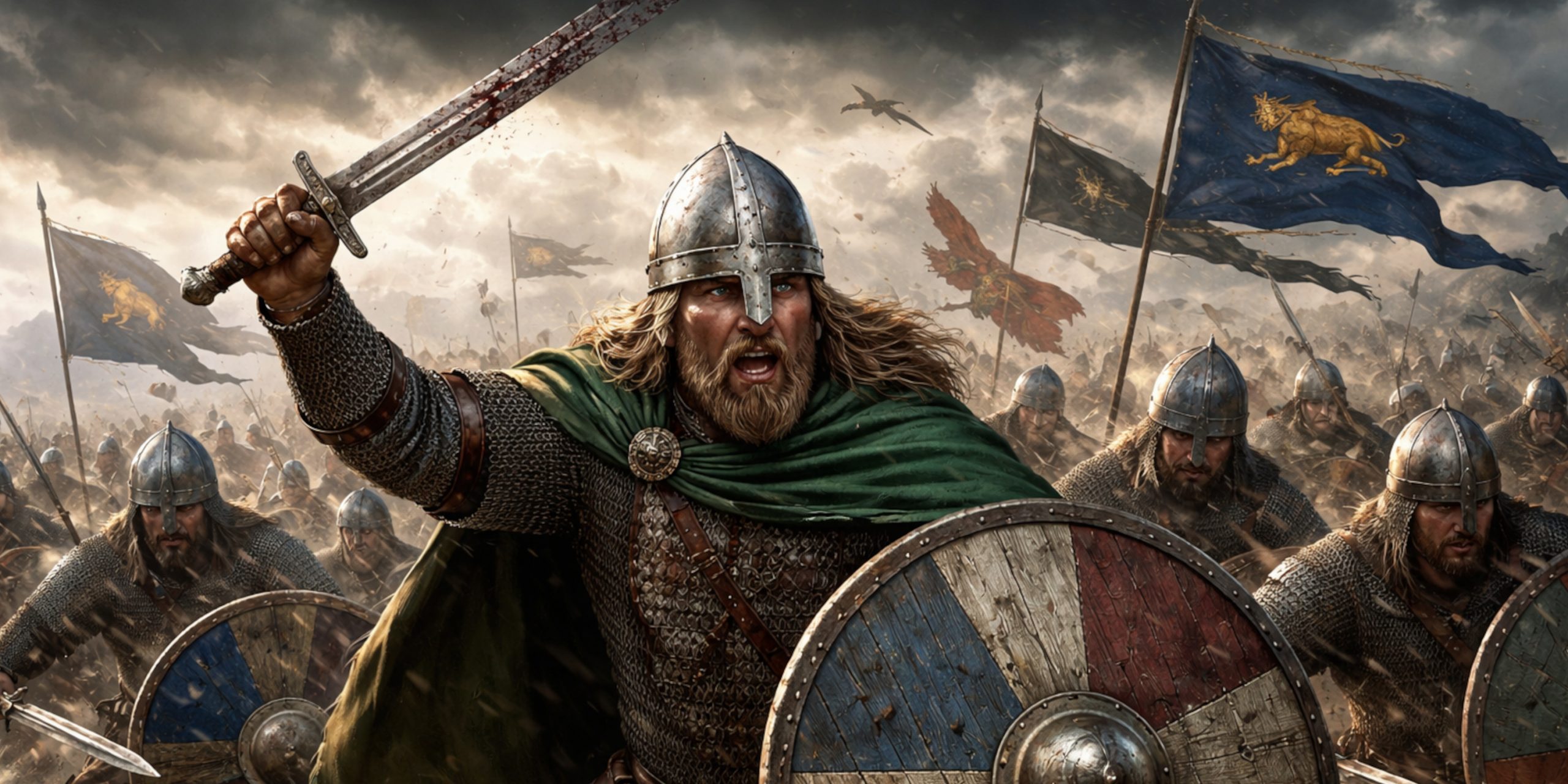
A king of Alba in the early tenth century would probably have worn:
- A knee-length wool or linen tunic
- A heavy cloak fastened with a decorated brooch
- Leather boots or simple shoes
- A conical iron helmet, perhaps with a nasal guard
- A mail shirt for battle, if wealthy enough
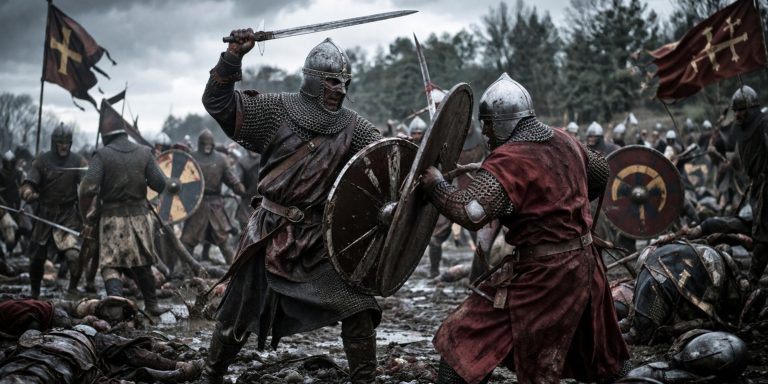
Mail remained expensive and rare. Most ordinary warriors fought with little armour beyond a shield and thick clothing. Elite retainers and nobles would have been better equipped.
The overall appearance of Constantine’s warband probably mixed Pictish, Gaelic and Norse influences. This was a frontier world where styles and equipment travelled surprisingly quickly.
Swords and Weapons of Constantine’s Reign
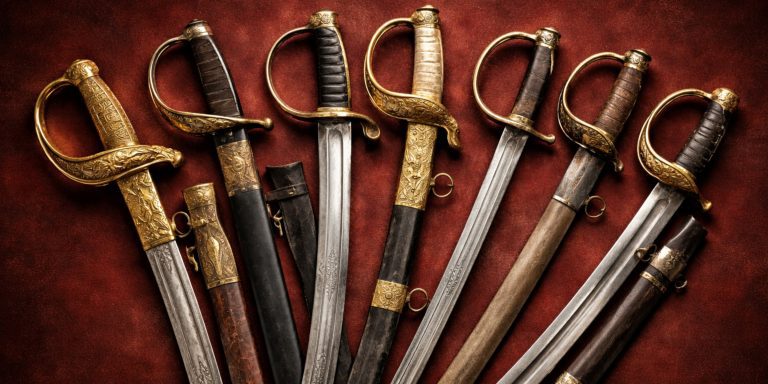
The sword most associated with Constantine’s era would have been a broad, double-edged blade of the Petersen Type, imported or influenced by Viking styles.
Likely sword types included:
| Weapon | Description |
|---|---|
| Petersen Type H Sword | A common Viking-age sword with a broad blade and distinctive hilt, widely used across Britain and Scandinavia |
| Petersen Type K Sword | More elaborate, often richly decorated, perhaps suitable for a king or noble |
| Early Gaelic Ring-Hilt Sword | A weapon with roots in earlier Irish and Scottish traditions |
| Seax | A long knife or short sword, useful in close combat |
| Spear | The most common battlefield weapon, cheap and effective |
| Dane Axe | Increasingly common in areas affected by Norse warfare |
The spear was probably the most important weapon in Constantine’s armies. Swords were valuable status symbols. A king might carry one into battle, but most of his men would have preferred a spear and shield, partly because they were practical and partly because losing a sword was a remarkably expensive way to have a bad day.
Shields and Defensive Equipment
Most warriors used round wooden shields reinforced with an iron boss. These were usually between 70 and 90 centimetres across.
Some shields may have been painted in bright colours or marked with simple symbols. A king’s personal guard likely carried better-made equipment and perhaps matching arms.
Excavated examples from Scotland and northern England suggest that warriors of Constantine’s age favoured:
- Round shields
- Iron spearheads
- Pattern-welded sword blades
- Mail fragments
- Decorated belt fittings and brooches
Political Legacy
The King Who Helped Create Scotland
Constantine’s greatest achievement was not a battlefield victory. It was that Alba survived at all.
During his reign the kingdom became:
- More politically unified
- More closely tied to the church
- More distinctly Gaelic in identity
- Better established as a separate northern kingdom
By the time Constantine left the throne in 943, Alba looked much more like the medieval Scottish kingdom that later generations would recognise.
Some historians have even called him the first truly Scottish king. That may go too far, but there is no doubt that he was one of the most important rulers in the formation of Scotland.
Retirement and Death
Constantine abdicated in 943 and entered the monastery at St Andrews. This was unusual but not entirely unheard of.
He died in 952.
There is something rather fitting about Constantine ending his days in a monastery after decades of warfare. One imagines he spent his final years grateful that nobody was trying to invade Fife for at least five minutes.
Artefacts and Where to See Them
Very few objects can be directly linked to Constantine himself, but several important artefacts from his reign and world survive.
St Andrews Sarcophagus
An elaborate carved monument associated with the early kings of the Picts and Alba. Though older than Constantine, it helps illustrate the royal culture he inherited.
Can be seen at St Andrews Cathedral Museum.
The Dupplin Cross
An important Pictish cross from around the ninth century, standing close to the world Constantine knew. It provides evidence of royal and religious symbolism in early Alba.
Can be seen at St Serf’s Church.
The Forteviot Arch
Fragments from the royal centre at Forteviot, one of the likely residences of the kings of Alba.
Can be seen at National Museum of Scotland.
Viking-Age Swords and Armour
Several swords, spearheads and mail fragments from tenth-century Scotland survive and help reconstruct the equipment of Constantine’s warriors.
These can be seen at National Museum of Scotland and Perth Museum.
Latest Archaeology and Historical Discoveries
Recent archaeological work has transformed our understanding of Constantine’s world.
At Forteviot, excavations have uncovered evidence for an elite royal centre dating to the ninth and tenth centuries. Archaeologists found traces of high-status buildings, imported goods and ceremonial spaces, suggesting that the kings of Alba ruled from far more sophisticated centres than once believed.
Further work at Scone and around Perth has revealed early medieval royal landscapes connected with Constantine’s dynasty. These discoveries support the idea that Alba already had important centres of kingship and administration during his reign.
Excavations at Burghead and other northern sites have also shed new light on the relationship between Picts, Gaels and Vikings. Rather than replacing one another, these groups often mixed, traded and fought in complicated ways. Medieval Scotland was not neatly divided into tribes and kingdoms. It was a political patchwork stitched together with alliances, marriages and the occasional spear.
Recent studies of Viking-age weapon burials in Scotland have also shown that imported Scandinavian swords were more common than once believed, particularly among the elite. This fits well with the world Constantine inhabited, where Norse influence could be found not only on the battlefield but in dress, weapons and royal politics.
Contemporary and Near-Contemporary Quotes
“Constantine son of Áed held the kingship for a long time.”
From the Chronicle of the Kings of Alba.
“A meeting was held by Constantine the king and Cellach the bishop upon the Hill of Belief.”
From the Chronicle of the Kings of Alba, describing the agreement of 906.
“Five young kings lay on the battlefield, and seven of Anlaf’s earls.”
From the Anglo-Saxon Chronicle’s account of Brunanburh. The chronicler did not mention Constantine by name in this line, but his coalition had suffered terribly.
Takeaway
Constantine II was not a conqueror in the grand heroic mould. He did not sweep all before him or leave behind a trail of effortless victories. What he did leave was something more durable.
He preserved Alba through one of the most dangerous periods in its history. He fought Vikings, bargained with rivals, lost battles, survived humiliation and somehow emerged as one of the architects of medieval Scotland.
That, frankly, is impressive enough.