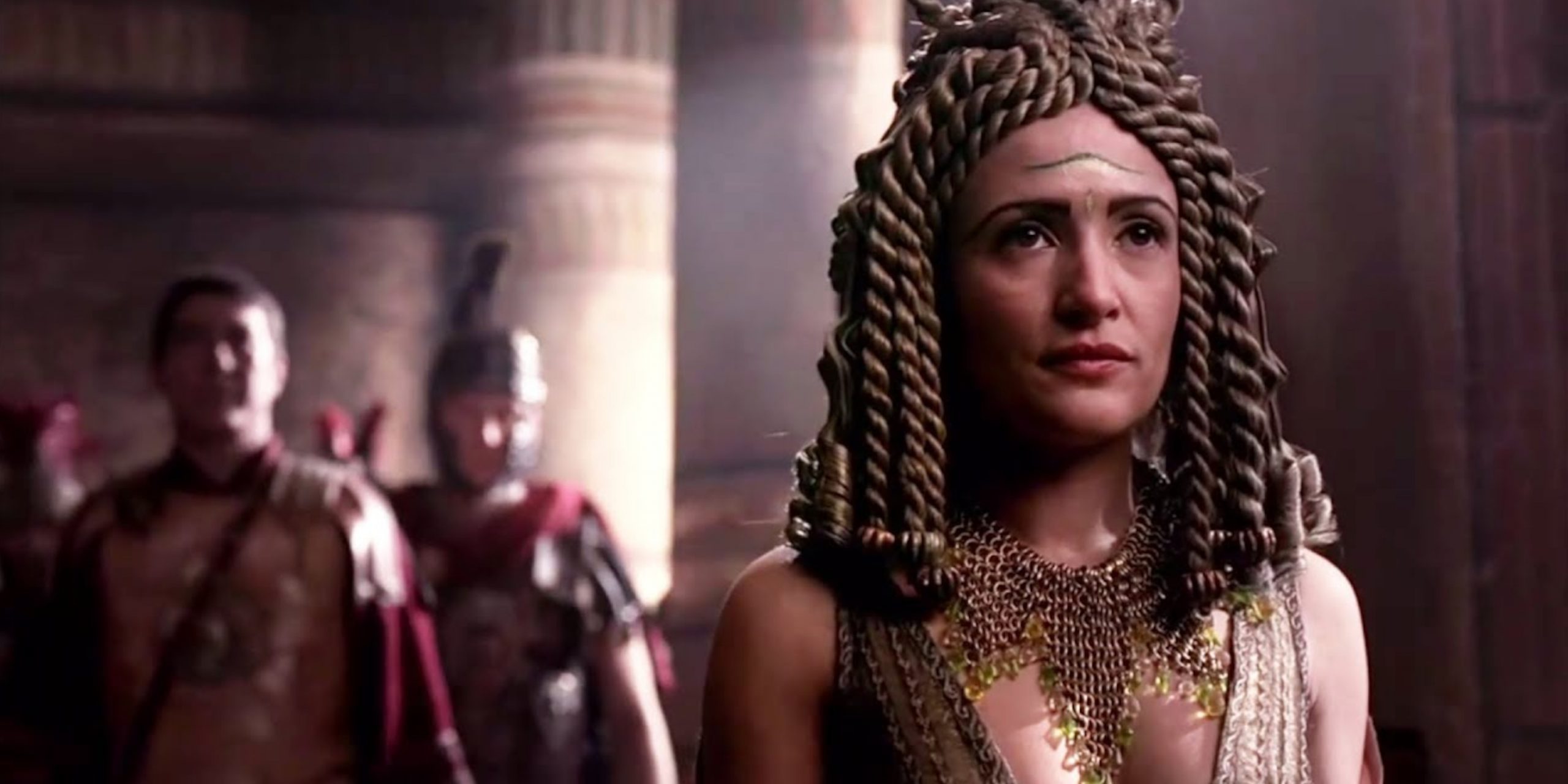
Cleopatra’s arrival in Rome feels deliberately unsettling. She is not introduced as a romantic ideal or a tragic icon but as a political force who understands people faster than they understand her. Watching her scenes, you sense that every glance, pause, and word choice is calculated. This Cleopatra is not here to be liked. She is here to win.
The show resists the urge to make her immediately sympathetic, and that choice pays off. She feels dangerous because she is intelligent, isolated, and acutely aware that Egypt’s survival depends on her ability to outplay Rome at its own game.
Power First, Always
Cleopatra’s power in Rome is not built on armies or speeches. It is built on leverage. She reads Julius Caesar with unnerving accuracy, recognising both his ambition and his vanity, and she positions herself accordingly. Egypt becomes indispensable, and she becomes the human face of that necessity.
What stands out is how openly the series treats power as transactional. Cleopatra never pretends otherwise. Alliances are tools, intimacy is currency, and loyalty lasts only as long as it remains useful. It feels brutally honest, and oddly refreshing, compared to softer screen versions that blur political survival with romance.
Beauty as Strategy
This Cleopatra is not framed as conventionally glamorous in the Hollywood sense, and that feels intentional. Her beauty works because it disarms expectations. She appears slight, even fragile, yet the confidence behind her posture makes people lean in.
The series suggests that attraction is less about appearance and more about control of space and attention. Cleopatra understands how to be underestimated and uses that gap ruthlessly. When she chooses to perform softness, it is exactly that, a performance.
Manipulation Without Apology
Manipulation in Rome is not a moral flaw unique to Cleopatra. It is the political language everyone speaks. The difference is that she is better at it than most. She adapts constantly, shifting tone depending on whether she is facing Caesar, Antony, or her own court.
There is something almost modern about her approach. She treats power like a system that can be learned, exploited, and redesigned. If that makes her unsettling, it also makes her believable. Ancient politics rarely rewarded sincerity.
A Performance That Refuses Comfort
Lyndsey Marshal plays Cleopatra with a sharp restraint that refuses easy admiration. She is cold when needed, theatrical when it serves her, and quietly exhausted beneath it all. The performance never begs for sympathy, which makes the character far more interesting.
This Cleopatra feels young, pressured, and constantly watched. Her mistakes land harder because they come from miscalculation rather than innocence. You get the sense she is learning in real time, and the cost of those lessons is always high.
Why This Cleopatra Works
What makes Rome’s Cleopatra endure is that she feels politically literate. She understands empire, image, and survival in a way that feels timeless. Strip away the linen dresses and incense, and she would not look out of place in modern power circles.
She is not softened for comfort or inflated into myth. She is sharp, compromised, and relentlessly human. That may not be the most romantic Cleopatra ever put on screen, but it might be the most honest.