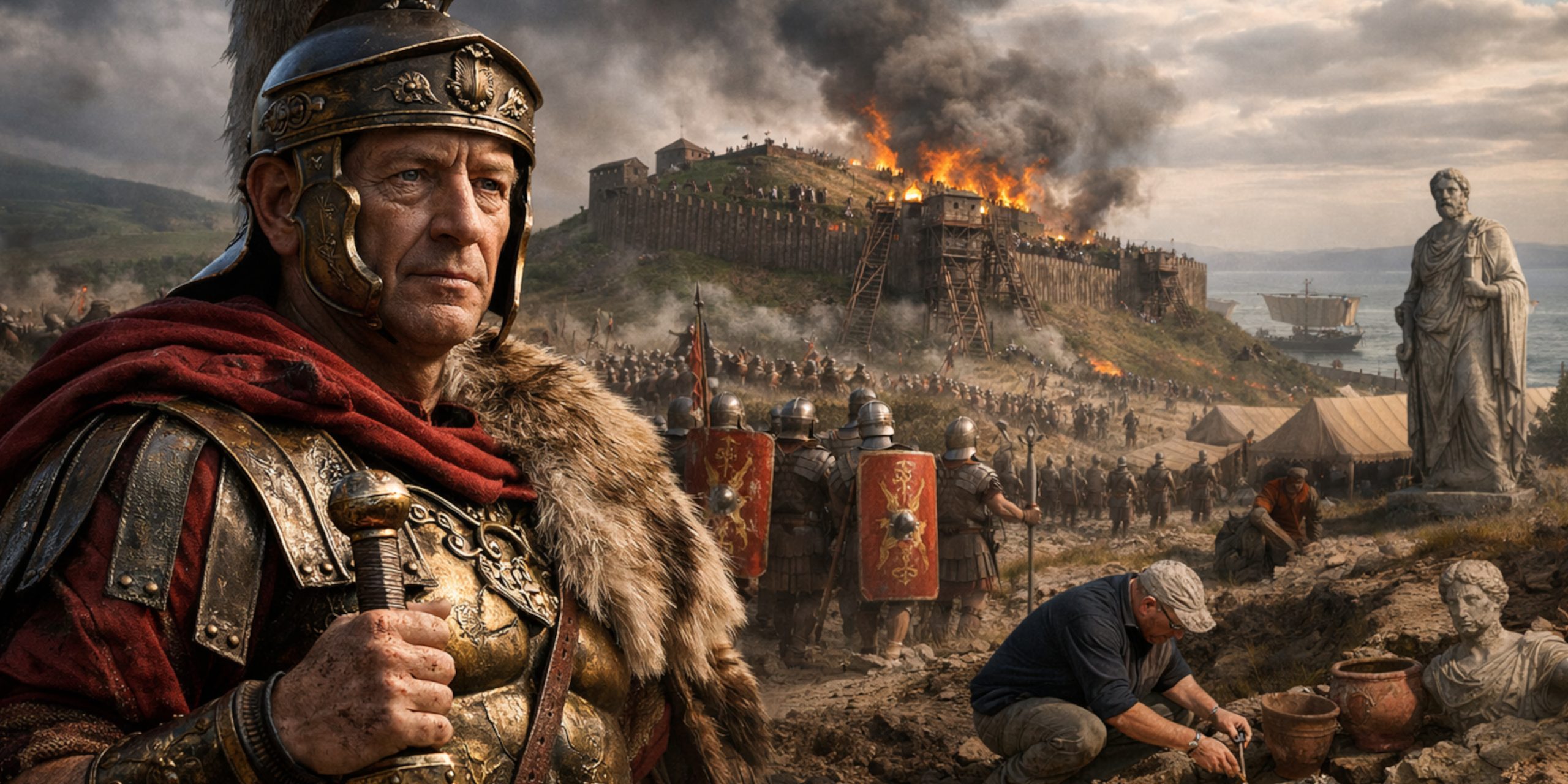
Claudius at a Glance
Tiberius Claudius Caesar Augustus Germanicus ruled the Roman Empire from AD 41 to 54. He is often remembered as the awkward emperor, the scholarly one who limped, stammered and spent most of his early life being quietly ignored by his own family. Roman historians, who loved a glamorous tyrant and had very little patience for a bookish administrator, made him sound like a nervous uncle who accidentally wandered onto the throne.
That judgement has never sat quite right with me.
Claudius inherited an empire shaken by the murder of Caligula. He left behind a larger, richer and better organised Roman state. He expanded imperial government, conquered Britain, improved justice, built roads, harbours and aqueducts, and managed to survive the sort of family life that would make a modern therapist sit down very quickly.
He was not a great conqueror in the style of Julius Caesar, nor a brilliant military showman like Augustus. Yet he was far more capable than the ancient gossip suggests. Claudius was clever, stubborn, surprisingly practical and, when necessary, quite ruthless.
Early Life and Family
Claudius was born on 1 August 10 BC at Lugdunum, modern Lyon. He was the son of Drusus, one of Rome’s finest generals, and Antonia Minor, niece of Augustus.
By birth, Claudius stood near the centre of the Julio-Claudian dynasty. In practice, however, he spent much of his early life pushed to the margins.
Ancient writers describe him as having a limp, weak knees, involuntary movements and a stammer. Modern historians have suggested cerebral palsy, Tourette syndrome or another neurological condition, though certainty is impossible.
His own family often treated him as an embarrassment. His mother allegedly called him “a monster of a man, not finished but merely begun by nature.” Families in Roman history could be extraordinarily cruel. One suspects Christmas dinner at the Julio-Claudians’ house was not a relaxed affair.
Yet Claudius had one great advantage. Because nobody expected him to rule, nobody saw him as a threat.
While his relatives schemed, murdered and adopted one another at a pace that makes a modern corporate merger look calm, Claudius studied history, law, language and administration. He wrote books on the Etruscans, Carthaginians and Roman history. Most are now lost.
How Claudius Became Emperor
In AD 41, Caligula was assassinated by members of the Praetorian Guard.
Rome briefly collapsed into confusion. Some senators hoped to restore the Republic. Others simply tried to work out who was still alive.
According to tradition, Claudius was discovered hiding behind a curtain in the imperial palace. A soldier recognised him and hailed him emperor.
The story is probably exaggerated, though it is too good for ancient historians to resist. The more important point is that the Praetorian Guard backed Claudius immediately.
Without military support, he would never have ruled.
The Senate reluctantly accepted him. Claudius was fifty years old when he became emperor, far older than most previous rulers, and he arrived with little political experience. Many aristocrats assumed he would be weak and easy to control.
They were wrong.
Claudius and the Roman Empire
Claudius ruled an empire stretching from Spain to Syria and from the Rhine to North Africa.
He strengthened the central government by relying more heavily on imperial officials and freedmen. Men such as Narcissus, Pallas and Callistus became powerful administrators.
Roman senators hated this. They considered it disgraceful that former slaves wielded influence. Claudius, however, cared more about competence than aristocratic pride.
His government:
- Expanded the imperial bureaucracy
- Reformed the legal system
- Improved grain supply to Rome
- Built new roads, canals and aqueducts
- Increased the role of provincial elites in government
- Extended Roman citizenship to more communities
One of his most important speeches, preserved on the Lyon Tablet, argued that provincial nobles from Gaul should be allowed to join the Roman Senate. Claudius understood something many Roman aristocrats did not. The empire could not survive if Rome remained a private club for a few old families.
Battles and Military Acumen
Claudius never developed the reputation of a warrior emperor. He spent little of his youth in military command and rarely led armies in person.
Even so, he showed sound military judgement.
He understood logistics, chose capable generals and supported expansion where it strengthened Rome’s position. Unlike Caligula, who once allegedly declared war on the sea and ordered his soldiers to collect shells, Claudius generally knew what he was doing.
The Conquest of Britain
Claudius’ greatest military achievement was the invasion of Britain in AD 43.
Roman armies under Aulus Plautius crossed the Channel and fought several battles against British tribes led by Caratacus and Togodumnus.
Claudius himself arrived later with reinforcements, including war elephants. He took part in the final advance on Camulodunum, modern Colchester.
The campaign was carefully calculated.
Britain offered:
- Prestige for the new emperor
- Access to metals and trade
- A chance to prove his legitimacy
- A major victory without risking the empire’s core frontiers
Claudius remained in Britain for only a short time, probably sixteen days, but that was enough. He returned to Rome in triumph.
The Senate awarded him the title Britannicus.
Other Military Campaigns
Claudius also oversaw:
- The annexation of Mauretania in North Africa
- The incorporation of Thrace into the empire
- Stronger frontier defences along the Rhine and Danube
- Continued Roman operations in Judea and the East
Although he depended heavily on generals, Claudius usually chose well.
Important commanders under his reign included:
- Aulus Plautius
- Ostorius Scapula
- Corbulo
- Suetonius Paulinus, later famous in Britain
Claudius had a careful, administrative style of warfare. He preferred preparation, engineering and overwhelming force rather than reckless heroics.
Frankly, that is often how successful Roman warfare worked, despite what films would have us believe.
Arms and Armour in the Reign of Claudius
Claudius rarely appears in armour in surviving literature, but Roman sculpture and coinage show him in the traditional military style of an emperor.
He is usually depicted wearing a richly decorated cuirass with scenes of victory, gods and conquered peoples.
Claudius’ Personal Armour
An emperor’s ceremonial armour during this period often included:
- A muscled bronze cuirass or decorated breastplate
- A red military cloak, the paludamentum
- A laurel wreath or military crown
- A sword, usually a gladius
- High military boots, known as caligae
Ceremonial armour was designed as political theatre. It projected strength and authority even if the emperor was not standing in the front rank with a spear.
Roman Arms Under Claudius
The Roman army of Claudius’ reign used equipment typical of the early imperial period.
| Weapon or Armour | Description |
|---|---|
| Gladius | Short stabbing sword carried by legionaries |
| Pugio | Small dagger worn at the belt |
| Pilum | Heavy javelin designed to bend on impact |
| Scutum | Large curved rectangular shield |
| Lorica Segmentata | Articulated iron armour increasingly used by legionaries |
| Mail Armour | Chain mail worn by auxiliaries and officers |
| Cavalry Spatha | Longer sword used by mounted troops |
| Helmet | Iron or bronze helmet with cheek guards |
The conquest of Britain also exposed Roman troops to British weapons such as long slashing swords, spears and chariots. Roman discipline usually proved more effective, though there must have been moments when a legionary facing a painted Briton in a charging chariot briefly wondered whether he had chosen the right career.
Claudius and Britain
Britain remained Claudius’ proudest achievement.
Coins, triumphal arches and inscriptions constantly referred to the conquest. The emperor wanted everyone in the empire to know that he had succeeded where Julius Caesar had only made a beginning.
Roman rule in Britain expanded quickly after AD 43. New roads, forts and towns appeared across southern Britain.
Important foundations from Claudius’ reign included:
- Camulodunum
- Londinium
- Verulamium
Roman Britain would outlast Claudius by centuries.
Claudius’ Marriages and Family
Claudius’ private life was considerably less successful than his public career.
He married four times.
His most infamous wife was Messalina, who became notorious in Roman sources for alleged affairs and political intrigues. Ancient writers painted her as spectacularly immoral, though they were not always reliable and clearly enjoyed a scandal.
Messalina was eventually executed after a conspiracy.
Claudius then married Agrippina the Younger, his niece. This was awkward even by Roman standards and required a change in the law.
Agrippina persuaded Claudius to adopt her son Nero.
That decision proved disastrous.
Death and the Question of Poison
Claudius died on 13 October AD 54.
Ancient sources claim he was poisoned, probably by Agrippina, who wanted Nero to succeed him before Claudius could favour his own son Britannicus.
The exact method varies depending on the source. Some mention poisoned mushrooms. Others suggest poison hidden in a feather used to make him vomit.
Roman historians were never people to let a good story remain merely plausible.
Modern historians remain uncertain. Claudius was sixty-three and in poor health. Natural causes are entirely possible.
Still, given the history of the Julio-Claudians, poisoning can hardly be dismissed.
Artefacts From the Reign of Claudius
Several important artefacts survive from Claudius’ reign.
The Lyon Tablet
The Lyon Tablet preserves part of Claudius’ speech to the Senate supporting the admission of Gallic nobles.
It is one of the most remarkable surviving texts from any Roman emperor because it allows us to hear Claudius’ own words.
Today it can be seen in Lyon.
The Claudius Arch Inscriptions
Fragments from Claudius’ triumphal arch celebrating the conquest of Britain survive in Rome.
These inscriptions praise the emperor’s victory and confirm the importance he attached to Britain.
Coins of Claudius
Coins from his reign survive in large numbers and often show:
- Claudius in military dress
- References to Britain
- Images of Pax, Liberty and Victory
- His wife Agrippina and son Britannicus
Coins are often the most honest propaganda in Roman history. They tell us exactly what an emperor wanted people to believe.
The Bronze Head of Claudius
A bronze head of Claudius discovered at the River Alde in Suffolk is one of the most famous Roman finds from Britain.
It probably came from a statue erected after the conquest.
Where to See Artefacts From Claudius’ Reign
| Museum or Site | Important Artefacts |
| Capitoline Museums, Rome | Busts and statues of Claudius |
| Vatican Museums, Vatican City | Portraits and imperial sculpture |
| British Museum, London | Coins, inscriptions and British conquest material |
| Museum of London | Finds from early Roman Londinium |
| Colchester Castle Museum | Artefacts linked to the conquest of Britain |
| Musée Gallo-Romain, Lyon | The Lyon Tablet |
| Ashmolean Museum, Oxford | Roman coins and imperial portraits |
| Suffolk Museum collections | Bronze head of Claudius |
For anyone interested in Claudius, Colchester is especially worth visiting. Camulodunum was effectively his British showpiece. You can still sense the first confident footprint of Roman rule there.
Latest Archaeology Findings
Archaeology continues to reshape our understanding of Claudius and his reign.
New Discoveries in Roman Britain
Excavations at Colchester, London and along Roman roads have uncovered more evidence of the Claudian invasion period.
Recent finds include:
- Early military camps dating to AD 43
- Roman weaponry and cavalry equipment
- Burn layers showing conflict during the conquest
- Imported Roman goods appearing in Britain earlier than once believed
These discoveries suggest the Roman invasion was larger, faster and more organised than older historians thought.
The Fishbourne Palace Debate
Archaeologists continue to debate whether the earliest phase of Fishbourne Roman Palace in Sussex was connected to Claudius’ conquest and perhaps to the pro-Roman king Tiberius Claudius Cogidubnus.
If true, it would show how quickly Rome rewarded loyal local rulers.
Reassessment of Claudius’ Image
Recent scholarship has also challenged the ancient image of Claudius as weak or foolish.
Historians increasingly see him as:
- An effective administrator
- A capable judge of people
- A ruler who strengthened the empire
- A far more successful emperor than Caligula or Nero
Ancient authors such as Tacitus and Suetonius were aristocrats with very clear prejudices. Claudius’ use of freedmen and provincial elites offended them deeply.
Their judgement tells us as much about Roman snobbery as it does about Claudius himself.
Legacy
Claudius ruled for thirteen years and left the empire stronger than he found it.
His greatest achievements included:
- The conquest of Britain
- Expansion of Roman citizenship
- Stronger government administration
- Major public building works
- Greater integration of the provinces into Roman life
He was not glamorous. He did not cultivate the image of a heroic conqueror. He looked awkward, sounded awkward and often appeared underestimated.
That may be precisely why he succeeded.
As a historian, I find Claudius one of the most fascinating Roman emperors because he reminds us how misleading first impressions can be. Ancient writers laughed at him. Senators dismissed him. His family ignored him.
Then he ruled Rome for over a decade and quietly changed the empire.
That is rather satisfying.