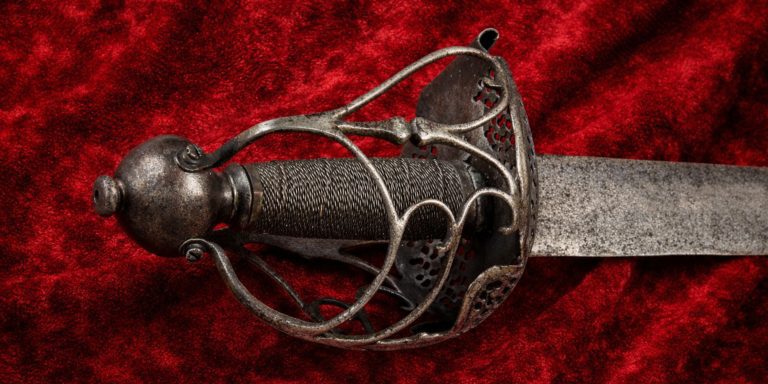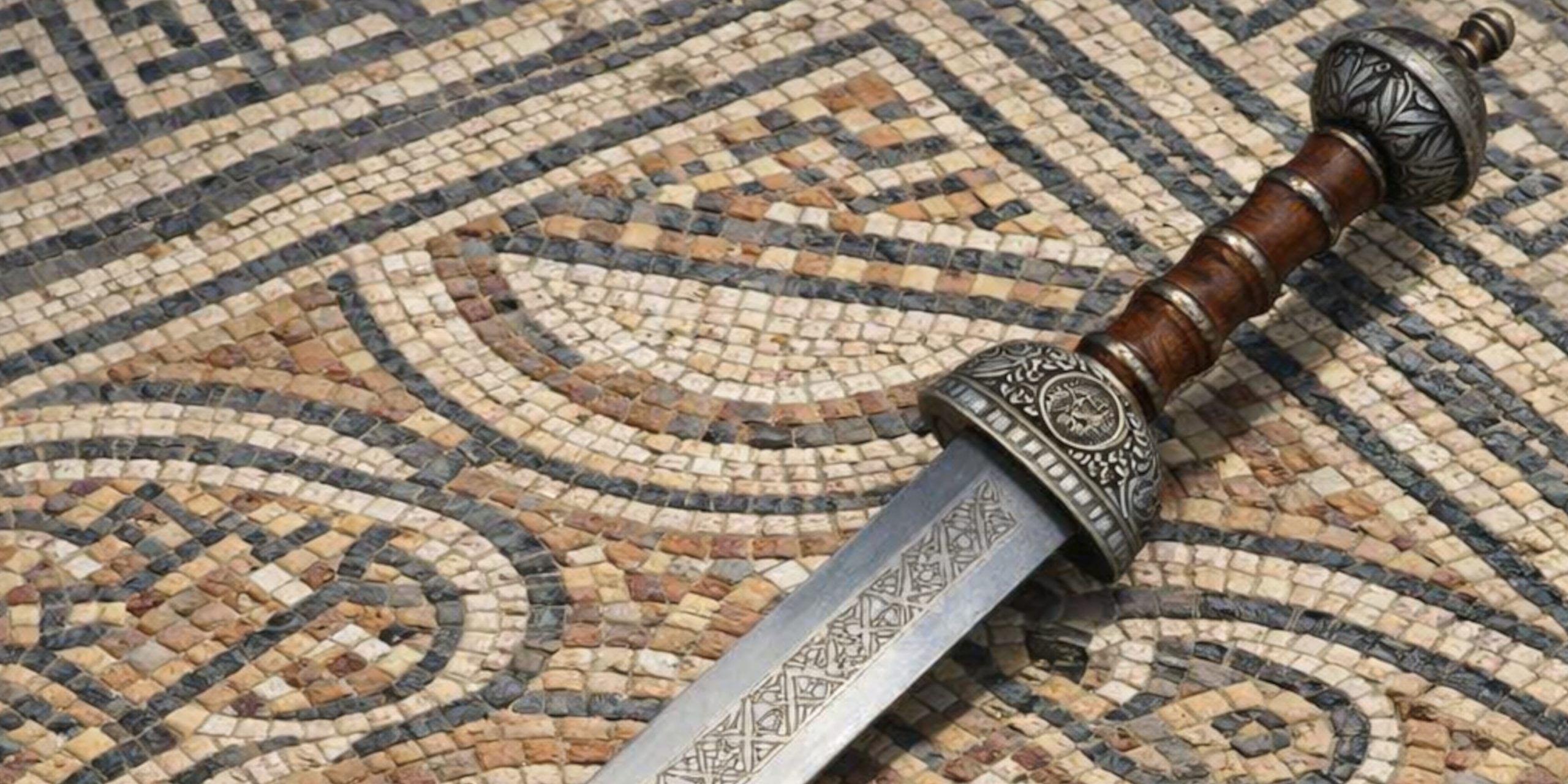
The phrase “centurion’s parade sword” is a modern convenience rather than a Roman classification. It describes an officer-grade gladius presented with an emphasis on visual authority. The blade itself remains short and practical, but the scabbard and fittings carry the message. Bright metal, narrative reliefs, and careful finishing turn a standard infantry weapon into a statement of rank.
These swords were not theatrical props. Roman officers lived with their equipment, marched with it, and were buried with it. Decoration did not cancel function. It simply made the owner visible.
Specifications
Because there was no single parade pattern, specifications are best understood as common ranges drawn from surviving examples and archaeological parallels.
Typical dimensions and construction
| Feature | Common range | Notes |
|---|---|---|
| Blade length | 50 to 55 cm | Short, stiff blades suited to close combat |
| Overall length | 65 to 70 cm | Varies with hilt and pommel form |
| Blade profile | Double-edged, tapering point | Mainz and Pompeii families dominate |
| Scabbard core | Wood with leather covering | Metal mounts fixed to organic core |
| Scabbard decoration | Bronze plates, tinning, gilding | Relief scenes and symbolic imagery |
Materials and finish
- Blade material: wrought iron
- Hilt components: wood, bone, horn, or composite materials
- Scabbard fittings: bronze, often tinned or gilded
- Decorative methods: engraving, relief casting, applied plates
The visual impact comes from the scabbard rather than exotic blade metallurgy.
History and evolution
The decorated officer sword emerges from a Roman military culture that valued visibility and hierarchy. Centurions were expected to be recognised instantly, whether on parade, on campaign, or in the chaos of a fight.
| Period | Development | Context |
|---|---|---|
| Late Republic | Personal purchase equipment common | Officers express status through fittings |
| Early 1st century AD | Highly ornate scabbards appear | Political imagery and imperial symbolism |
| Mid to late 1st century AD | Pompeii-type blades spread | Decoration continues despite blade change |
| 2nd to 3rd century AD | Gradual adoption of the spatha | Officer display culture persists |
The famous Mainz example demonstrates that an elaborate scabbard could coexist with a fully functional weapon. Roman military aesthetics were practical, not precious.
Advantages and disadvantages
Advantages
- Clear visual authority within the unit
- Strong morale and identity signalling
- Compact size suited to Roman fighting styles
Disadvantages
- Higher cost due to metalwork and decoration
- Scabbard fittings vulnerable to wear and damage
- Modern market confusion between authentic pieces and replicas
Comparison with similar weapons
| Weapon | Role | Key differences |
|---|---|---|
| Standard legionary gladius | Rank-and-file weapon | Plainer scabbard, minimal decoration |
| Spatha | Longer cavalry and later infantry sword | Greater reach, different carry |
| Pugio dagger | Secondary sidearm | Often ornate but shorter and symbolic |
| Modern ceremonial swords | Dress and display | Different construction and cultural logic |
The centurion’s parade sword sits between utility and display, not fully ceremonial and never purely decorative.
Legacy
The image of the decorated Roman officer sword has shaped how the Roman army is visualised in museums, books, and popular culture. Replica makers lean heavily on this tradition, often labelling ornate gladii as “centurion” models regardless of historical nuance.
Its real legacy lies in how it shows Roman attitudes toward power. Authority was meant to be seen, not explained.
Where to see examples
One of the most important surviving decorated Roman gladius and scabbard sets is held by the British Museum, where the Mainz sword provides a benchmark for understanding officer-grade equipment.
Smaller scabbard mounts and fittings can also be found in regional museums and private collections, offering insight into decoration styles even when blades do not survive.
Collector’s guide, including prices
Market categories
Collectors generally encounter three types of material:
- Decorative replicas intended for display
- Functional replicas suitable for reenactment
- Authentic Roman blades or fittings with documented provenance
Typical price ranges
| Category | Price range |
|---|---|
| Decorative replica gladius | £40 to £150 |
| Reenactment-grade replica | £150 to £300 |
| Premium replica with detailed scabbard | £250 to £450 |
| Authentic Roman gladius, incomplete | £1,500 to £3,500 |
| Complete sword and ornate scabbard sets | £30,000 and above |
Condition, completeness, and documentation drive prices far more than visual appeal alone.
What to check before buying
- Clear provenance and ownership history
- Honest assessment of corrosion and repairs
- Absence of modern construction features on claimed antiques
- Compliance with local antiquities regulations
- Seller expertise in ancient arms
Practical advice
If the goal is visual impact, a high-quality replica delivers without legal or ethical risk. Authentic Roman swords are serious acquisitions that demand research, patience, and a tolerance for paperwork. Many experienced collectors begin with scabbard fittings before committing to complete weapons.