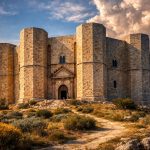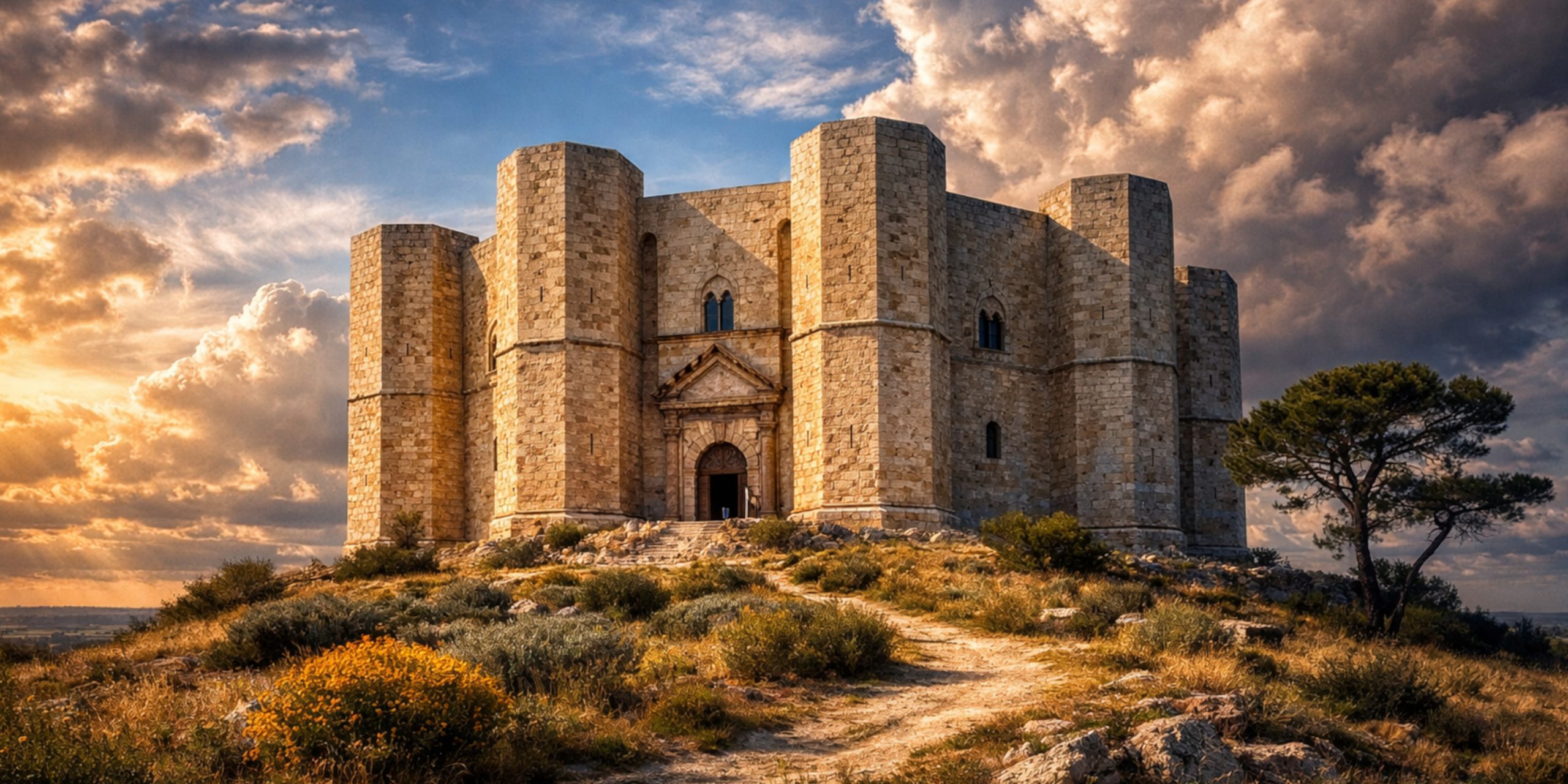
Castel del Monte sits alone on a hill in Apulia like a great stone riddle. At first glance it looks almost too perfect to be medieval, all precise angles and pale limestone, as though a mathematician had been given a castle and told not to get carried away. Naturally, Frederick II got very carried away.
Built in the mid-13th century near Andria in southern Italy, Castel del Monte remains one of the strangest and most fascinating castles in Europe. It has no obvious moat, no proper outer defences, and very little that resembles the rough practicality of most medieval fortresses. Instead it rises from the landscape in a flawless octagon, crowned by eight matching towers. It is less a castle in the usual sense and more a statement, carved into stone by one of the most unusual rulers of the Middle Ages.
Where Is Castel del Monte?
Castel del Monte stands on a hill around 540 metres above sea level in the Apulian countryside, west of Bari and close to the town of Andria.
From the hilltop the castle dominates the surrounding landscape. On a clear day the view stretches across fields, woods and distant settlements. That commanding position was useful, though perhaps not entirely for military reasons. Frederick II seems to have wanted the building to be seen from far away. Medieval rulers were rarely shy about displaying their power, but Frederick preferred geometry to banners.
Who Built Castel del Monte?
The castle was commissioned by Holy Roman Emperor Frederick II, King of Sicily, sometime around 1240.
Frederick II was one of the most remarkable figures of the Middle Ages. He spoke several languages, maintained a court filled with scholars, and showed a deep interest in mathematics, astronomy, philosophy and the cultures of the Islamic world. Medieval chroniclers called him Stupor Mundi, or ‘the Wonder of the World’. His enemies had a rather less flattering list of names, though rulers of his sort usually did.
Castel del Monte reflected Frederick’s personality perfectly. It was cosmopolitan, intellectual and just a little eccentric. This was a ruler who corresponded with scientists and falconers while simultaneously quarrelling with popes and leading armies. Building an octagonal castle that still confuses historians 800 years later was entirely in character.
Why Was Castel del Monte Built?
This remains the great question.
There is no evidence that Castel del Monte was built as a conventional fortress. It lacks many of the features one would expect in a defensive castle:
- No moat
- No drawbridge
- No large barracks
- No extensive stables
- No obvious outer bailey
For many years historians argued that it must have been a hunting lodge. Frederick II was famous for his love of falconry and hunting, and nearby forests would have suited that purpose.
Yet the castle feels too grand and too carefully designed to be merely a place to stay between hunts. Others have suggested it may have been:
- A ceremonial residence
- A symbol of imperial authority
- An astronomical observatory
- A philosophical or mathematical monument
- A place for elite gatherings and courtly display
The truth is probably a mixture of these ideas. Castel del Monte may have been intended as a palace, retreat and statement of power all at once.
As a historian, I rather suspect Frederick II enjoyed the fact that nobody could entirely work it out. Some rulers wanted to leave behind a dynasty. Frederick seems to have wanted to leave behind a puzzle.
The Extraordinary Architecture of Castel del Monte
The castle is famous for its perfect octagonal design.
The main structure is an eight-sided building, with eight octagonal towers at each corner. Inside are:
- Two floors
- Eight rooms on each floor
- An octagonal courtyard at the centre
- Spiral staircases in three of the towers
The repeated use of the number eight appears deliberate. Medieval symbolism often associated the number with eternity, resurrection and the meeting point between heaven and earth.
The octagon itself may have been intended to stand between the square and the circle. The square represented the earthly world. The circle represented the divine. Castel del Monte sits awkwardly and magnificently between the two.
The building combines several architectural traditions:
- Classical Roman details in the columns and entranceways
- Gothic features in the vaulting and windows
- Islamic influences in its geometric precision and decorative style
This blend of styles mirrors Frederick II’s own interests. His court drew ideas from Latin Christendom, the Islamic world and the eastern Mediterranean. Castel del Monte therefore feels less like a simple medieval castle and more like the stone version of an overfilled library.
Inside Castel del Monte
The interior of the castle is far plainer today than it once was.
Originally the walls were decorated with marble, mosaics and carved stone. There were rich floor surfaces, elegant columns and fine window frames. Much of this was stripped away in later centuries, particularly during the 18th century when the castle was treated less like a priceless monument and more like a very convenient builders’ merchant.
Even so, parts of the interior still survive:
- Rib-vaulted ceilings
- Carved capitals and brackets
- Fragments of mosaic flooring
- Impressive fireplaces
- Narrow staircases hidden within the towers
The courtyard is especially striking. Empty and enclosed by pale stone walls, it has a curious stillness about it. Visitors often describe the building as mysterious, though that may partly be because everyone arrives expecting a secret passage or a Templar conspiracy. Medieval architecture has suffered terribly from novelists.
Contemporary Quotes About Castel del Monte and Frederick II
Several medieval writers commented on Frederick II and his unusual tastes, even if they did not always mention Castel del Monte directly.
The English chronicler Matthew Paris described Frederick as:
“A man of astonishing ability, gifted beyond measure.”
Another contemporary writer, Salimbene di Adam, though less sympathetic, admitted:
“He knew how to read, write and sing, and he delighted in subtle things.”
The castle itself was later described in a royal document as a structure built “near the church of Santa Maria del Monte” and intended to be completed with great care.
Centuries later, the Italian historian Franco Cardini offered perhaps the best summary of the entire place:
“The only certain thing about Castel del Monte is that it is, indeed, a castle.”
That sounds almost absurd until one has spent time studying it.
Sieges and Military History
Castel del Monte was never the scene of a major medieval siege in the dramatic sense. There were no towering siege engines, no starving defenders eating their last mule, and no heroic final stand while someone dramatically waved a banner from the walls.
That in itself is telling.
The castle’s design and location meant it was never used as a front-line fortress. During the later Middle Ages it passed quietly between rulers and officials.
There may have been brief occupations and local disturbances during periods of political unrest in southern Italy, especially during the struggles between the Hohenstaufen and Angevin dynasties, but no famous siege is recorded.
In a way, Castel del Monte escaped the fate of many castles precisely because it was too strange and too impractical to become a battlefield stronghold.
Occupants Timeline
| Date | Occupants and Use |
|---|---|
| c. 1240-1250 | Constructed under Frederick II |
| Mid-13th century | Used occasionally by Frederick II and his court |
| After 1250 | Controlled by Manfred, Frederick’s son |
| After 1266 | Taken by Charles I of Anjou |
| Late 13th century | Used as a prison for members of the Hohenstaufen family, including Manfred’s sons |
| 14th-16th centuries | Passed between noble owners and royal officials |
| 17th century | Increasingly neglected and partly abandoned |
| 18th century | Marble and interior decorations stripped and reused elsewhere |
| 1876 | Purchased by the Italian state |
| 1928 onwards | Major restoration work begins |
| 1996 | Recognised as a UNESCO World Heritage Site |
One of the castle’s bleakest chapters came after the fall of the Hohenstaufen dynasty. Manfred’s sons, including Henry, Azzo and Enzo, were imprisoned there by the victorious Angevins. There is a cruel irony in that. Frederick II built a castle that looked more like a philosophical dream than a prison, only for his descendants to end up confined within it.
Archaeology and Recent Discoveries
Archaeology has changed our understanding of Castel del Monte considerably.
For many years historians believed the castle had never possessed proper defences. Excavations, however, suggest that the building was once surrounded by an outer curtain wall and perhaps additional structures.
Archaeologists have also discovered:
- Traces of a surrounding enceinte
- Evidence of sophisticated water systems
- Remains of decorative marble and mosaic flooring
- Fragments of sculpture from the courtyard
- Signs that the towers may once have been taller
Excavations have revealed that rainwater was carefully channelled through the building. This was no accidental arrangement. The castle had an advanced hydraulic system, with cisterns and drainage built into the design.
Recent research has also focused on the castle’s astronomical alignment. Certain windows and rooms appear to interact with the movement of sunlight during the solstices and equinoxes. Whether this was intentional or merely a happy coincidence remains debated. Historians are divided. Frederick II, one suspects, would have enjoyed the argument.
Castel del Monte in the Modern Era
By the 19th century Castel del Monte had fallen into serious disrepair. Fortunately the Italian state purchased the castle in 1876 and began efforts to preserve it.
Large-scale restoration started in the 1920s. Much of what visitors see today has been stabilised and repaired, though the surviving structure is still largely original.
In 1996 UNESCO declared Castel del Monte a World Heritage Site, praising its blend of classical, Islamic and Gothic influences.
Today the castle is one of the most recognisable landmarks in Italy. It appears on the Italian one-cent coin, which is perhaps fitting. Even in miniature, it remains unmistakable.
The Importance of the Castle Today
Castel del Monte endures because it refuses to behave like an ordinary castle.
It is too elegant to be merely military, too austere to be a palace, and too enigmatic to be explained away as a hunting lodge. Instead it reflects the mind of Frederick II himself: brilliant, contradictory, curious and impossible to place neatly into a single category.
Most medieval castles tell you exactly what they were for. Castel del Monte does not. It stares back in silence and leaves you to decide.
That is why historians still return to it. Not because we have solved the mystery, but because we have not.