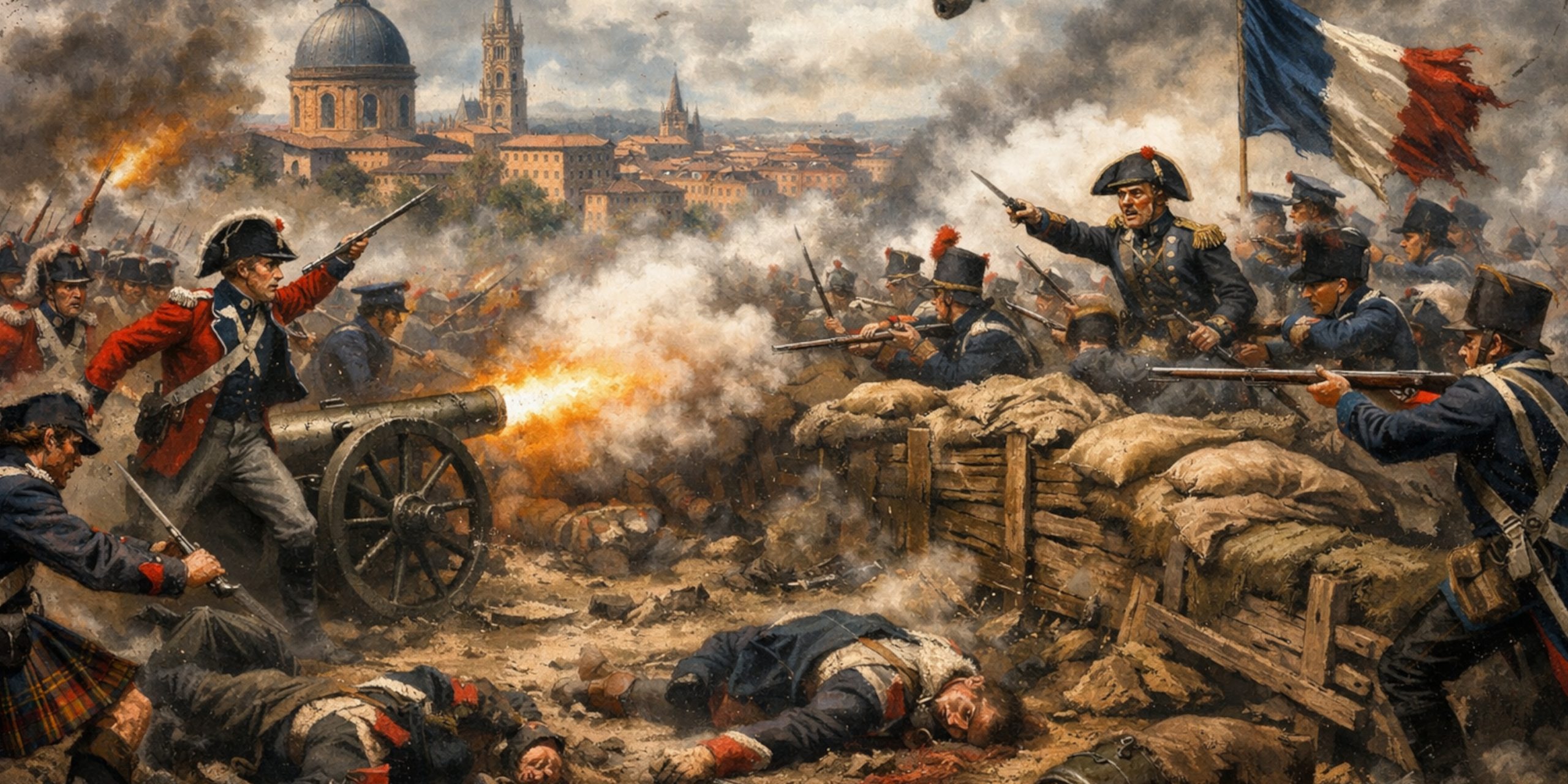
The Battle of Toulouse, fought on 10 April 1814, is one of those Napoleonic finales that feels almost awkward in hindsight. The war was effectively over, Napoleon had already abdicated, and yet the guns still spoke outside Toulouse. News travelled slowly, pride travelled quickly, and neither side was inclined to stop first.
For the Duke of Wellington, this was the last major engagement of the Peninsular War, a campaign that had dragged French power steadily back across Spain and into southern France. For Marshal Soult, it was a defensive stand made with professional skill, even if history would later judge the timing as unfortunate rather than heroic.
Strategic Background
By early 1814 the Allied advance had crossed the Pyrenees. Wellington’s army had battered its way into France, defeating Soult at Orthez and forcing a retreat towards Toulouse. The city mattered for morale, logistics, and reputation. Losing it meant southern France lay open.
Soult knew his position was politically fragile, but militarily respectable. Wellington knew the French were cornered, but also knew Soult was at his best when defending prepared ground. Neither man wanted to be the one remembered for blinking.
Forces
Overall Strength
| Side | Estimated Strength |
|---|---|
| Allied Army | c. 52,000 |
| French Army | c. 42,000 |
Commanders
- Allied
- Arthur Wellesley
- French
- Jean-de-Dieu Soult
Troop Composition
Allied Army
- British infantry divisions with experienced Peninsular veterans
- Portuguese line infantry and light troops
- Spanish divisions, increasingly reliable by 1814
- Cavalry brigades for pursuit and screening
- Extensive artillery train
French Army
- Line infantry with mixed veteran and conscript quality
- Light infantry holding key high ground
- Limited cavalry, mostly for local defence
- Well-sited artillery covering approaches
Soult’s troops were fewer, but deployed with care. Wellington’s army was larger, but faced difficult terrain and prepared positions.
Arms and Armour
Napoleonic warfare was dominated by firearms and artillery, but edged weapons still mattered, particularly in close combat and cavalry actions.
Common Weapons in Use
Infantry
- Charleville Model 1777 musket
- Brown Bess musket
- Bayonets for close assault
Cavalry Sword Types
Officers’ Swords
- Small swords for French officers
- British spadroons and infantry officer swords
Despite popular imagination, swords were secondary tools here. Artillery fire and musket volleys decided Toulouse, not flashing steel.
The Battle Timeline
Early Morning
Allied forces advanced east of Toulouse, aiming to seize the Mont Rave heights. French artillery opened fire almost immediately.
Mid Morning
Spanish divisions attacked strongly held positions and suffered heavy casualties. Their persistence mattered, even if the cost was high.
Late Morning to Afternoon
British divisions pushed uphill against entrenched French troops. Fighting was confused, close, and brutal. Urban edges and broken ground favoured the defence.
Late Afternoon
Soult withdrew in good order, preserving his army. Wellington held the field but had taken significant losses.
Aftermath
Days later, news arrived of Napoleon’s abdication. The battle instantly shifted from strategic necessity to historical irony.
Archaeology and the Battlefield Today
Modern Toulouse has absorbed much of the battlefield, but traces remain.
- Earthworks and redoubt outlines near Mont Rave
- Artefacts such as musket balls and uniform buttons recovered in the 19th and 20th centuries
- Local memorials marking key engagement points
Unlike Waterloo, Toulouse is quiet about its Napoleonic past. The city has moved on, and perhaps that is fitting.
Casualties
| Side | Estimated Losses |
|---|---|
| Allied Army | c. 4,600 |
| French Army | c. 3,200 |
For a battle fought after the war was effectively decided, these numbers sting. Historians still debate whether Toulouse was necessary or merely inevitable.
Contemporary Voices
A British officer later reflected on the grim timing of the battle:
“We fought with all the fury of men who believed the war still theirs to win.”
Soult, characteristically defensive but dignified, wrote after learning of Napoleon’s abdication:
“I did what honour required, and nothing more could be asked of a soldier.”
There is a quiet professionalism in both sentiments, even if history remains unimpressed by the delay.
Historical Assessment
Toulouse was a tactical success for Wellington, but not a clean one. Soult executed a skilful withdrawal and avoided disaster. The battle added little to Allied victory and much to the casualty lists.
As a historian, it feels like a final echo rather than a climax. The Peninsular War had already been decided by endurance, logistics, and political collapse. Toulouse simply reminded everyone that wars rarely stop neatly when they should.
Legacy
- Final major battle of the Peninsular War
- Reinforced Wellington’s reputation for persistence
- Highlighted the lag between political events and battlefield reality
- Often overshadowed by Waterloo, and perhaps relieved to be
If Toulouse has a lesson, it is that history does not always end with a drum roll. Sometimes it ends with paperwork arriving too late.