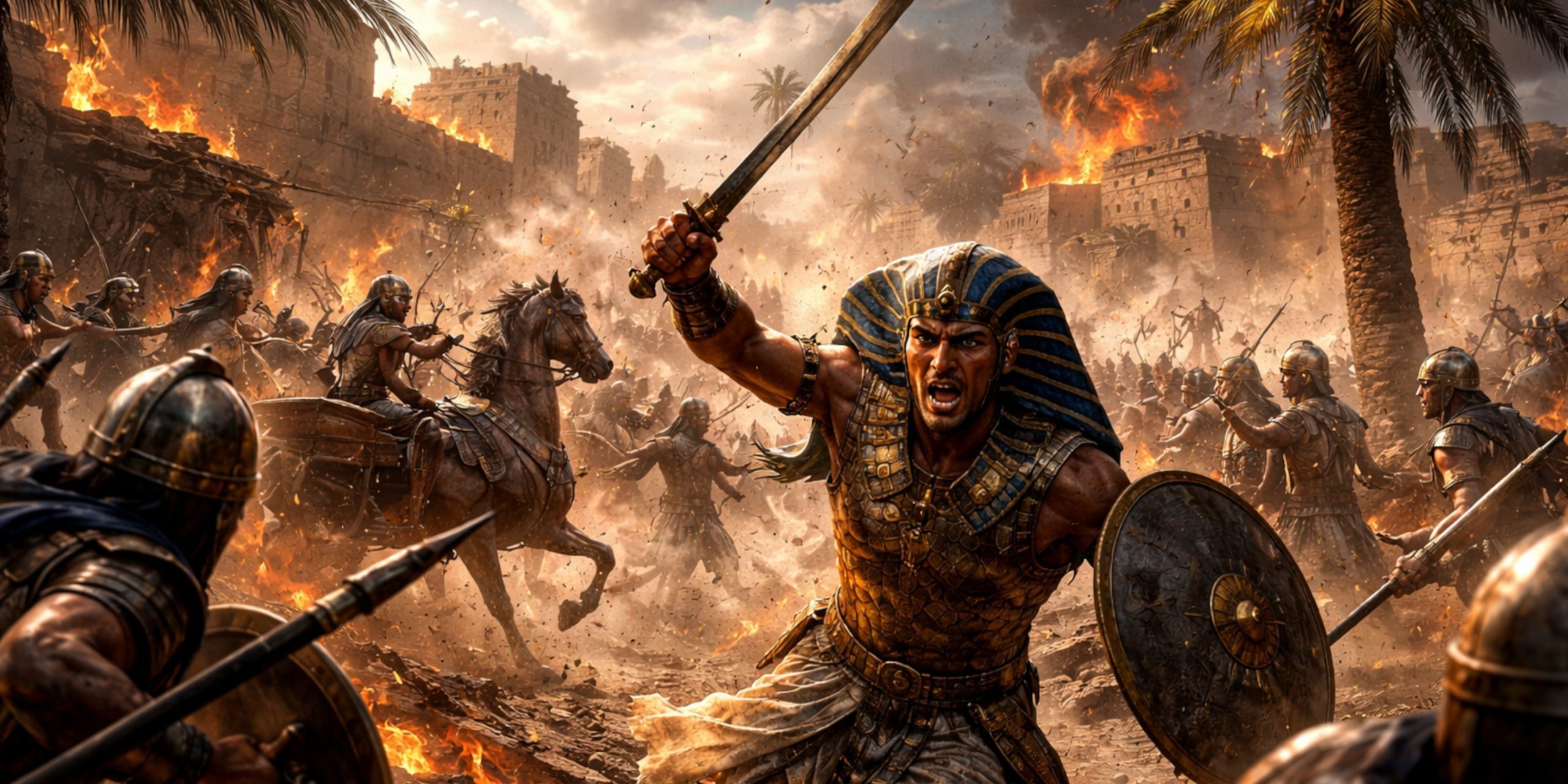
The Battle of Tanis belongs to the final phase of Egypt’s war against the Hyksos rulers of the north, a conflict that dragged the Nile Delta into decades of intermittent fighting and ended with the birth of the New Kingdom. Tanis was not a single neat clash on an open plain. It was a campaign moment, likely urban and chaotic, fought in canals, streets, and fortified compounds.
What makes Tanis fascinating is precisely what frustrates historians. We have no tidy battlefield narrative, no heroic blow-by-blow. Instead, we have scarred layers of destruction, weapon fragments, and later royal texts that compress years of bloodshed into a few victorious lines. As a historian, I find this oddly refreshing. Real wars rarely behave like inscriptions want them to.
Historical Background
By the mid sixteenth century BC, Egypt had been divided for generations. The Hyksos ruled Lower Egypt from their power base in Avaris, while native Egyptian dynasties held the south. The Theban kings, particularly Seqenenre Tao and later Kamose, reopened the war with a ferocity that feels personal. Ahmose I inherited both the conflict and the ambition to end it.
Tanis, in the eastern Delta, sat near vital waterways and supply routes. Control of the area meant pressure on Hyksos logistics and influence beyond Avaris itself. If Tanis fell or was devastated, it would have sent a clear message that Hyksos power was cracking.
Forces
Egyptian Kingdom (Theban-led)
| Element | Details |
|---|---|
| Leadership | Royal commanders acting for Ahmose I |
| Troop type | Infantry-heavy with emerging chariot units |
| Estimated strength | Several thousand |
| Tactical aim | Break Hyksos control of Delta routes |
Hyksos Kingdom
| Element | Details |
|---|---|
| Leadership | Local Hyksos governors |
| Troop type | Mixed infantry and experienced chariot forces |
| Estimated strength | Comparable to Egyptian forces |
| Tactical aim | Defend Delta strongholds and delay invasion |
Arms and Armour
Egyptian Equipment
• Bronze-tipped spears for formation fighting
• Axes with crescent blades, effective in close combat
• Daggers and short swords, including early khopesh variants
• Leather or linen armour with wooden shields
• Bows for skirmishing and urban fighting
Hyksos Equipment
• Composite bows, a technological edge earlier in the war
• Long daggers and straight bronze swords
• Battle axes with heavier heads
• Chariots used for mobility and shock, though restricted in Delta terrain
The irony is that by this stage, the Egyptians had learned most of the Hyksos tricks. Chariots, bronze casting methods, and composite bows were no longer foreign. Tanis likely saw two very similar armies, which makes the fighting all the more brutal.
The Battle and Campaign
The fighting at Tanis was probably not a single engagement. Evidence suggests repeated assaults, burning, and partial abandonment. Egyptian forces would have pushed through canal networks, cutting supply lines and isolating Hyksos-held districts. Urban resistance would have been stubborn, with fighting room by room.
This was not glamorous warfare. It was mud, smoke, and panic. If you are picturing heroic chariot charges, gently set them aside. Tanis was about attrition and pressure, not spectacle.
Battle Timeline
• Egyptian advance into the eastern Delta
• Initial clashes along waterways and outer defences
• Prolonged fighting within the settlement
• Destruction layers from fire and collapse
• Hyksos withdrawal or defeat in the area
• Momentum shifts decisively towards Avaris
Archaeology
Excavations at Tanis reveal burn layers, smashed masonry, and displaced occupation consistent with violent disruption in the late Second Intermediate Period. Weapon fragments and hurried abandonment suggest a population that did not leave calmly.
Later Ramesside reuse of the site complicates matters. Stones were moved, monuments recycled, and history blurred. Archaeology here is like listening to a conversation where half the speakers have been interrupted for three thousand years.
Contemporary Quotes
From the Rhind Mathematical Papyrus, indirectly referencing the period of conflict:
“Foreign rulers had no power in Egypt when the rightful king rose.”
From later New Kingdom inscriptions attributed to Ahmose’s reign:
“He drove the Asiatics from the Delta and cleansed Egypt.”
These are not battlefield diaries. They are victory slogans. Useful, but never to be trusted alone.
Historical Significance
Tanis mattered because it marked the tightening grip of the Theban kings on the Delta. Each broken city weakened Hyksos legitimacy and logistics. The battle belongs to the final act of a long war that reshaped Egypt into an outward-looking military state.
Without Tanis and places like it, there is no New Kingdom, no empire in Nubia and the Levant, and no swaggering warrior pharaohs carved into temple walls. History often pivots on unglamorous fights, and Tanis is a fine example.
Final Thoughts from the Historian
Tanis will never give us the clean narrative people crave. That is its charm. It reminds us that ancient warfare was chaotic, political, and deeply human. Victories were rarely sudden, and collapses were usually slow. If Ahmose I celebrated Tanis loudly, it was probably because the struggle had been so hard-won.