The Battle of Saint-Omer, fought in July 1340 during the early phase of the Hundred Years’ War, was one of those encounters that rarely receives headline treatment, yet quietly shaped the politics of Flanders and the wider Anglo French struggle. It was not a grand set piece like Crécy. It was not a massacre. It was, instead, a hard reminder that alliances built on commerce and grievance do not always translate into battlefield cohesion.
Saint-Omer itself, then under French control, lay in Artois, a region whose loyalties were never simple. When English interests and Flemish ambitions collided with French authority, the result was a sharp and chaotic fight outside the town walls.
Background
In 1340, Edward III had declared himself King of France, staking a claim that ignited the long war between the Valois crown and the Plantagenets. The cloth towns of Flanders, economically dependent on English wool, leaned towards England. Their political leadership, particularly Jacob van Artevelde in Ghent, favoured alliance with Edward.
The objective at Saint-Omer was straightforward. Flemish forces, aligned with England, sought to challenge French control in Artois and draw the French army into a disadvantageous engagement. The French, under experienced commanders loyal to Philip VI of France, were prepared and well positioned.
The result was a battle that revealed the limits of enthusiasm without discipline.
Forces
Precise numbers remain debated, though chroniclers give broad estimates.
Anglo Flemish Coalition
- Estimated strength, 20,000 to 25,000 men
- Predominantly Flemish urban militia
- English knights and men at arms in smaller numbers
- Limited cavalry compared to French forces
French Royal Army
- Estimated strength, 10,000 to 15,000 men
- Strong contingent of mounted men at arms
- Professional infantry and crossbowmen
- Garrison support from Saint-Omer
The coalition may have held numerical superiority. On paper, that matters. In practice, cohesion matters more.
Leaders and Troop Composition
| Side | Key Leaders | Troop Types |
|---|---|---|
| Anglo Flemish | Robert III of Artois, Flemish captains loyal to Artevelde | Urban militia pikemen, English men at arms, archers |
| French | Eudes IV, Duke of Burgundy, Jean de Clermont | French knights, mounted men at arms, crossbowmen, infantry |
Robert III of Artois, a French noble in exile and a driving force behind Edward’s continental ambitions, played a significant role in urging offensive action. His personal vendetta against Philip VI added a note of bitterness to the campaign.
Arms and Armour
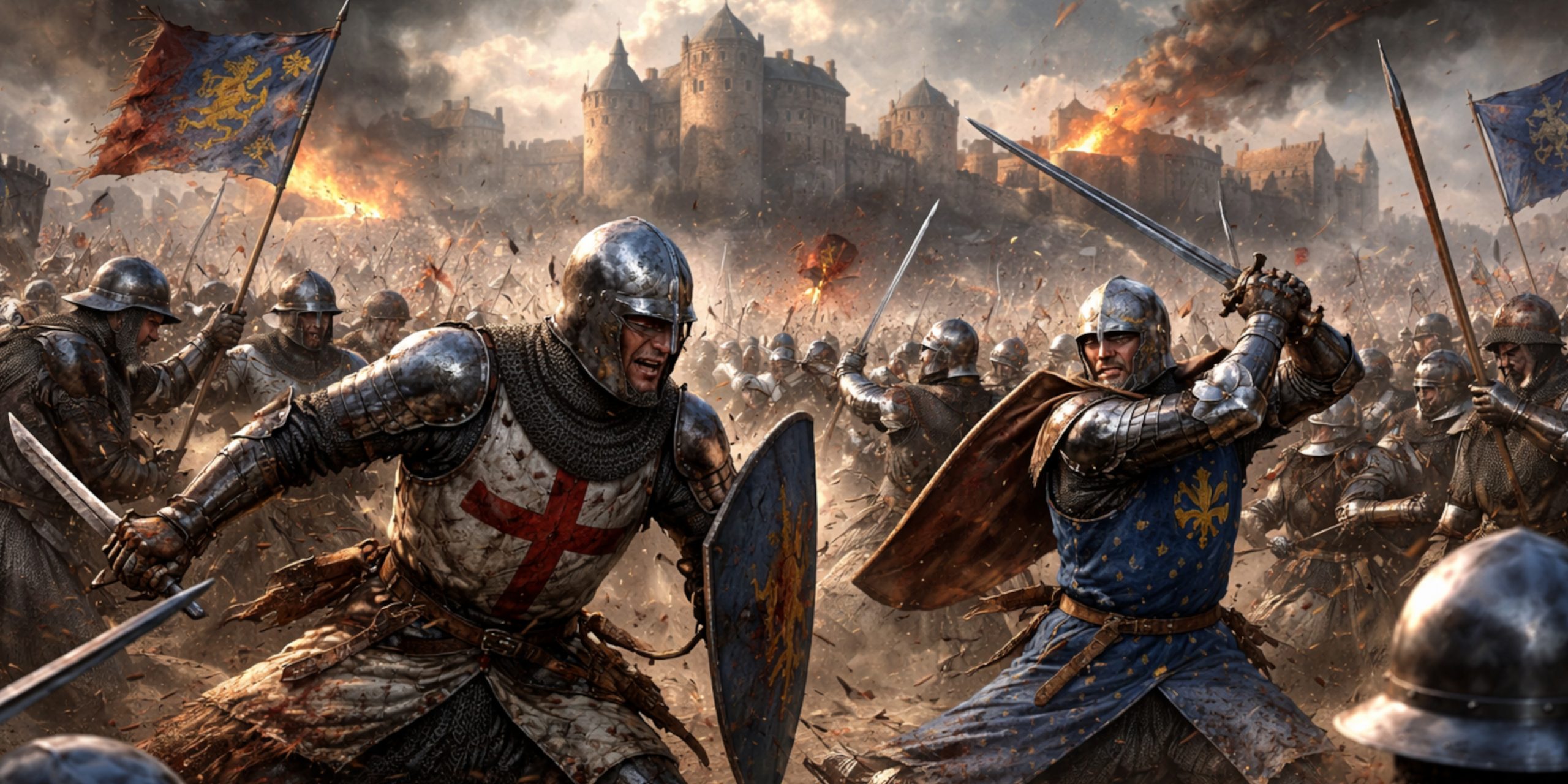
The battle took place at a transitional moment in military equipment, when older mail traditions overlapped with emerging plate reinforcement.
Armour
- Mail hauberks reinforced with early plate elements
- Bascinets with mail aventails
- Coats of plates beneath surcoats
- Kite and heater shields among infantry
French knights were generally better equipped and more uniformly armoured. Flemish militia varied considerably, reflecting urban wealth rather than royal supply.
Sword Types Used
Specific sword forms likely included:
- Oakeshott Type XIIIa, broad cutting swords suited to mounted combat
- Oakeshott Type XV, increasingly stiff, thrust oriented blades emerging in this period
- Arming swords of Types XII and XIV among infantry and men at arms
French cavalry favoured longer, cutting blades effective against lightly armoured militia. Flemish infantry relied more heavily on pikes and goedendags, though sidearms were common.
Crossbows, particularly in French service, played a critical supporting role. English longbowmen were present but did not dominate the engagement as they would in later battles.
As a historian, I cannot resist observing that while swords capture the imagination, this battle was decided far more by formation discipline and cavalry shock than by elegant blade work.
The Battle
The Flemish army approached Saint-Omer expecting the French to remain within the town. Instead, the French launched aggressive sorties.
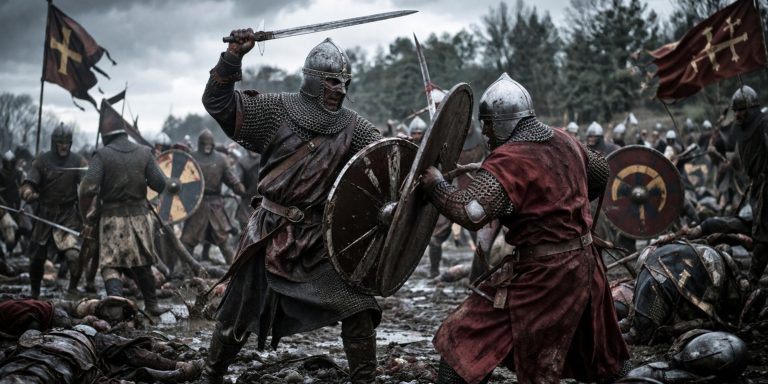
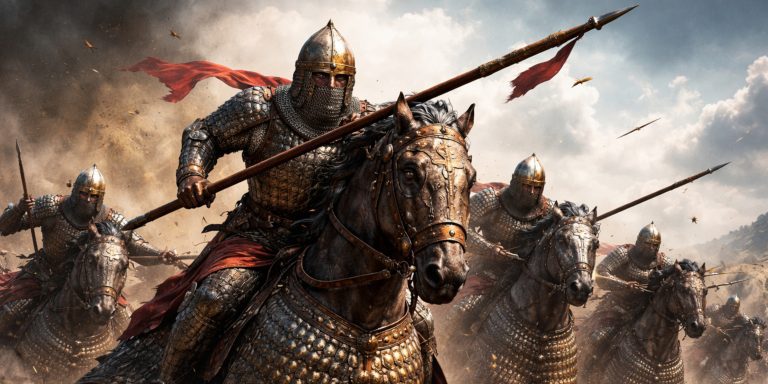
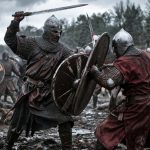
Poor coordination among the Flemish contingents proved costly. Some units advanced prematurely. Others failed to support them. French cavalry exploited these gaps with repeated charges.
Despite fierce resistance, particularly from urban militia determined to prove themselves, the coalition line fractured. Casualties mounted, especially among Flemish ranks.
The French held the field. The town remained secure.
Battle Timeline
Early July 1340
Coalition forces assemble and advance towards Saint-Omer.
Mid July 1340, Morning
Flemish contingents deploy outside the town, expecting defensive posture from the French.
Late Morning
French cavalry sorties from Saint-Omer in coordinated attacks.
Midday
Coalition units engage unevenly, with fragmented command and limited communication.
Afternoon
French counter attacks intensify. Flemish militia suffer heavy losses.
Late Afternoon
Coalition retreat becomes disorderly. French maintain control of the field.
Archaeology
The site of the battle lies in and around modern Saint-Omer in northern France. Urban expansion has obscured much of the medieval landscape.
Archaeological evidence is limited compared to larger engagements. Isolated finds include:
- Arrowheads and crossbow bolts
- Fragments of mail and plate
- Horse equipment fittings
The absence of large scale battlefield excavations leaves many tactical details uncertain. Unlike Crécy or Towton, Saint-Omer has not yielded dramatic mass grave discoveries.
That silence in the soil is frustrating, though perhaps fitting for a battle overshadowed by later, bloodier encounters.
Contemporary Quotes
Chroniclers of the period offer glimpses of perception rather than precise data.
Jean Froissart, writing later in the century, described the Flemish as brave but ill ordered, suggesting they “fought eagerly, yet without the governance of wise captains.”
French sources emphasised the discipline of their mounted men at arms, portraying the engagement as a demonstration of royal authority over rebellious towns.
Such accounts are never neutral. They reveal pride, anxiety, and propaganda in equal measure.
Significance
The Battle of Saint-Omer did not end the war. It did not even shift the grand balance decisively. Yet it exposed the fragility of the Anglo Flemish alliance and confirmed that enthusiasm alone would not defeat a disciplined royal army.
For Edward III, it was a sobering lesson early in a long campaign. For Flanders, it was proof that commercial interests and military realities do not always align neatly.
History is often shaped by these smaller engagements. They test assumptions. They thin the ranks of overconfidence.
Saint-Omer did precisely that.
Seven Swords Takeaway
The Battle of Saint-Omer in 1340 stands as an early chapter in the Hundred Years’ War that illustrates the complexities of coalition warfare, the limits of militia enthusiasm, and the enduring importance of cavalry shock in fourteenth century combat.
It deserves more attention than it receives. Not because it was spectacular, but because it was instructive. And in military history, those are often the battles that matter most.