The Battle of Notium in 406 BC was not the largest clash of the Peloponnesian War, nor the bloodiest. Yet it was one of the most consequential. A single act of ill judgement cost Athens a capable commander and handed Sparta renewed confidence at sea.
Fought near the harbour of Notium, close to Ephesus in Ionia, the engagement was part of the long and bitter struggle between Athens and Sparta. By this stage of the war, naval supremacy was everything. Whoever controlled the Aegean controlled supply, tribute and morale.
This battle did not hinge on grand strategy. It hinged on a subordinate officer who decided to show off.
Strategic Context
By 406 BC, the Ionian War had dragged on for years. Athens, though battered by previous defeats, still relied heavily on its fleet. Sparta, traditionally a land power, had invested heavily in naval expansion with Persian financial backing.
The Spartan fleet was commanded by Lysander, a disciplined and politically astute officer. The Athenian fleet was under the overall authority of Alcibiades, brilliant, erratic and never dull.
Alcibiades left part of the fleet at Notium under the command of his helmsman Antiochus. He explicitly ordered him not to engage the Spartans.
Antiochus promptly did the opposite.
Forces
Estimated Fleet Strength
| Side | Ships | Type of Ships | Notes |
|---|---|---|---|
| Athens | Approx 80 triremes | Triremes | Part of main Ionian fleet |
| Sparta | Approx 90 triremes | Triremes | Backed by Persian funding |
Precise numbers vary in ancient sources, particularly in Xenophon, whose account forms the backbone of our knowledge.
The key factor was not numbers but discipline.
Leaders and Command Structure
Athens
- Overall Commander: Alcibiades
- Acting Commander at Notium: Antiochus
- Experienced rowers and marines drawn from Athenian citizen and allied contingents
Sparta
- Fleet Commander: Lysander
- Professionalised crews, increasingly trained through sustained campaigning
- Financial support from Persian satrap Cyrus
Sparta’s naval command was becoming more structured and disciplined. Athens still relied on individual brilliance. Sometimes that works. Sometimes it ends badly.
Arms and Armour
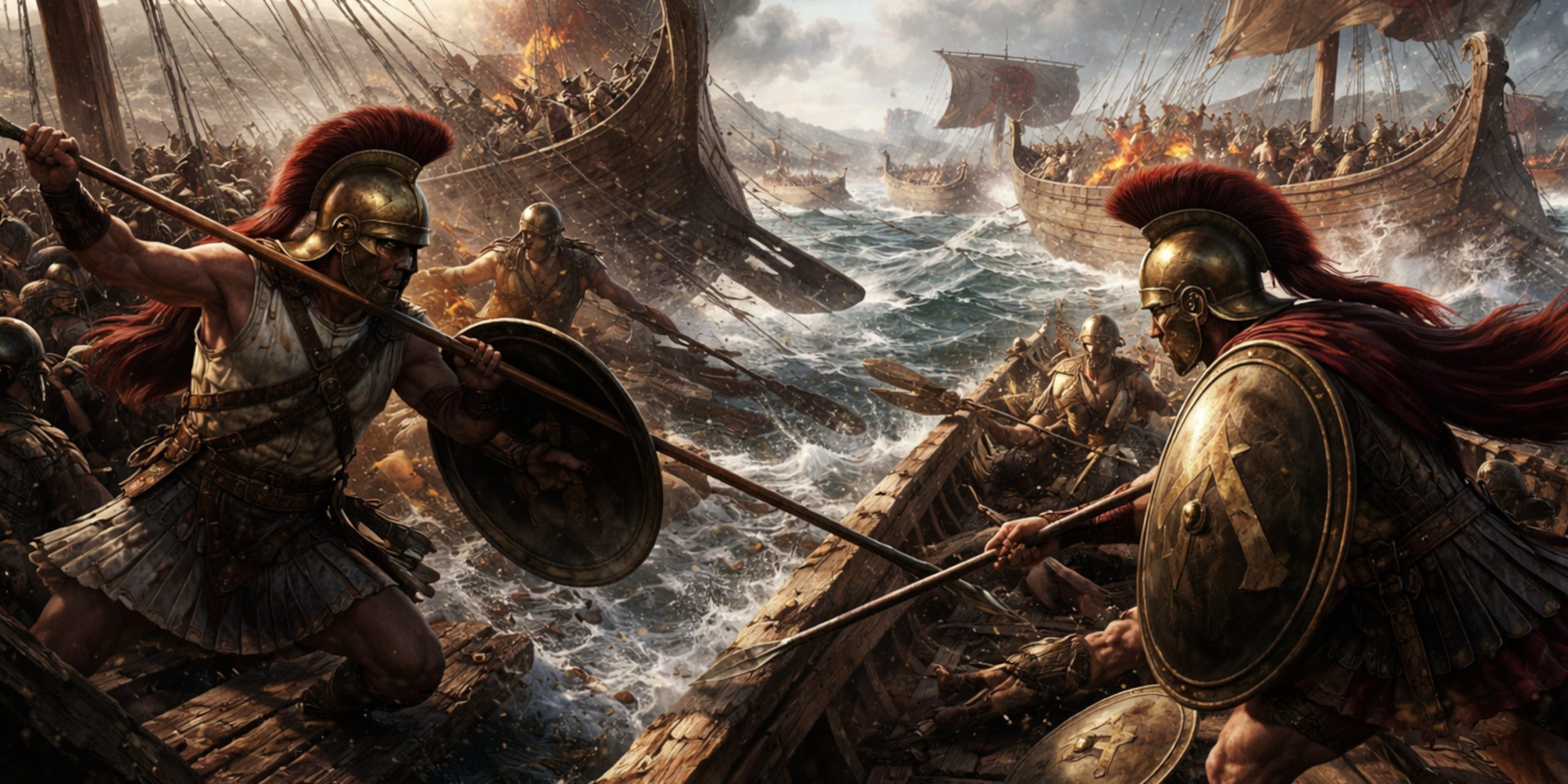
Naval battles in this period were primarily contests of manoeuvre and ramming, yet boarding actions did occur.
Ship Type
- Trireme, three banks of oars
- Bronze ram mounted at the prow
- Light hull construction for speed
Personal Arms
Athenian and Spartan Marines likely carried:
- Short swords such as the Greek xiphos
- Possibly the kopis, a forward curved cutting sword
- Spears for close fighting
- Large round hoplite shields, though marines often carried lighter versions
- Bronze helmets, often Corinthian or Chalcidian styles
- Linen cuirasses or bronze breastplates
The confined deck of a trireme did not favour heavy armour. Speed and balance mattered more than full hoplite panoply. This was not a phalanx on land. It was a wrestling match on planks barely wide enough to stand two men abreast.
The Battle
Antiochus, seeking either reconnaissance or glory, sailed forward with a small number of ships to provoke Lysander.
According to Xenophon, he attempted to draw the Spartans out by taunting manoeuvres. Lysander responded with disciplined aggression. The Spartan fleet surged forward in formation.
Antiochus was killed early in the fighting when his ship was rammed. Without central control, the Athenian vessels fell into confusion. Several were captured or sunk.
The rest retreated in disorder.
There was no heroic last stand. There was no dramatic reversal. It was a sharp, efficient Spartan victory.
Battle Timeline
| Stage | Event |
|---|---|
| Pre-battle | Alcibiades leaves fleet at Notium under Antiochus with strict orders not to engage |
| Initial Contact | Antiochus sails forward with small detachment to provoke Spartans |
| Spartan Response | Lysander launches coordinated counterattack |
| Clash | Antiochus’ ship rammed and destroyed, he is killed |
| Collapse | Athenian ships lose cohesion, several captured |
| Aftermath | Surviving Athenians withdraw to safety |
The entire engagement was brief. Naval battles could be decided in minutes once formation was broken.
Contemporary Quotes
Xenophon writes with restrained clarity:
Antiochus, though ordered not to engage, sailed out with two ships and provoked the enemy.
He further notes that the Athenians were defeated and that Antiochus was killed in the opening action.
There is no dramatic flourish in his account. The tone suggests something worse than defeat. It suggests embarrassment.
Archaeology
Direct archaeological evidence from the Battle of Notium is limited. Unlike land battles, naval clashes leave fewer durable traces.
What we know comes from:
- Excavations around Ephesus and the Ionian coastline
- Comparative study of trireme construction, including reconstructions such as the Olympias project
- Naval rams recovered from other Greek battle sites
Bronze rams recovered from Mediterranean seabeds illustrate the destructive power of trireme prows. A direct hit could splinter hull planking and cripple a ship instantly.
No confirmed wreck from Notium has been conclusively identified. The seabed keeps its secrets well.
Consequences
The political fallout in Athens was immediate and severe.
Although Alcibiades was not present during the engagement, he bore ultimate responsibility. His enemies seized the opportunity. He was removed from command and effectively exiled once more.
This loss of leadership proved critical. Within a year, Lysander would return to command and eventually secure the decisive Spartan victory at Aegospotami.
Notium was not the end of Athens. It was, however, the beginning of the end.
Historical Assessment
From a military perspective, the battle demonstrates three clear lessons:
- Discipline outweighs bravado
- Naval warfare demands tight command control
- Political systems can punish even indirect failure
As a historian, I find Notium quietly tragic. Not for its casualties, which were modest compared to other engagements, but for its symbolism. An empire at war cannot afford vanity at the helm.
Antiochus may have sought to imitate Alcibiades’ daring. He lacked the instinct. Lysander, by contrast, understood patience. When provoked, he struck cleanly and without theatrics.
In war, the quieter commander often wins.
Takeaway
The Battle of Notium in 406 BC was a limited naval engagement with outsized consequences. It weakened Athenian leadership, strengthened Spartan confidence, and set the stage for the final phase of the Peloponnesian War.
It serves as a reminder that in protracted conflict, small defeats can reshape grand strategy. Sometimes history turns not on epic confrontations, but on a single reckless decision at sea.