Norman Ambition and Southern Italian Resistance
The Battle of Nicotera was one of the lesser discussed yet revealing clashes of the Norman conquest of southern Italy. Fought near the coastal town of Nicotera in Calabria during the eleventh century, it formed part of the grinding campaign by Norman adventurers to carve principalities out of Byzantine and Lombard territory.
It lacks the theatrical scale of Hastings or the political drama of Civitate, yet it captures something more instructive. This was frontier warfare. It was personal, opportunistic and at times brutally pragmatic.
Historical Background
In the mid eleventh century, southern Italy was a mosaic of powers:
- The Byzantine Empire controlled much of Calabria and Apulia
- Lombard principalities struggled to retain independence
- Arab influence lingered from earlier Sicilian expansion
- Norman mercenaries shifted from hired swords to territorial rulers
The Normans, originally from northern France, were not supposed to stay. They arrived as soldiers for hire. Instead, they stayed, fought, married strategically, and gradually replaced their employers.
Nicotera sat on the Tyrrhenian coast, a position of logistical importance. Control of the port meant movement of troops, supplies and reinforcements between mainland Italy and Sicily.
Forces
Precise numbers are uncertain, as is often the case with eleventh century engagements. Chroniclers preferred moral drama to headcounts. That said, we can outline the likely composition.
| Side | Estimated Strength | Core Troops | Command Structure |
|---|---|---|---|
| Norman | 800 to 1,500 | Heavy cavalry, mounted knights, infantry spearmen | Led by regional Norman lords, possibly linked to the Hauteville family |
| Byzantine / Local Forces | 1,500 to 3,000 | Infantry, archers, limited cavalry | Byzantine officers with local levies |
The Normans typically fielded smaller but more cohesive forces. Their advantage lay in discipline and shock tactics rather than raw numbers.
Leaders
While the battle is not as well documented as larger campaigns, contemporary references suggest Norman commanders connected to the expanding Hauteville network, the family that would later dominate southern Italy.
Possible Norman leadership:
- Norman baron operating under Robert Guiscard
- Local Norman captains consolidating coastal Calabria
Byzantine leadership likely consisted of:
- A regional strategos or military governor
- Officers commanding thematic troops and local militia
Southern Italy in this period was full of ambitious men with sharp swords and sharper instincts.
Arms and Armour
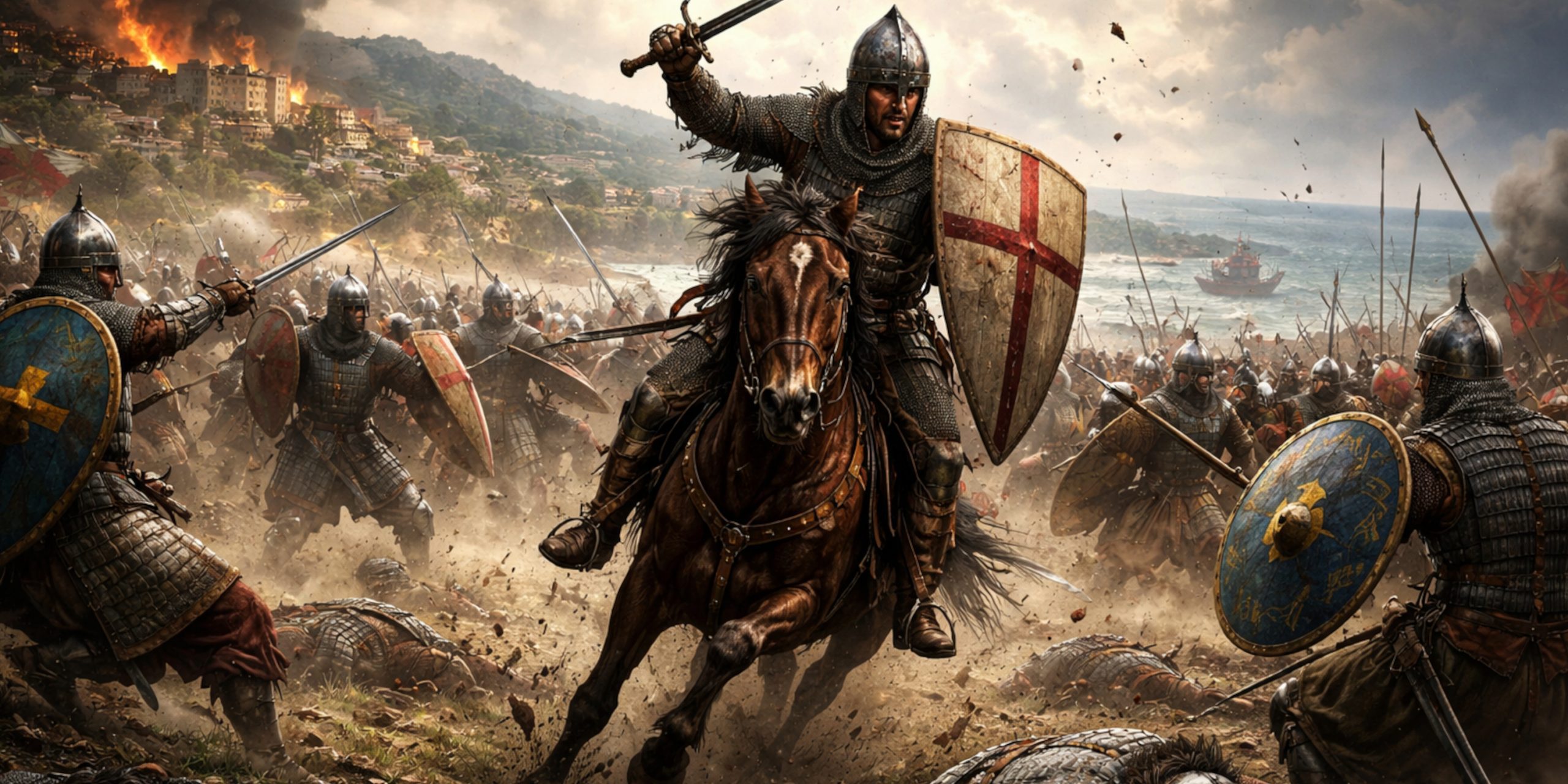
Norman Equipment
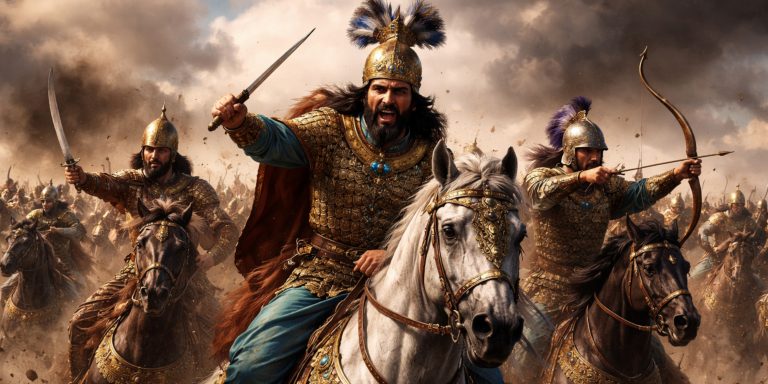
- Mail hauberk reaching to mid thigh
- Conical helmet with nasal guard
- Kite shield
- Heavy cavalry lance
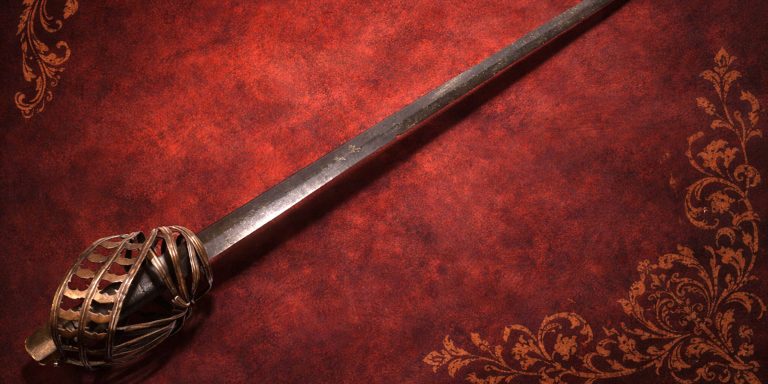
- Sword, typically early medieval types consistent with Oakeshott Type X forms
The Norman sword was a broad bladed, double edged weapon optimised for powerful cuts from horseback. It was not elegant, but it did not need to be.
Byzantine Equipment
- Lamellar or scale armour
- Rounded or oval shields
- Spears and javelins
- The spathion, a straight double edged sword derived from Roman traditions
The Byzantine army favoured combined arms, but in Calabria the quality of troops varied. Frontier garrisons rarely matched the elite units of Constantinople.
The Battle
Though exact tactical details are sparse, the pattern of Norman warfare offers clues.
- Rapid cavalry manoeuvres to disrupt infantry formations
- Concentrated charges at weak points
- Aggressive pursuit once enemy lines faltered
Byzantine forces likely attempted to anchor their position defensively, perhaps near terrain features outside Nicotera’s walls. If the Normans secured the port or surrounding heights, resistance would have collapsed quickly.
The chronicler Amatus of Montecassino writes of Norman victories in Calabria that were won “not by multitude, but by boldness.” It is a line heavy with admiration and mild horror.
Battle Timeline
Pre engagement
- Norman forces advance along the Calabrian coast
- Byzantine or local forces assemble to block coastal control
Engagement
- Norman cavalry initiates shock assault
- Infantry engagement stabilises centre
- Defensive lines fracture under mounted pressure
Aftermath
- Nicotera falls under Norman influence
- Consolidation of coastal routes
- Gradual weakening of Byzantine Calabria
Archaeology
Material evidence from Nicotera is fragmentary but consistent with eleventh century conflict.
Finds in the region include:
- Iron spearheads and arrowheads
- Mail fragments typical of Norman construction
- Pottery layers showing disturbance and burning
While no grand battlefield excavation has transformed our understanding, the archaeological profile supports a contested and militarised coastline during this period.
One sometimes hopes for a perfectly preserved sword in the sand. Archaeology is rarely so obliging.
Contemporary Voices
Amatus of Montecassino describes the Normans as men who “made themselves masters where once they were guests.”
Later chroniclers in Byzantine circles characterised them as “insatiable in ambition and fierce in war.”
The language is telling. The Normans were not simply invaders. They were opportunists who learned local politics and exploited them ruthlessly.
Significance and Legacy
The Battle of Nicotera contributed to the broader Norman consolidation of Calabria. Each coastal town secured tightened their grip on southern Italy and prepared the ground for later campaigns in Sicily.
Within a generation, Norman rule in the region would be institutionalised under figures such as Roger I of Sicily.
Nicotera was not the largest battle of the conquest. It was not the bloodiest. But it was typical. And sometimes typical tells us more than spectacle.
It reveals how states fall not in a single dramatic collapse, but through repeated, calculated blows delivered by determined men who understood timing and terrain.