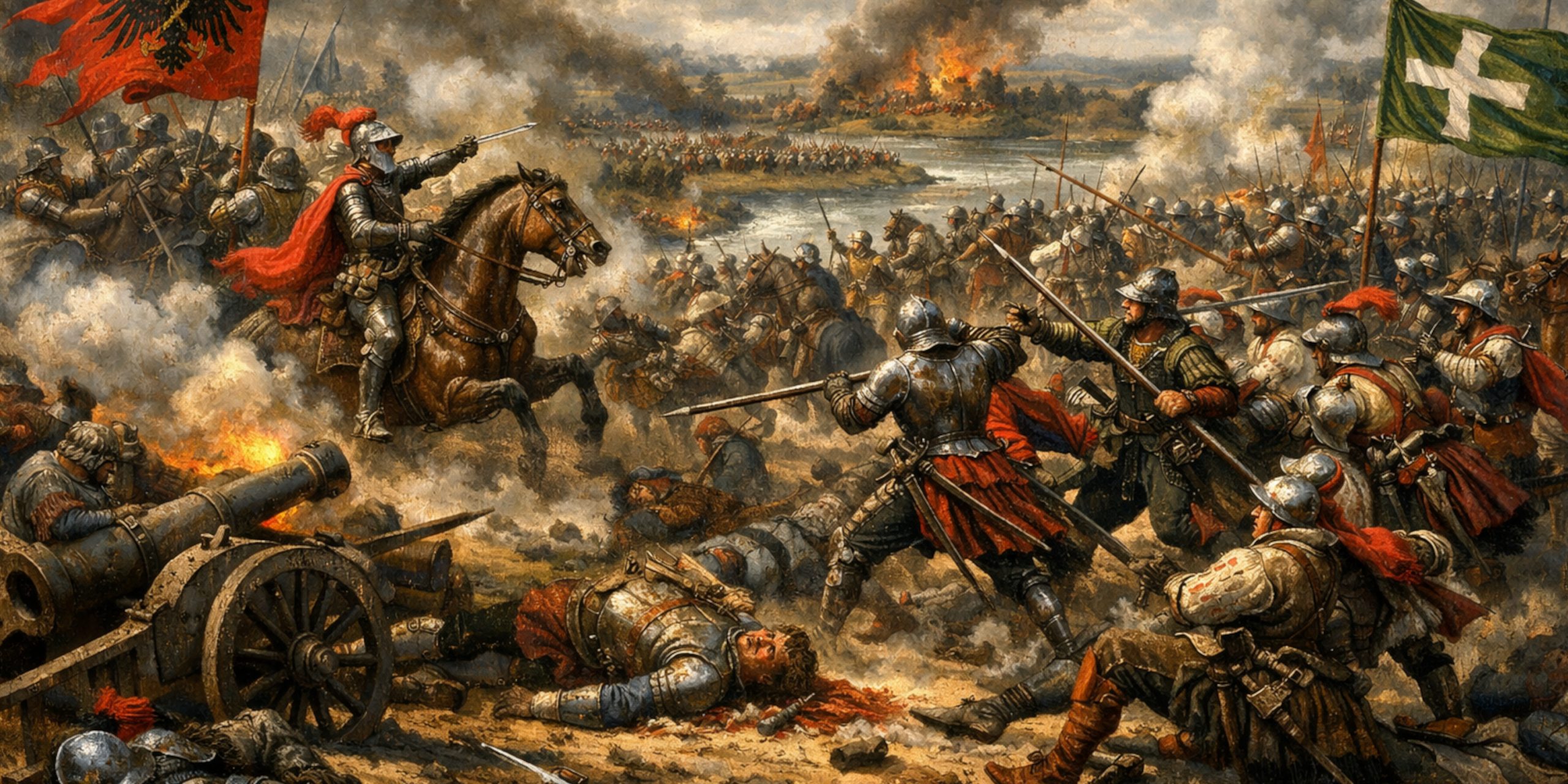
The Battle of Mühlberg, fought on 24 April 1547 beside the Elbe, marked the decisive moment of the Schmalkaldic War. It was a short battle, almost abrupt, yet its political weight was enormous. Imperial authority under Charles V crushed the main Protestant field army and captured its leader, John Frederick of Saxony. From a military historian’s view, Mühlberg is a reminder that preparation, logistics, and timing often matter more than bravery or numbers.
The fight itself barely lasted a morning. The consequences lingered for decades.
Background
By 1547 the Schmalkaldic League was tired, divided, and slow to react. Imperial forces, reinforced by Spanish veterans and supported by Catholic allies, had spent months manoeuvring with patience that would have bored most commanders but paid off in the end. John Frederick assumed the Elbe provided safety. Charles V saw it as an obstacle that could be crossed with nerve and good intelligence.
That miscalculation decided the war.
Forces
Imperial Army
| Element | Details |
|---|---|
| Overall command | Charles V |
| Key commanders | Duke of Alba, Maurice of Saxony |
| Estimated strength | 16,000 to 18,000 |
| Composition | Spanish infantry, German Landsknechts, heavy cavalry, artillery |
| Morale | High and confident |
Schmalkaldic Army
| Element | Details |
|---|---|
| Overall command | John Frederick of Saxony |
| Key commanders | Ernestine Saxon nobles |
| Estimated strength | 7,000 to 8,000 |
| Composition | Saxon infantry, cavalry, limited artillery |
| Morale | Uneven and defensive |
Arms and Armour
Imperial Equipment
- Swords
- Spanish rapier type side swords
- German longswords among Landsknechts
- Polearms
- Pikes for infantry blocks
- Firearms
- Arquebuses, increasingly decisive
- Armour
- Three quarter plate for cavalry
- Munition armour for infantry
Schmalkaldic Equipment
- Swords
- German longswords
- Early cut and thrust side swords
- Polearms
- Halberds and pikes
- Firearms
- Fewer arquebusiers than the Imperial army
- Armour
- Mixed quality, often partial harness or brigandine
The Imperial edge lay in coordination rather than kit. Their swords were not better, they were simply in the right place at the right time.
Battle Timeline
- Pre dawn
Imperial scouts locate a shallow crossing of the Elbe. - Early morning
Cavalry and infantry begin the river crossing under mist and smoke. - Mid morning
Schmalkaldic forces are surprised and fail to form a coherent battle line. - Late morning
Imperial cavalry rout Saxon units. John Frederick is wounded and captured. - By noon
Resistance collapses. The field belongs to Charles V.
The speed of the action still catches readers off guard. This was not a grinding melee but a clean strike.
Contemporary Quotes
Charles V, writing later, captured the cold confidence of the moment:
“I came, I saw, and God granted the victory.”
A Saxon chronicler was less triumphant and more honest:
“The river was our wall, and yet it opened to the enemy.”
History rarely offers better summaries.
Archaeology
The battlefield itself has yielded little in the way of spectacular finds, which is fitting given how quickly the fighting ended. Archaeological surveys around Mühlberg have identified:
- Musket balls and shot near likely crossing points
- Scattered weapon fragments rather than mass graves
- Landscape features consistent with 16th century riverbanks
The absence of dense artefact layers supports the written accounts of a swift and decisive engagement.
Outcome and Legacy
The capture of John Frederick broke organised Protestant resistance. Within weeks, the Schmalkaldic League was effectively finished. Charles V stood at the height of his power, immortalised by Titian on horseback, looking every inch the victorious emperor.
Yet the irony is hard to ignore. Within a decade, Charles would be forced to compromise with the very forces he defeated. Mühlberg won the war, but it did not settle the Reformation.
As battles go, it is almost unsatisfying in its brevity. As a turning point, it is brutally effective.
Watch the documentary: