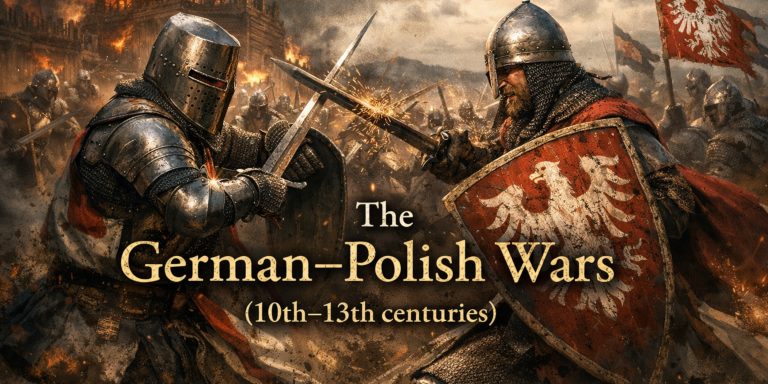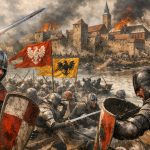
The Battle of Krosno Odrzańskie, fought in August 1015, was one of the defining clashes of the long and bitter struggle between the Polish ruler Bolesław I Chrobry, better known as Bolesław the Brave, and the Holy Roman Emperor Henry II. At first glance it appears to be a straightforward German victory. Henry crossed the Oder, drove back the Polish defenders and forced open the frontier.
Yet medieval warfare has a habit of making fools of anyone who celebrates too early.
Within days, Henry’s campaign began to unravel. His allies drifted away, his army was exposed deep in hostile territory and the Germans soon found themselves retreating from a victory that had brought them remarkably little. Krosno Odrzańskie therefore stands as one of those awkward triumphs in military history: successful on the battlefield, disappointing everywhere else.
Background
The battle took place during the German-Polish War of 1002-1018. By 1015 the conflict had already dragged on for more than a decade. Bolesław the Brave had taken advantage of turmoil within the Holy Roman Empire after the death of Emperor Otto III, seizing territory in Lusatia, Meissen and Bohemia.
Henry II spent years trying to reverse these gains. He was persistent, capable and not especially charming, which in fairness was a common quality among medieval rulers. Bolesław, meanwhile, was one of the most formidable princes in Europe. He had a talent for war, diplomacy and surviving impossible situations.
In the summer of 1015 Henry launched a major invasion of Poland. His aim was to cross the Oder near Krosno Odrzańskie and force his way into the Polish heartland. Bolesław entrusted the defence of the crossing to his son, Mieszko, later King Mieszko II.
The Oder crossing at Krosno mattered enormously. Whoever held it controlled one of the easiest routes into western Poland. The town itself stood at the junction of the Oder and Bóbr rivers, surrounded by marshes, woodland and riverbanks that made movement difficult.
A medieval commander looking at the landscape would have seen an obvious conclusion: if there was going to be a battle, it would happen at the crossing.
Forces
Precise numbers are impossible to establish. Medieval chroniclers were fond of inflating armies until they sounded less like armies and more like migrating populations. Modern historians generally agree that Henry II commanded the larger force.
| Side | Estimated Strength | Composition |
|---|---|---|
| Duchy of Poland | 5,000 to 8,000 | Polish infantry, shield-wall troops, mounted retainers, archers and local levies |
| Holy Roman Empire | 10,000 to 15,000 | German heavy cavalry, Saxon infantry, armoured retainers, engineers and allied contingents |
Polish Forces
The Polish army was primarily defensive in character.
- Infantry guarded the riverbank and likely occupied earthworks or timber fortifications.
- Archers and javelin-men covered likely crossing points.
- Mounted warriors were held back for counter-attacks.
- Scouts watched the river and surrounding woodland.
Imperial Forces
Henry II’s army was larger and more varied.
- Heavy cavalry formed the elite striking force.
- Saxon and Franconian infantry supported the crossing.
- Engineers and labourers built bridges and boats.
- Allied troops from Saxony and the Veleti accompanied the army.
The Germans also enjoyed a considerable advantage in siege and river-crossing equipment. Henry had learned from earlier campaigns and came prepared with prefabricated materials for bridges and pontoons. Medieval logistics rarely sound exciting, but in this case a pile of timber and rope mattered almost as much as the knights.
Leaders and Troop Composition
| Side | Leader | Role | Troop Composition |
| Duchy of Poland | Bolesław I Chrobry | Supreme commander, not present at every stage of the battle | Directed the wider campaign and entrusted defence to his son |
| Duchy of Poland | Mieszko, son of Bolesław | Commander at Krosno Odrzańskie | Infantry, mounted retainers, local levies |
| Holy Roman Empire | Henry II | Emperor and overall commander | Heavy cavalry, infantry, engineers and allied forces |
| Holy Roman Empire | Saxon nobles and imperial retainers | Sub-commanders during the crossing | Armoured knights and supporting infantry |
Mieszko’s task was difficult. He needed to prevent Henry from crossing the Oder while also guarding against the possibility of a flank attack further upstream or downstream. Henry exploited precisely this weakness.
Arms and Armour
The battle was fought at a moment when European warfare was changing. Mail armour was becoming more common among elites, cavalry was growing in importance and swords had begun to evolve into the broad, straight knightly weapons associated with the eleventh century.
| Weapon Type | Used By | Description |
| Spear | Both sides | The principal battlefield weapon, used by infantry and cavalry alike |
| Sword | Both sides | Sidearm and status symbol for nobles and professional warriors |
| Axe | Polish infantry and some German troops | Effective in close fighting and against shields |
| Bow and Javelin | Primarily Polish defenders | Used to harass river crossings |
| Shield | Both sides | Round or kite-shaped, often reinforced with iron bosses |
Sword Types Used
Although surviving evidence is limited, the swords used at Krosno Odrzańskie were probably early medieval blades of the Petersen and early Oakeshott traditions.
- Polish nobles likely carried broad, straight double-edged swords resembling Petersen Type X or Type S weapons.
- German cavalry increasingly favoured longer, slightly broader swords that would later evolve into Oakeshott Type X knightly swords.
- Wealthier warriors may have carried pattern-welded blades, though by 1015 many swords were made from more advanced homogeneous steel.
These were not elegant duelling weapons. They were hefty, practical blades designed for hacking at shields, mail and any unfortunate soul who happened to be standing too close.
Polish Arms and Armour
- Mail shirts for nobles and elite retainers
- Conical helmets with nasal guards
- Round shields with painted designs
- Spears, axes and swords
- Some light cavalry with throwing spears
Imperial Arms and Armour
- Heavy mail hauberks
- Early kite shields, particularly among mounted troops
- Iron helmets with nasal guards
- Lances and swords for cavalry
- Larger numbers of professional armoured retainers
The imperial cavalry had a clear advantage in open ground. Fortunately for the Poles, the marshes and riverbanks around Krosno offered very little open ground at all.
The Battle
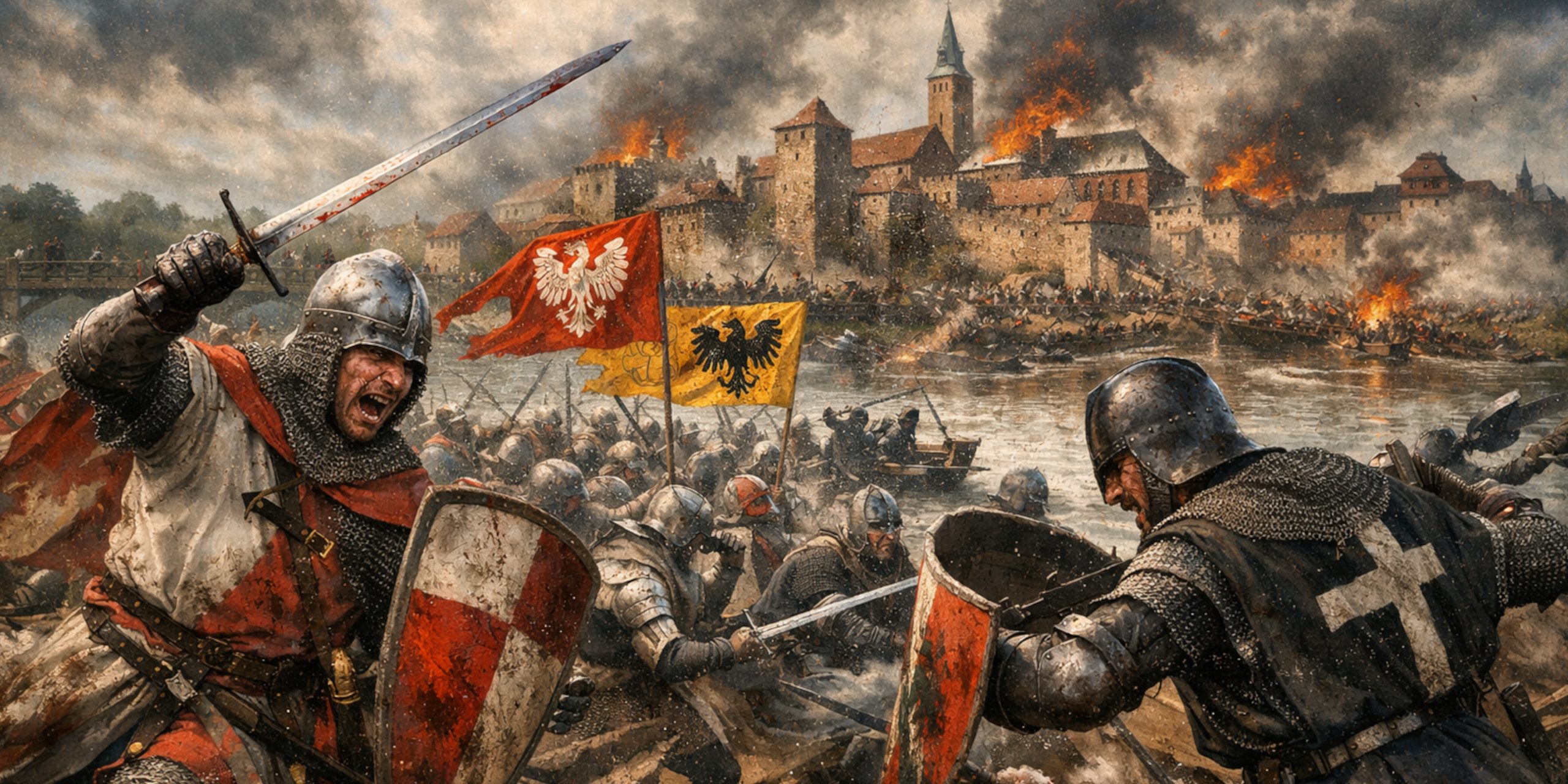
Henry II approached the Oder in late July or early August 1015. Mieszko’s men blocked the crossing near Krosno Odrzańskie, using the river itself as a defensive barrier.
For several days the Germans prepared boats and bridge materials. The Polish defenders watched the main crossing point carefully, expecting the imperial army to attempt a direct assault.
That expectation turned out to be exactly what Henry wanted.
While the Poles focused on the visible preparations, Henry secretly sent part of his force to cross the river elsewhere. Once a bridgehead had been established on the Polish side, the emperor ordered a frontal crossing at Krosno itself.
Mieszko was caught in an awkward position. If he stayed where he was, he risked being surrounded. If he withdrew, Henry would cross unopposed.
He chose to retreat.
The imperial army broke through the Polish line on 3 August 1015. German chroniclers celebrated the victory, and on a purely tactical level they were right to do so. Henry had achieved what he set out to do: he crossed the Oder and forced the defenders back.
Yet the victory was incomplete. The Polish army escaped intact, the terrain slowed the German advance and Henry soon discovered that winning a river crossing is not quite the same thing as winning a war.
Battle Timeline
| Date | Event |
| Late July 1015 | Henry II advances towards the Oder crossing at Krosno Odrzańskie |
| Early August 1015 | Polish forces under Mieszko take up defensive positions along the river |
| Several days before 3 August | German engineers construct boats and bridge materials |
| Night before the battle | Henry sends troops to cross at an alternative point on the river |
| 3 August 1015 | Main German assault begins at Krosno Odrzańskie |
| 3 August 1015 | Polish defenders withdraw to avoid encirclement |
| Days after the battle | Henry advances further into Poland but loses support from allies |
| Later in August 1015 | German army begins retreat and is later harried by Polish forces |
Aftermath
Krosno Odrzańskie gave Henry II a battlefield success but not a strategic breakthrough.
His allies soon melted away. The Saxons and Veleti had little interest in marching deeper into Poland once there was plunder to carry home. A separate Bohemian attack failed after Moravian resistance blocked its advance.
Henry suddenly found himself inside hostile territory with a tired army and fewer allies than he had expected.
Bolesław, who had wisely avoided risking everything at the river, now regained the initiative. The Germans eventually retreated and suffered further losses during the withdrawal, particularly in the fighting in the land of the Dziadoszanie.
The wider war continued until the Peace of Bautzen in 1018, which largely favoured Poland.
So Krosno Odrzańskie became one of those battles that historians quietly enjoy because it refuses to behave neatly. The Germans won, except they did not really profit from it. The Poles lost, except they remained in a stronger strategic position by the end of the campaign.
That sort of contradiction is medieval warfare in its purest form.
Archaeology
Archaeological evidence from Krosno Odrzańskie and the surrounding Oder valley has revealed just how important the site was in the early medieval period.
Excavations have uncovered:
- Remains of an early Piast stronghold.
- Timber fortifications and defensive earthworks.
- Traces of river crossings and bridge structures.
- Weapons fragments, including spearheads, arrowheads and axe heads.
- Evidence of settlement destruction and rebuilding in the eleventh century.
Recent archaeological work around the Oder has also suggested the existence of multiple medieval crossing points and bridge lines near Krosno. This supports the written accounts that Henry II may have used an alternative crossing to outflank the Polish defenders.
The strongest surviving evidence comes not from swords or armour but from the geography itself. The rivers, marshes and narrow crossing points still explain the battle better than any chronicler.
Standing near the Oder today, it is easy to understand why both armies converged there. It is also easy to understand why the men involved probably spent much of the battle knee-deep in mud, regretting several of their life choices.
Contemporary Quotes
The most important source for the battle is Thietmar of Merseburg, a German bishop and chronicler who was broadly sympathetic to Henry II.
“The king crossed the Oder after overcoming the resistance of the enemy.”
“Mieszko withdrew his forces, fearing that he would be surrounded.”
Thietmar also complained that the emperor failed to destroy the retreating Polish army, which reveals rather neatly that even Henry’s supporters felt the victory should have achieved more.
A later Polish tradition presented the campaign rather differently, emphasising that Bolesław and Mieszko preserved their forces and eventually forced Henry to withdraw.
Why the Battle remains important
The Battle of Krosno Odrzańskie mattered because it demonstrated several enduring truths about medieval warfare:
- River crossings were often more important than pitched battles.
- Terrain could neutralise superior numbers.
- Tactical victory did not guarantee strategic success.
- Bolesław the Brave remained one of the most dangerous rulers in Europe.
It also marked one of the earliest major military roles played by Mieszko II, who would later inherit the Polish crown.
For Henry II, the battle proved that he could outmanoeuvre the Poles at the Oder. Unfortunately for him, crossing the river was the easy part. Staying in Poland was another matter entirely.
Further Reading
- Thietmar of Merseburg, Chronicon
- Jerzy Wyrozumski, Dzieje Polski Piastowskiej
- Karol Olejnik, Cedynia, Niemcza, Głogów, Krzyszków
- Gerard Labuda, Bolesław Chrobry
- Przemysław Urbańczyk, Bolesław Chrobry: Lew Ryczący