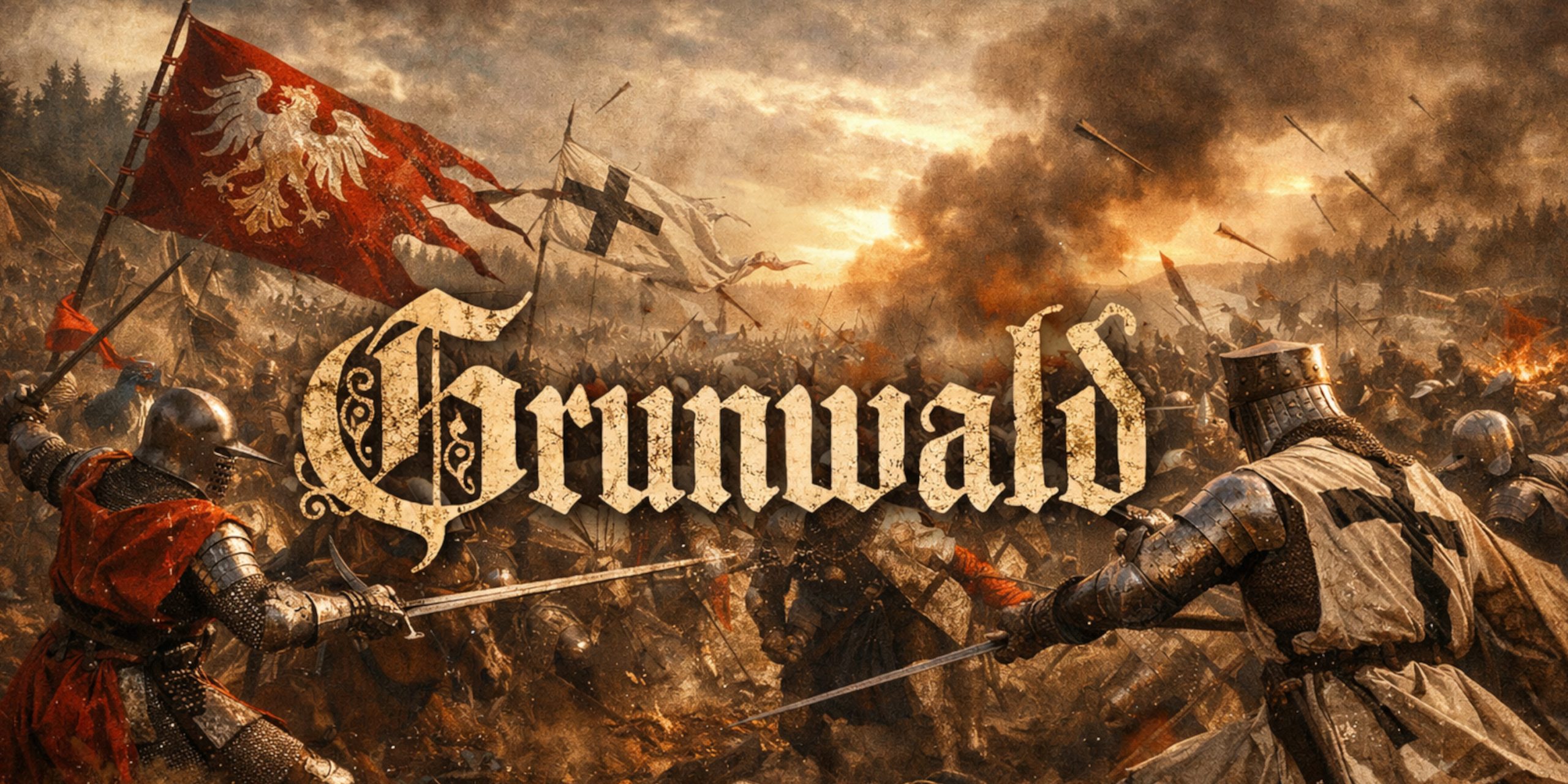
On 15 July 1410, near the villages of Grunwald, Tannenberg and Ludwigsdorf, one of medieval Europe’s largest and most consequential battles unfolded. The clash between the Kingdom of Poland, the Grand Duchy of Lithuania, and the Teutonic Order was not merely a contest of arms. It was a reckoning.
The defeat of the Teutonic Knights shattered the aura of invincibility they had cultivated for generations. It altered the balance of power in the Baltic and marked the beginning of a slow but irreversible decline for the Order. As a historian, I find Grunwald fascinating not just for its scale, but for its human drama. Pride, ritual, religious conviction, political calculation and battlefield improvisation all collided under a blazing summer sun.
Background to the Conflict
The roots of the battle lay in long running tensions between the Teutonic Order and the Polish Lithuanian union. The Christianisation of Lithuania removed the Order’s ideological justification for crusade, yet territorial disputes in Samogitia and control of Baltic trade routes remained unresolved.
In 1386, the Union of Krewo united Poland and Lithuania through the marriage of Jogaila, King of Poland, and Vytautas, Grand Duke of Lithuania. This was a political earthquake. The Teutonic Order suddenly faced a powerful consolidated neighbour rather than fragmented rivals.
By 1409, rebellion in Samogitia and diplomatic breakdown led to open war. Both sides prepared meticulously. Neither expected the scale of what was coming.
Forces at Grunwald
Estimates vary, but most scholars place total numbers between 30,000 and 50,000 men.
Polish Lithuanian Coalition
| Component | Estimated Strength | Notes |
|---|---|---|
| Polish Crown forces | 15,000 to 20,000 | Heavy cavalry dominant |
| Lithuanian forces | 10,000 to 12,000 | Included Ruthenian contingents |
| Tatar light cavalry | 1,000 to 2,000 | Highly mobile |
| Allied mercenaries | Several thousand | Bohemians, Moravians and others |
Principal Leaders
- King Władysław II Jagiełło
- Grand Duke Vytautas
- Zyndram of Maszkowice
Teutonic Order
| Component | Estimated Strength | Notes |
|---|---|---|
| Teutonic Knights | 12,000 to 15,000 | Elite heavy cavalry core |
| German crusaders | Several thousand | Volunteers from across Europe |
| Infantry and crossbowmen | Several thousand | Professional and levy troops |
Principal Leaders
- Grand Master Ulrich von Jungingen
- Grand Marshal Friedrich von Wallenrode
- Grand Komtur Kuno von Lichtenstein
The Order’s army was smaller but tightly organised and heavily armoured. Their confidence was legendary. One might say overconfident.
Arms and Armour
Grunwald was a meeting point of western chivalric warfare and eastern mobility.
Polish Heavy Cavalry
- Longswords of Oakeshott Type XV and XVIII forms
- Lances with pennons
- Maces and war hammers
- Plate armour with mail voiders
- Great helms and bascinets with visors
Polish knights were well equipped, drawing on western European styles. Their swords were optimised for thrusting against armour, reflecting late medieval battlefield realities.
Lithuanian and Ruthenian Forces
- Sabres influenced by eastern steppe traditions
- Spears and lighter lances
- Lamellar or partial plate armour
- Open faced helmets
Lithuanian contingents blended western and eastern techniques. Their lighter equipment allowed manoeuvre, particularly in the early phases of battle.
Tatar Cavalry
- Composite bows
- Curved sabres
- Minimal armour
Their role was harassment and mobility, not shock combat.
Teutonic Knights
- High quality longswords
- Heavy lances
- Poleaxes and maces
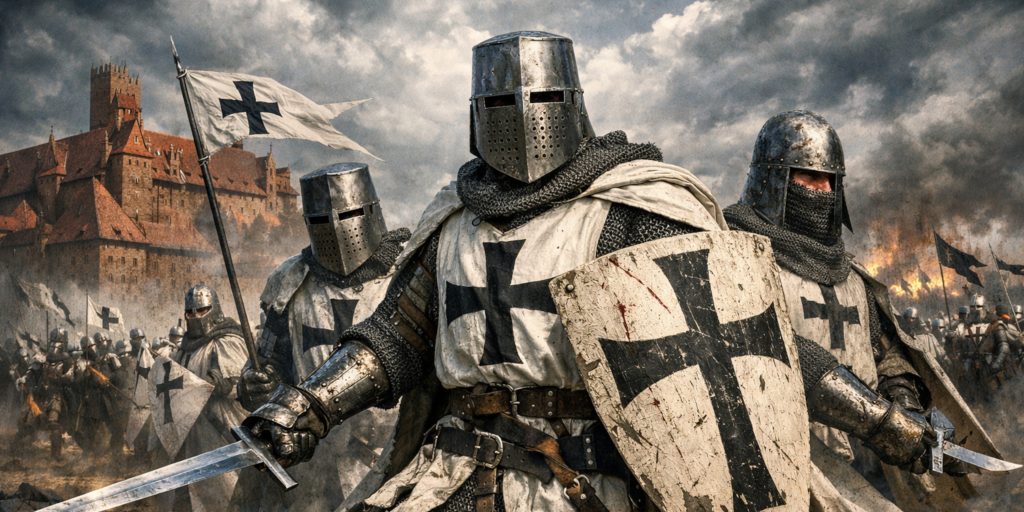
- Full plate harness with surcoats bearing the black cross
- Bascinets and great helms
The Teutonic Order represented the height of western heavy cavalry doctrine. Their equipment was uniform, disciplined, and visually imposing. They looked invincible. On this field, appearances deceived.
The Battle Timeline
Morning, 15 July 1410
Both armies deploy. The Teutonic line forms with artillery pieces positioned forward. The heat is intense.
Late Morning
The Lithuanian wing advances. A fierce cavalry engagement develops.
Midday
Lithuanian forces begin to withdraw. Whether this was feigned retreat or genuine collapse remains debated. The Order pursues aggressively.
Early Afternoon
Polish forces engage the Teutonic centre in brutal hand to hand fighting. Banners fall and are raised again.
Later Afternoon
Grand Master Ulrich von Jungingen leads a direct assault toward the Polish king’s position. He is killed in the melee.
Late Afternoon
The Teutonic line disintegrates. Surrounded and exhausted, many knights are slain or captured.
The death of the Grand Master marked the psychological breaking point. Once command cohesion faltered, the Order’s disciplined structure collapsed into chaos.
Contemporary Voices
The chronicler Jan Długosz later wrote:
“Never before had so many noble and distinguished men been brought low in one place.”
A Teutonic source lamented:
“The flower of knighthood fell beneath the heathen sword.”
That last line reflects the Order’s enduring refusal to see Lithuania as fully Christian, even after decades of change. Ideology has a long afterlife.
Archaeology of the Battlefield
For centuries, the precise battlefield location was debated. Modern archaeological surveys near Grunwald have uncovered:
- Arrowheads and crossbow bolts
- Spur fragments
- Broken sword blades
- Elements of plate armour
- Mass graves containing multiple individuals
Metal detecting surveys in the early twenty first century dramatically increased artefact recovery. Distribution patterns suggest intense fighting zones and confirm accounts of chaotic pursuit phases.
The material record supports the written sources in one respect above all. The fighting was close, brutal, and prolonged. This was not a tidy cavalry clash. It was attritional and savage.
Why Grunwald still Resonates
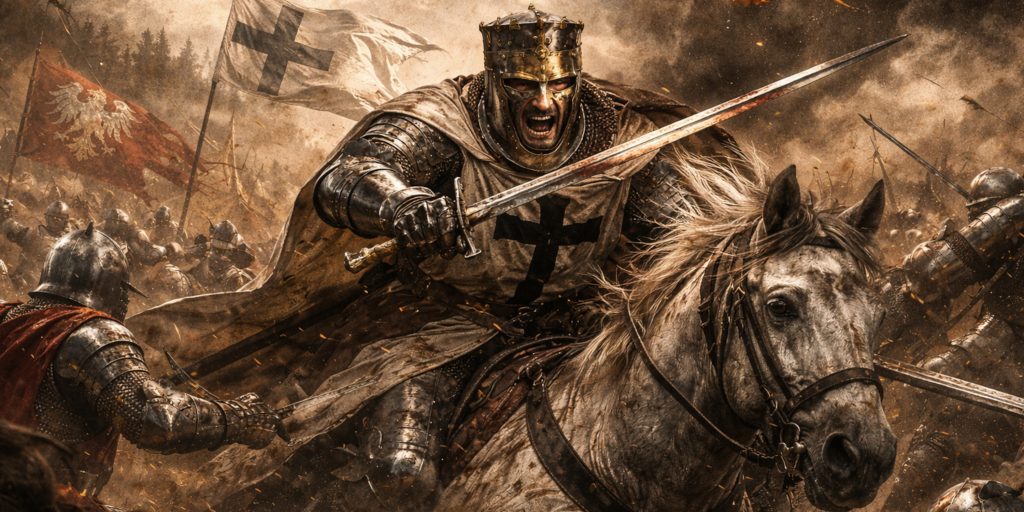
The immediate aftermath did not see the destruction of the Teutonic Order, but it broke their military prestige. The Peace of Thorn in 1411 imposed financial strain and territorial concessions.
In the longer term, Grunwald strengthened the Polish Lithuanian union and reshaped Baltic politics. It marked the beginning of the Order’s gradual decline and the rise of a regional power bloc that would influence central and eastern Europe for centuries.
As a historian, I am always cautious about declaring turning points. Yet Grunwald earns the label. It was not merely a victory. It was a demonstration that crusading states built on martial myth could bleed like any other polity.
Takeaway
The Battle of Grunwald remains one of medieval Europe’s defining clashes. It combined chivalric spectacle with political calculation and tactical improvisation. It reminds us that confidence can shade into arrogance, and that even the most formidable institutions are vulnerable when strategy falters.
In the summer heat of 1410, beneath banners stitched with crosses and eagles, an era shifted. The swords did their work. The consequences endured.
Watch the documentary: