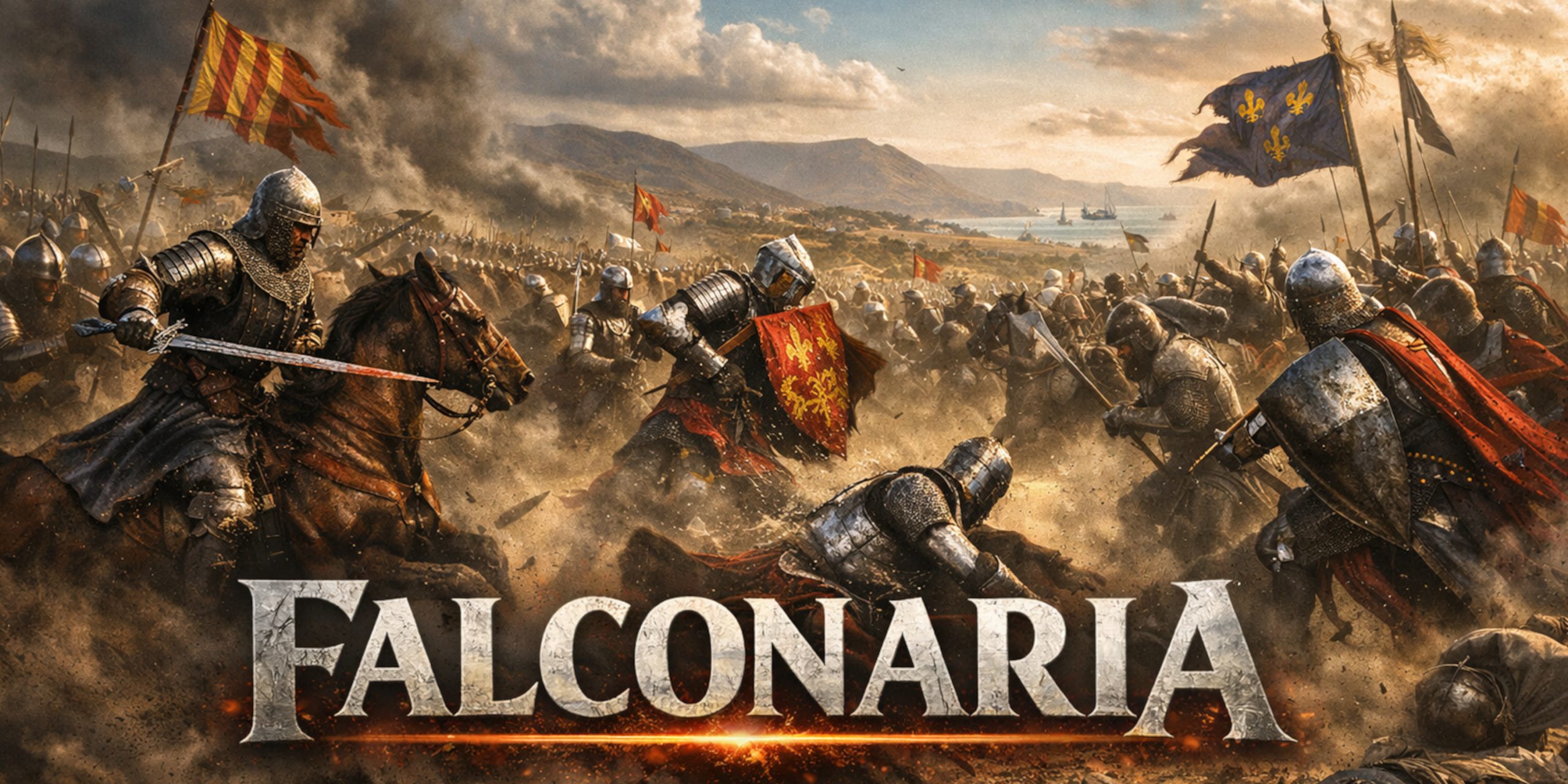
The Battle of Falconaria, fought on 1 December 1299 near the town of Falconara in western Sicily, sits quietly among the many clashes of the War of the Sicilian Vespers. Quietly, that is, until one notices the rather dramatic outcome. A king was captured, a rebellion held its ground, and the Angevin dream of reclaiming Sicily took another bruising blow.
The battle pitted Frederick III of Sicily against the forces of Philip I of Taranto, son of Charles II of Naples. On paper, Frederick’s position was precarious. Sicily had been in revolt against Angevin rule since 1282, and the island faced constant attempts at reconquest. Yet the young Sicilian king proved stubborn, resourceful, and rather fond of turning bad odds into victories.
Falconaria became one of the most decisive moments of that conflict. In the dust of the Sicilian plain, Frederick’s army shattered an Angevin expedition and captured its commander. Medieval warfare is rarely neat, but this was about as decisive as one could reasonably hope.
Background
The War of the Sicilian Vespers had begun nearly two decades earlier when Sicilians rose against Angevin rule in a violent uprising. The revolt quickly escalated into a Mediterranean struggle involving the Crown of Aragon, the Kingdom of Naples, and various Italian powers.
By the late 1290s the situation remained unresolved. Sicily was ruled by Frederick III, brother of James II of Aragon, but the Papacy and the Angevins still claimed the island.
Philip of Taranto launched a campaign intended to break Sicilian resistance. His aim was simple. Defeat Frederick in the field and force the island back under Angevin control.
Frederick had other ideas.
Forces
Precise numbers are uncertain, as medieval chroniclers often preferred enthusiasm to arithmetic. Most historians estimate that both armies were modest in size but composed of experienced troops.
| Army | Estimated Strength | Composition |
|---|---|---|
| Kingdom of Sicily | 3,000 to 4,000 | Sicilian infantry, Aragonese knights, light cavalry |
| Angevin Kingdom of Naples | 4,000 to 5,000 | French knights, Italian infantry, cavalry contingents |
The Angevin army likely held the numerical advantage, particularly in heavy cavalry. That advantage would soon prove rather theoretical.
Leaders
Kingdom of Sicily
- Frederick III of Sicily – King and overall commander
- Blasco d’Alagona – Senior Sicilian noble and field commander
- Sancho of Aragon – Knightly leader among the Aragonese contingent
Angevin Forces
- Philip I of Taranto – Prince of Taranto and Angevin commander
- Angevin baronial captains – Various Neapolitan and French nobles
Philip commanded a force rich in aristocratic cavalry. Unfortunately for him, medieval aristocrats were not always keen on restraint once the charge began.
Arms and Armour
The battle reflected the military equipment common across southern Europe at the close of the thirteenth century.
Sicilian and Aragonese Equipment
- Arming swords of straight double edged design
- Falchions and broad cutting blades used by infantry
- Lances carried by mounted knights
- Round or heater shields
- Mail hauberks with padded gambesons beneath
- Open faced helmets and early bascinets
The arming sword, similar to Oakeshott Type XII forms, was the most common knightly sidearm. Its broad blade allowed effective cutting from horseback.
Angevin Equipment
- Knightly arming swords
- Long cavalry lances
- Heavy kite and heater shields
- Mail armour reinforced with plates in some cases
- Great helms worn by elite cavalry
The Angevin knights were heavily equipped shock troops. When properly organised they could break infantry formations with terrifying speed. When poorly coordinated they could also become isolated targets.
Falconaria showed both possibilities.
The Battlefield
Falconara lies on a relatively open plain near the Sicilian coast. The terrain provided good ground for cavalry manoeuvre, though broken patches of farmland and low rises disrupted formations.
Frederick used the landscape carefully. He positioned his infantry to absorb the initial charge while keeping reserves ready to exploit disorder.
This was not the sort of terrain where a single glorious charge would neatly settle matters.
Battle Timeline
Morning, 1 December 1299
The two armies approached one another near Falconara. Both commanders deployed with cavalry wings and infantry centres, a fairly standard arrangement.
Frederick kept his forces compact. Philip appeared eager to engage quickly.
Early Engagement
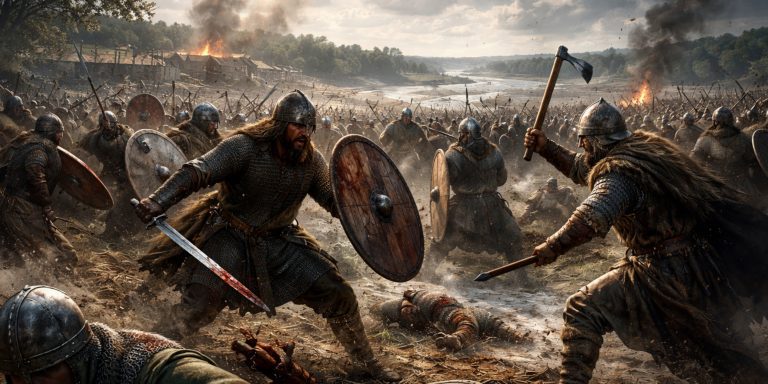
The Angevin cavalry launched an aggressive attack. Their initial charge struck the Sicilian lines with force, driving back some infantry.
For a moment the Angevin advance looked promising.
Sicilian Counterattack
Frederick’s reserves moved in as Angevin cavalry became scattered after their charge. Sicilian troops pressed the disordered knights from multiple directions.
Close fighting followed across the field. Lances broke, swords took their place.
Collapse of the Angevin Line
Once the Angevin cavalry lost formation the battle shifted quickly. Sicilian forces began surrounding isolated groups of knights.
Philip of Taranto was unhorsed and captured during the fighting.
Capturing the enemy commander tends to have a certain effect on morale.
Afternoon
With their leader taken prisoner, Angevin resistance collapsed. Survivors retreated toward the coast or attempted to escape inland.
Frederick held the field.
Archaeology
Archaeological work in the Falconara region has uncovered scattered artefacts consistent with late medieval conflict.
Finds include:
- Fragments of mail armour rings
- Iron lance heads
- Arrowheads typical of thirteenth century warfare
- Horse fittings and buckles
While no large battlefield excavation has been conducted, these discoveries support the historical accounts of mounted combat in the area.
Medieval battlefields often leave surprisingly light traces. Armour was valuable and quickly salvaged after fighting ended. The scavengers of the thirteenth century were nothing if not efficient.
Contemporary Accounts
Several chronicles describe the battle, though details vary.
The Chronicle of the Sicilian Vespers records the moment Philip was captured:
“The prince of Taranto, surrounded on every side, was taken by the men of the king.”
Another account highlights Frederick’s leadership:
“King Frederick stood firm among his knights, and by his courage the enemy was overcome.”
Medieval chroniclers tended to favour dramatic language. To be fair, capturing an opposing prince does provide material for drama.
Consequences
The victory at Falconaria strengthened Frederick’s hold on Sicily. The capture of Philip of Taranto was both a military and political triumph.
Key outcomes included:
- Angevin invasion plans suffered a serious setback
- Sicilian morale improved considerably
- Frederick’s legitimacy as king gained greater support
The broader conflict dragged on for years, as medieval wars often did, but Falconaria demonstrated that the Sicilian kingdom was far from easy prey.
Legacy
The Battle of Falconaria rarely receives the attention given to larger medieval battles, yet its importance within Sicilian history is clear.
Frederick III proved he could defeat Angevin forces in open battle and capture one of their senior princes in the process. That achievement strengthened Sicilian independence during a period when external pressure remained constant.
Historians sometimes overlook such engagements because the armies were not enormous and the political map of Europe did not immediately change.
Yet for Sicily the result mattered greatly. Frederick kept his crown, and the island remained stubbornly outside Angevin control.
For a small kingdom facing a powerful rival, that counts as a very respectable day’s work.