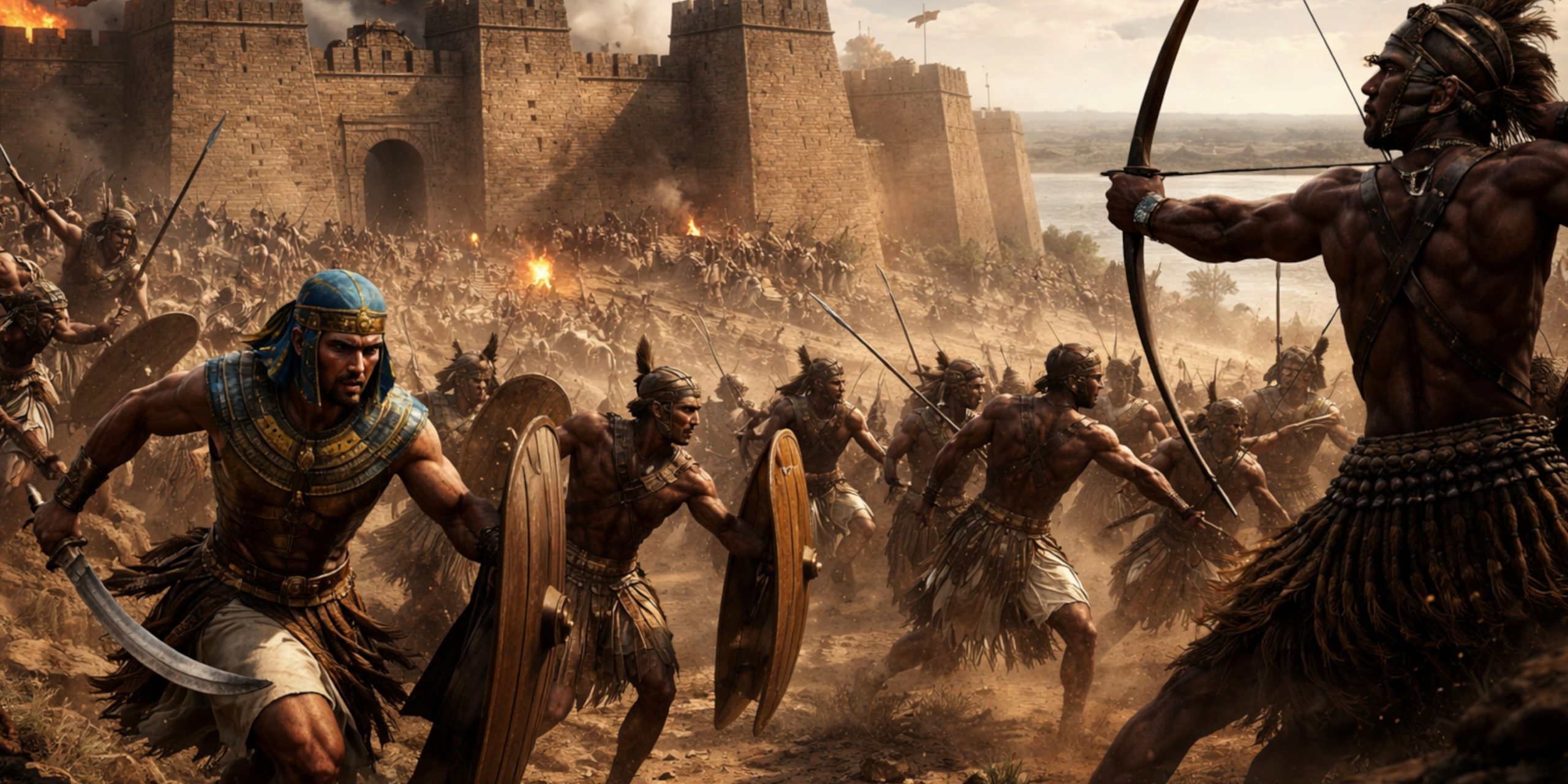
The Battle of Buhen was fought during the reign of Senusret III, whose southern campaigns were not romantic adventures. They were administrative violence, intended to stabilise borders, intimidate Nubian polities, and ensure gold, cattle, and manpower continued to flow north. Buhen was the hard edge of that policy, a fortress that expected trouble and usually got it.
Strategic background
Buhen sat where the Nile narrows, twists, and misbehaves. Cataracts slow boats, force portage, and funnel traffic. For Egypt, this meant opportunity and anxiety in equal measure. Nubian groups had long traded with Egypt, fought it, worked for it, and occasionally reminded it that southern neighbours were not decorative.
By the Middle Kingdom, Egypt responded by building a chain of fortresses. Buhen was the largest and most heavily defended of them. Conflict here was rarely about glory. It was about preventing raids, enforcing taxation, and making a very visible point about who was in charge of the river.
Forces
The engagements at Buhen were not pitched battles in the later classical sense. They were sieges, skirmishes, and sharp encounters between garrison troops and Nubian warriors testing the walls.
Egyptian forces
| Element | Details |
|---|---|
| Core troops | Professional infantry from Upper Egypt |
| Command | Royal officials acting under pharaonic authority |
| Numbers | Several hundred within the garrison, reinforced during campaigns |
| Support | Archers, engineers, scribes, supply personnel |
Nubian forces
| Element | Details |
|---|---|
| Core troops | Local warriors from Lower Nubia |
| Command | Tribal or regional leaders |
| Numbers | Variable, often smaller but mobile |
| Support | Archers, scouts, raiding parties |
Egyptian strength lay in organisation and fortifications. Nubian strength lay in speed, local knowledge, and marksmanship. It was not an even match, which is precisely why Egypt invested so heavily in stone walls.
Leaders
Egyptian command
Senusret III looms over any discussion of Buhen, even if he was not personally present at every clash. His reign formalised the southern border and turned Nubia into a managed frontier rather than a vague concern.
Below him were military officials and fortress commanders. Their names survive only sporadically, which feels appropriate. These were men whose success was measured by silence on the frontier.
Nubian leadership
Nubian leaders remain largely anonymous in Egyptian records, which is more about Egyptian record keeping than Nubian insignificance. Archaeology and later texts suggest organised resistance rather than random banditry, with leaders capable of coordinating raids and probing attacks.
Arms and armour
The fighting around Buhen shows a clear contrast in military culture, and the archaeology is unusually generous.
Egyptian equipment
| Item | Description |
|---|---|
| Sword | Straight bronze short sword, often leaf shaped |
| Dagger | Copper or bronze, riveted tang |
| Spear | Wooden shaft with copper or bronze head |
| Bow | Composite bow for garrison archers |
| Shield | Wooden, leather faced |
| Armour | Linen body armour for officers |
Nubian equipment
| Item | Description |
|---|---|
| Sword | Short stabbing swords and long daggers |
| Spear | Lightweight spears suited to skirmishing |
| Bow | Powerful self bows, highly accurate |
| Shield | Hide shields |
| Armour | Minimal, prioritising mobility |
The Egyptian sword was not elegant, but it was reliable. Nubian bows, by contrast, earned a reputation that made even confident Egyptian soldiers wary. Being behind a wall helps with that sort of anxiety.
The fighting
Conflict at Buhen usually followed a familiar rhythm. Nubian forces tested patrols and supply lines. Egyptian garrisons responded with sorties, reinforcements, or punitive expeditions upriver. When pressure increased, Egypt escalated with full campaigns, often led or sanctioned directly by the pharaoh.
Walls mattered. Buhen’s massive mudbrick and stone defences, towers, and ditches turned many confrontations into contests of endurance rather than courage. The goal was deterrence, not annihilation. Everyone involved understood that tomorrow’s trade might depend on today’s restraint.
Battle timeline
- Initial Nubian raids on river traffic and outlying patrols
- Egyptian reinforcement of the Buhen garrison
- Skirmishes near the fortress approaches and riverbanks
- Egyptian counter raids into Nubian territory
- Reassertion of control and rebuilding of damaged defences
This pattern repeated often enough to feel routine. That does not make it peaceful. It makes it bureaucratic.
Archaeology
Buhen is one of the best excavated military sites in ancient Egypt. Excavations revealed walls over five metres thick, bastions, barracks, granaries, and workshops. Weapons found on site include spearheads, arrowheads, daggers, and fragments of swords.
The fortress was later dismantled and relocated during the construction of the Aswan High Dam. That act alone tells you how solid it was. You do not move a fortress unless it has already proved its worth.
Contemporary quotes
Direct battlefield commentary is rare, but royal inscriptions are revealing in tone if not detail. One Middle Kingdom text attributed to Senusret III states:
“I have made my boundary further south than my fathers, I have added to what was bequeathed to me.”
Another inscription, less poetic but more honest, notes that Nubians were “not to be trusted when water runs low”. Ancient prejudice, perhaps, but also a grudging admission that the southern frontier never slept.
Legacy
Buhen did its job. It stabilised Egypt’s southern border for generations and became a model for later frontier fortifications. It also reminds us that Egyptian power was not effortless. It required logistics, constant vigilance, and an acceptance that control was always temporary.
From a historian’s point of view, Buhen is refreshingly unromantic. No heroic last stands, no grand speeches, just mudbrick, bronze, and men doing unpleasant work in a very hot place. Dry humour aside, that may be closer to the truth of most ancient warfare than the epics ever managed.
Watch the documentary: