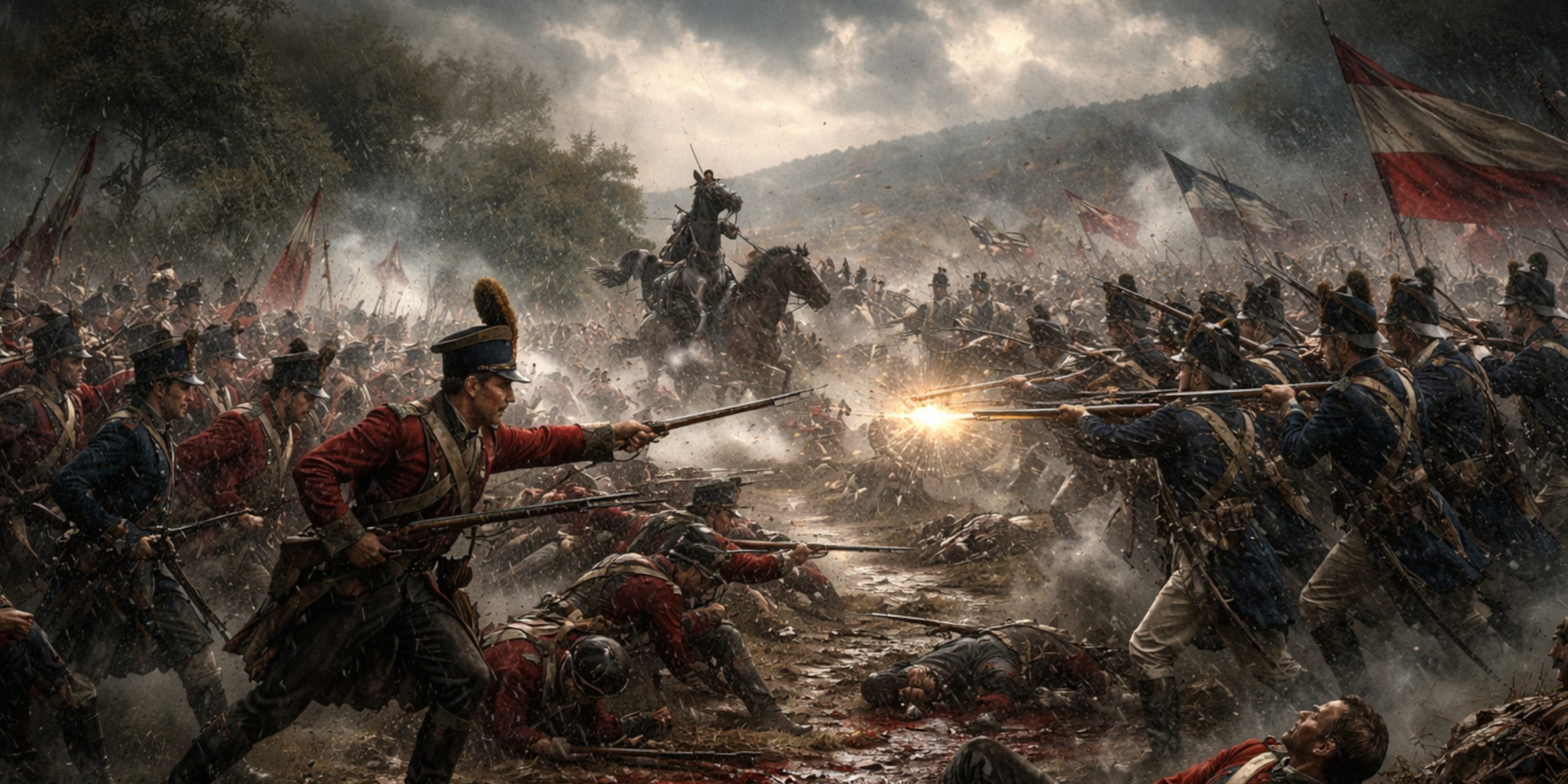
As a historian, I find Albuera unsettling. It lacks the clean drama of Austerlitz or Waterloo. Instead, it is a grinding struggle, soaked in rain and smoke, where units were nearly destroyed and yet somehow held. The result was technically an Allied victory. The cost was horrific.
Strategic Background
In 1811, the fortress city of Badajoz remained in French hands. The Allied army under Arthur Wellesley sought to reclaim it. While Wellington manoeuvred elsewhere, the siege was entrusted to Marshal William Beresford.
French Marshal Jean-de-Dieu Soult marched north with around 24,000 men to relieve Badajoz. The two forces met near the village of Albuera.
The battlefield was deceptively simple: low ridges, open fields, olive groves and a shallow stream. It offered little shelter. That mattered.
Forces
Overall Strength
| Army | Estimated Strength | Guns |
|---|---|---|
| Allied (British, Portuguese, Spanish) | 35,000 to 38,000 | 38 |
| French | 23,000 to 24,000 | 35 |
Casualties were savage.
| Army | Estimated Casualties |
|---|---|
| Allied | 5,900 to 6,000 |
| French | 5,500 to 7,000 |
For a battle of this size, those figures are staggering.
Leaders and Troop Composition
Allied Command
- Marshal William Beresford
- Lieutenant General Sir Lowry Cole
- Major General Daniel Houghton
- Spanish General Joaquín Blake
Composition:
- British infantry divisions
- Portuguese brigades trained along British lines
- Spanish infantry divisions
- Allied cavalry brigades
- Field artillery batteries
The British and Portuguese infantry were the backbone. The Spanish line, often criticised elsewhere, fought with unexpected resilience here.
French Command
- Marshal Jean-de-Dieu Soult
- General Honoré Gazan
- General François Girard
- French cavalry under Latour-Maubourg
Composition:
- Veteran French line infantry
- Polish Vistula Legion units
- French cavalry regiments
- Horse and foot artillery
Soult attempted a flanking attack against the Allied right, nearly succeeding.
Arms and Armour
Napoleonic warfare was dominated by smoothbore muskets and cold steel. At Albuera, close combat became unavoidable.
Allied Weapons
- Brown Bess flintlock musket
- Baker rifle in light companies
- Infantry hanger swords
- Heavy cavalry swords, notably the 1796 pattern heavy cavalry sword
- Artillery sabres
French Weapons
- Charleville 1777 pattern musket
- Sabres for infantry NCOs
- 1802 and 1803 pattern cavalry sabres
- Lances used by Polish units
Sword Types in Use
| Unit Type | Typical Sword |
|---|---|
| British Heavy Cavalry | 1796 Pattern Heavy Cavalry Sword |
| British Light Cavalry | 1796 Pattern Light Cavalry Sabre |
| French Cavalry | AN XI Cavalry Sabre |
| Polish Lancers | Lance with light sabre sidearm |
Armour was minimal. Metal helmets had largely disappeared from infantry use. Cavalry retained steel helmets and cuirasses in some French heavy regiments, though these were not universal at Albuera.
It was an age where cloth and courage were expected to stop iron.
The Battle Unfolds: Timeline
Early Morning
Soult advanced under cover of mist, initially feinting against the Allied centre. Beresford responded cautiously.
Mid Morning
The main French attack struck the Allied right flank. Spanish troops bore the brunt and held longer than expected.
Late Morning
British brigades under Houghton advanced to support the Spanish. They were caught in a storm of musket fire at close range. Casualties mounted at an appalling rate.
Midday
A torrential rainstorm drenched both sides. Visibility dropped. Musket smoke clung to the field.
Houghton was killed. His brigade suffered over fifty percent casualties. They did not break.
Early Afternoon
Cole’s division counterattacked, stabilising the line. French cavalry charges failed to exploit earlier gains.
Late Afternoon
Soult, judging his army too weakened to press further, withdrew.
The field belonged to the Allies. It felt hollow.
Contemporary Quotes
Napoleonic officers were not prone to understatement.
From a British officer:
“Another such battle will ruin us.”
From Marshal Soult:
“The English infantry is the devil.”
Wellington himself, upon hearing of the losses, reportedly remarked that it was the bloodiest action he had witnessed.
Archaeology of the Battlefield
The Albuera battlefield has yielded musket balls, buckles, fragments of uniform fittings and artillery roundshot. Modern metal detecting surveys have confirmed the intensity of fighting along the ridgelines where British and French infantry exchanged volleys at near point blank range.
Clusters of lead balls suggest sustained firefights rather than fleeting engagements. The ground itself still tells the story of men standing, loading, firing, and falling in place.
The village and surrounding landscape remain recognisable. Walking the field today, one is struck by how little cover there truly was. It explains much.
Tactical Analysis
Soult’s plan was intelligent. His flank attack nearly overwhelmed the Allied position. The Spanish line, often maligned in other campaigns, performed with determination.
Beresford’s leadership has been debated. He reacted slowly at first. Yet the Allied army held. That was no small achievement.
Albuera demonstrates a central truth of the Peninsular War. French tactical brilliance often met British and Allied stubbornness. When the latter refused to yield, the result was attrition on a horrifying scale.
Why Albuera Matters
The battle did not decisively end the siege of Badajoz. Yet it prevented Soult from relieving the fortress in that moment. It also reinforced the growing confidence of Allied troops.
More importantly, it revealed that French assaults could be endured and repelled. The psychological effect mattered.
It was not a glamorous victory. It was a costly lesson in endurance.
Seven Swords Takeaway
The Battle of Albuera stands as one of the bloodiest engagements of the Peninsular War. It lacks the grandeur of larger Napoleonic clashes, but in its grim determination it reveals something essential about the conflict.
Men held their ground because retreat was unthinkable. Brigades were shattered yet did not collapse. Soult withdrew not because he was routed, but because the price had become too high.
If one seeks heroism, it is here. If one seeks comfort, look elsewhere.