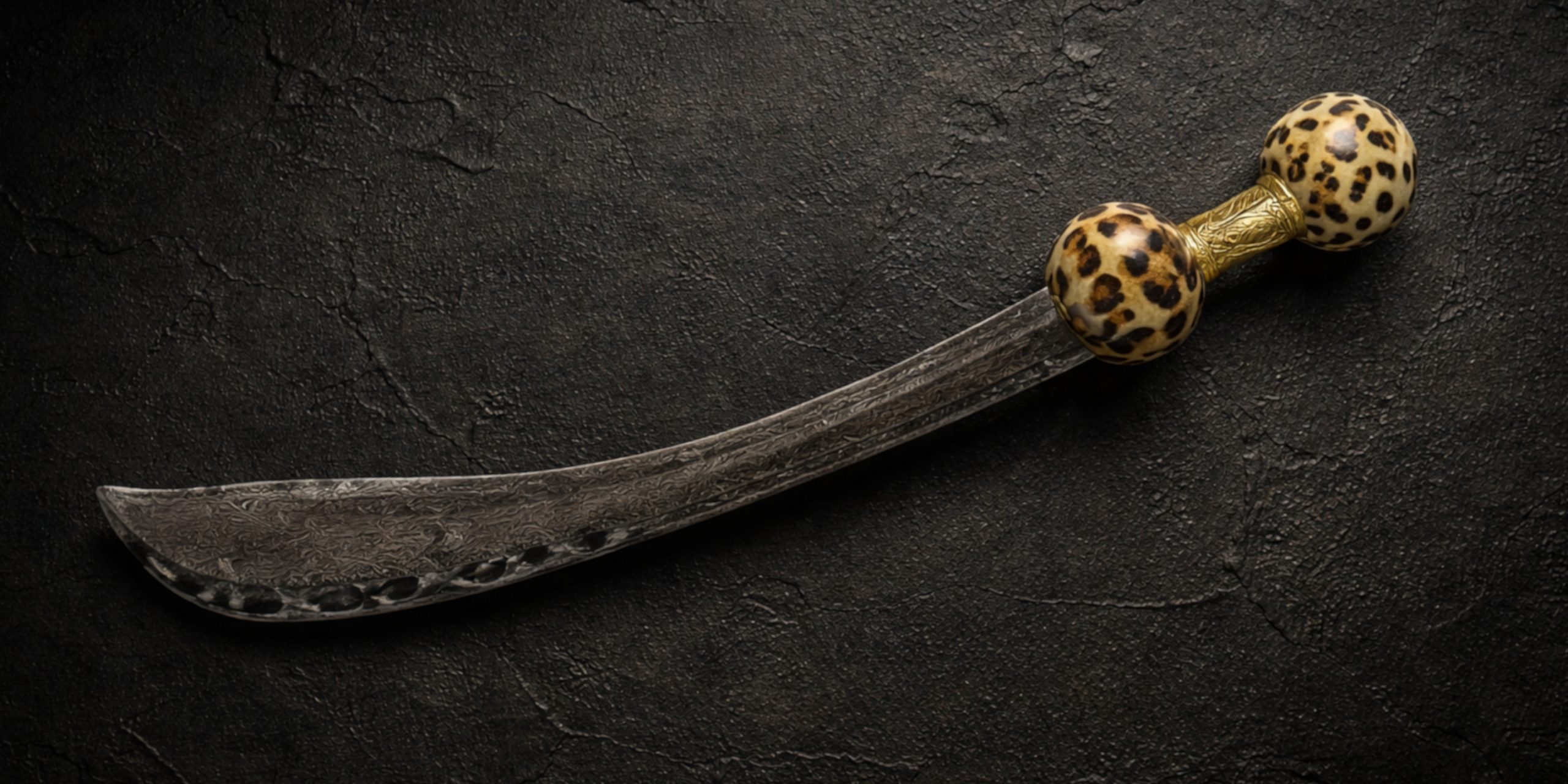
The Ashanti State Sword, commonly referred to as the Mponponsuo type, stands among the most symbolically charged weapons of pre colonial West Africa. Associated with the court of the Asantehene of the Ashanti Empire, it was less a battlefield implement and more a visible declaration of authority, lineage, and divine sanction.
In a culture where gold embodied the soul of the nation and regalia carried legal weight, the Mponponsuo was not simply carried, it was displayed, invoked, and in some cases sworn upon. To understand this sword is to understand how the Asante fused power, ritual, and artistry into a single object.
Specifications
While individual examples vary, surviving Mponponsuo swords share core design features that distinguish them from purely functional blades.
General Characteristics
| Feature | Typical Description |
|---|---|
| Type | Ceremonial state sword |
| Blade length | Approx. 40 to 60 cm |
| Blade form | Straight or slightly leaf shaped |
| Edge | Often double edged, sometimes blunt ceremonial edge |
| Hilt | Wood core, heavily clad in gold |
| Guard | Minimal crossguard or none |
| Pommel | Gold covered, sometimes globular or disc shaped |
| Decoration | Gold sheet, repoussé motifs, symbolic iconography |
Materials
- Iron or steel blade
- Wood grip core
- Hammered gold sheet covering hilt and fittings
- Occasional leather or fibre wrapping beneath gold
Gold was not ornamental excess. In Asante belief, it represented purity, permanence, and royal legitimacy.
History and Evolution
The Mponponsuo type emerged during the height of the Ashanti Empire between the seventeenth and nineteenth centuries. Asante military success against neighbouring states and later European coastal powers allowed the court to consolidate enormous wealth, much of it channelled into regalia.
Early Akan swords were practical cut and thrust weapons. As state structures strengthened under rulers such as Osei Tutu, court regalia evolved into a codified visual language. Swords began to function as:
- Symbols of office for court officials
- Objects used in oath taking ceremonies
- Insignia carried in processions
- Emblems of delegated royal authority
By the nineteenth century, certain sword types were reserved for specific officials. The Mponponsuo was associated with high ranking state functionaries and royal ceremonies. It was often present during assemblies where disputes were settled or decrees issued.
European accounts from the period describe glittering processions in Kumasi where gold sheathed swords caught the sun and projected the wealth of the kingdom as much as its power.
Advantages and Disadvantages
Although ceremonial, the sword retains the structural logic of a weapon. That duality defines both its strengths and limitations.
Advantages
- Strong symbolic authority within Asante political culture
- Compact and manageable proportions
- Gold hilt construction resistant to corrosion
- Blade capable of real cutting or thrusting if required
Disadvantages
- Heavy hilt due to gold cladding
- Balance often shifted toward the grip
- Decorative focus reduces battlefield practicality
- High value made it unsuitable for common military use
In essence, the Mponponsuo was a weapon by ancestry, but by maturity it was an instrument of theatre and governance.
Comparison With Similar Weapons
The Mponponsuo can be compared to other ceremonial swords across Africa and beyond.
| Weapon | Region | Function | Key Difference |
|---|---|---|---|
| Mponponsuo | Asante, Ghana | State regalia | Heavy gold hilt, Akan symbolism |
| Ethiopian Shotel | Ethiopia | Battlefield weapon | Deeply curved blade, combat focused |
| Sudanese Kaskara | Sudan | Combat and prestige | Long straight blade, less gold ornament |
| European Court Sword | France, Britain | Aristocratic dress weapon | Slim blade, emphasis on fashion not ritual |
Unlike the Ethiopian shotel or Sudanese kaskara, which retained primary battlefield roles, the Mponponsuo was embedded in ritual authority. Its closest conceptual parallel might be European coronation swords, though Asante symbolism is rooted in Akan cosmology rather than chivalric tradition.
Legacy
The fall of Kumasi to British forces in the nineteenth century and the subsequent incorporation of the region into colonial administration disrupted Asante sovereignty. Yet the symbolism of the Mponponsuo endured.
Today it represents:
- Akan artistic mastery
- Pre colonial statecraft
- The endurance of Asante identity
- The relationship between gold and spiritual authority
Modern Asante ceremonial life continues to feature swords derived from these historic types. They remain living symbols, not museum relics alone.
Where to See
Authentic examples of Mponponsuo swords can be viewed in major collections of African art and regalia.
Notable Locations
- British Museum, London
- National Museum of Ghana, Accra
- Victoria and Albert Museum, London
Collections often display these swords alongside gold weights, linguist staffs, and other regalia that contextualise their ceremonial function.
It is worth viewing them in person. Photographs rarely capture the subtle hammer work in the gold sheeting.
Collector’s Guide
Acquiring an authentic Mponponsuo type sword requires caution and expertise. Many modern replicas exist, and provenance is critical.
What to Look For
- Hand hammered gold sheet, not cast decoration
- Evidence of age on blade and wooden core
- Akan symbolic motifs consistent with known examples
- Documented provenance or collection history
Auction Prices
Values fluctuate significantly depending on condition and provenance.
| Condition | Provenance | Typical Auction Range |
|---|---|---|
| Museum quality | Documented pre 1900 export | £40,000 to £120,000 |
| Good condition | Partial documentation | £15,000 to £40,000 |
| Decorative but later | Uncertain origin | £3,000 to £10,000 |
Export laws and cultural heritage protections must be respected. Ghana maintains strict regulations on antiquities, and many high quality examples are unlikely to leave institutional collections.
Serious collectors often work with established African art dealers and consult specialists in Akan regalia before purchase.
Final Assessment
The Ashanti State Sword of the Mponponsuo type sits at the intersection of weaponry and state symbolism. It is neither a mere ornament nor a battlefield relic. It embodies a political system where gold signified sacred kingship and where objects could hold constitutional authority.
For historians of arms and armour, it challenges the narrow European lens through which sword culture is often viewed. For collectors, it demands respect, scholarship, and patience.
In the end, the Mponponsuo is best understood not simply as a sword, but as a statement of sovereignty forged in iron and sealed in gold.
.