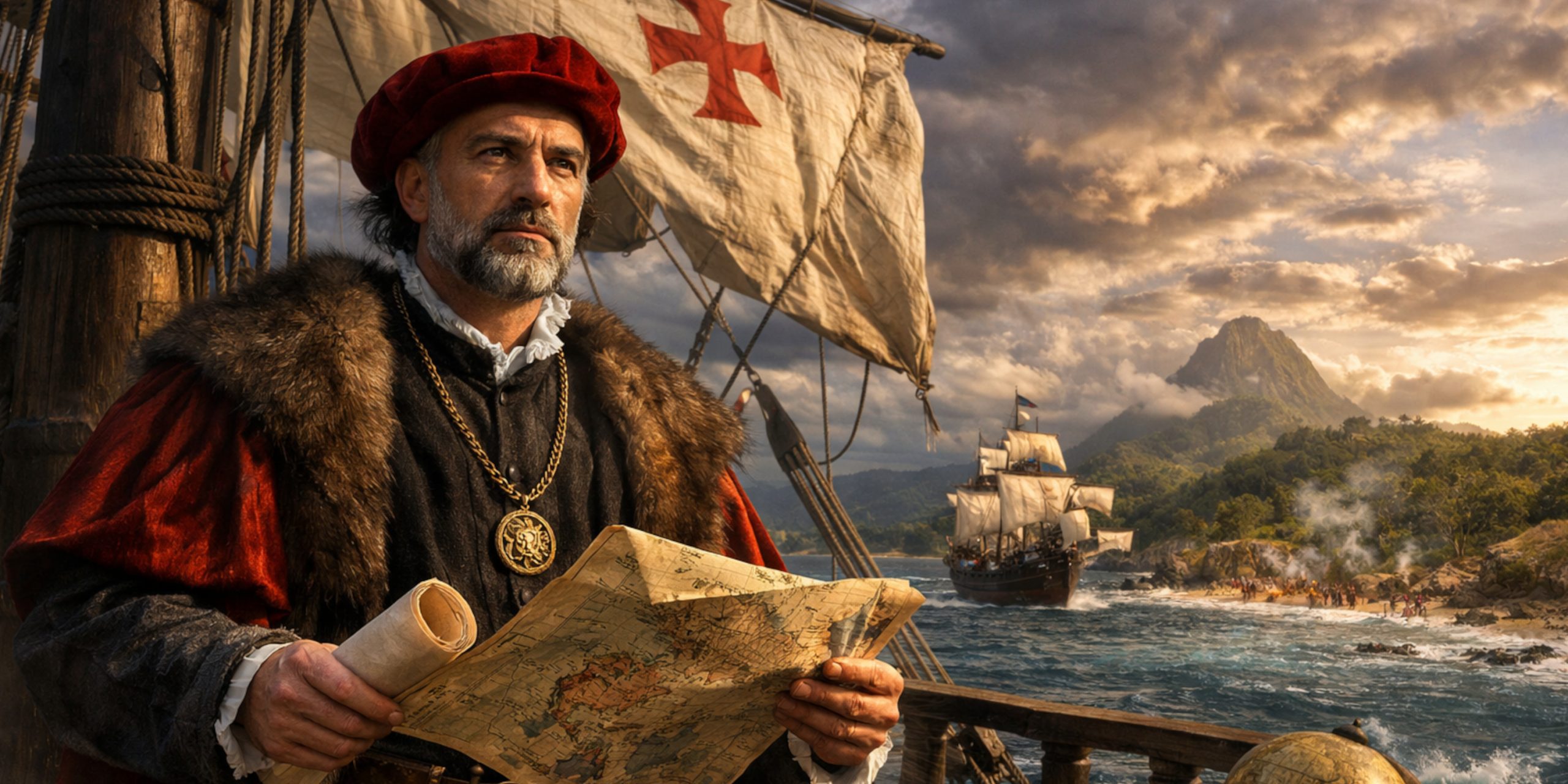
Few historical figures have had the audacity to lend their name to two continents. Yet that is precisely what happened with Amerigo Vespucci. He was not the first European to reach the Americas in the Age of Discovery, nor the most famous explorer of his time. That distinction belongs to Christopher Columbus. But Vespucci offered something different. He recognised that these lands were not Asia. They were a previously unknown continent.
His reputation has swung between praise and suspicion for centuries. What follows is what we know with reasonable certainty, and what remains contested.
Early Life in Florence
Amerigo Vespucci was born in 1454 in the Republic of Florence. Florence at that time was a city of bankers, scholars, and political intrigue. It was the world of the Medici and of Renaissance humanism.
Vespucci received a strong education. He studied astronomy, geography, and classical literature. This was not unusual for a well connected Florentine family, but it mattered later. Unlike some explorers who relied heavily on pilots, Vespucci had the intellectual training to interpret what he was seeing.
By the 1480s he was working for the powerful Medici banking house. His role eventually took him to Seville in Spain, a city that was becoming the launch point for Atlantic exploration.
Move to Spain and Entry into Exploration
In Seville, Vespucci worked in commercial ventures linked to Atlantic voyages. He helped outfit ships and provision expeditions. This practical involvement gave him exposure to the mechanics of exploration.
At some point in the 1490s, he transitioned from merchant administrator to participant. The exact details are debated, but by 1499 he was sailing west under the Spanish flag, likely on an expedition led by Alonso de Ojeda.
It is here that Vespucci begins to step into the historical spotlight.
The Voyages to the New World
Between 1499 and 1502, Vespucci participated in voyages along the coast of South America. He sailed along what is now Venezuela and Brazil. On at least one voyage he entered the service of Portugal.
The key point is not simply that he travelled, but what he concluded. While Columbus believed he had reached Asia, Vespucci argued that these lands were part of a “New World”. His letters describe vast coastlines, unfamiliar constellations, and societies unlike those known in Asia.
One of his most famous accounts, Mundus Novus, circulated widely in Europe. It was translated and printed repeatedly. European readers were captivated by descriptions of exotic lands and peoples. Some details were exaggerated. Renaissance audiences had an appetite for the dramatic.
Still, the geographical insight was significant. Vespucci proposed that these territories formed a new continent, separate from Asia. That intellectual leap changed European cartography.
The Naming of America
In 1507, the German cartographer Martin Waldseemüller published a world map. On it, the southern part of the New World was labelled “America”. He chose the name in honour of Amerigo Vespucci, whose writings had persuaded him that the landmass was distinct from Asia.
Waldseemüller later expressed uncertainty and even removed the name in subsequent editions. But the label had taken hold. Cartography has a stubborn memory.
It is worth noting that Vespucci did not name the continent after himself. The decision came from scholars influenced by his accounts. Whether he deserved the honour is still debated, particularly by those who see Columbus as the central figure of Atlantic discovery.
Letters, Reputation, and Controversy
Much of what we know about Vespucci comes from letters attributed to him. The most famous are the Lettera and Mundus Novus. Scholars have argued over their authenticity for centuries. Some believe they were altered by publishers eager to boost sales.
There are also disputes over the number of voyages he actually undertook. Claims of a 1497 voyage remain controversial. Documentary evidence is thin.
As a historian, I approach these sources cautiously. Renaissance printing culture was lively, and authorship could blur. What seems clear is that Vespucci did sail to South America and that his interpretations shaped European understanding of those lands.
His reputation rose rapidly in his lifetime. Later generations reassessed him more critically. That fluctuation tells us as much about changing historical priorities as it does about Vespucci himself.
Later Life and Official Role
In 1508, Vespucci was appointed Pilot Major of Spain. In this position he oversaw the training and licensing of pilots for the Spanish crown. He was responsible for maintaining the official master map, known as the Padrón Real.
This role placed him at the centre of Spanish navigation policy. It was a position of considerable trust and influence. He held it until his death in 1512.
By then, exploration of the Americas was accelerating. The world Vespucci had helped redefine was rapidly expanding.
Legacy
Vespucci’s legacy rests on interpretation rather than first contact. He articulated the idea that Europeans were facing a new continent. That conceptual shift mattered enormously.
Two continents now bear a name derived from his own. It is a remarkable outcome for a Florentine merchant who moved into exploration somewhat later in life.
I sometimes think about how accidental history can be. If Waldseemüller had preferred another source, we might be speaking of Columbia instead of America. Names are powerful. They fix narratives.
Amerigo Vespucci did not conquer empires or establish colonies. What he did was change the mental map of Europe. That, in its own way, altered the course of global history.
Takeaway
Amerigo Vespucci remains a complex figure. Explorer, merchant, navigator, and perhaps a little opportunistic. He was not the only voice of his era, but he was among the first to state clearly that these western lands were something entirely new.
For that insight, whether fully his or shaped by the printers and scholars around him, he became attached to one of the most consequential geographical labels in history.
It is an extraordinary legacy.