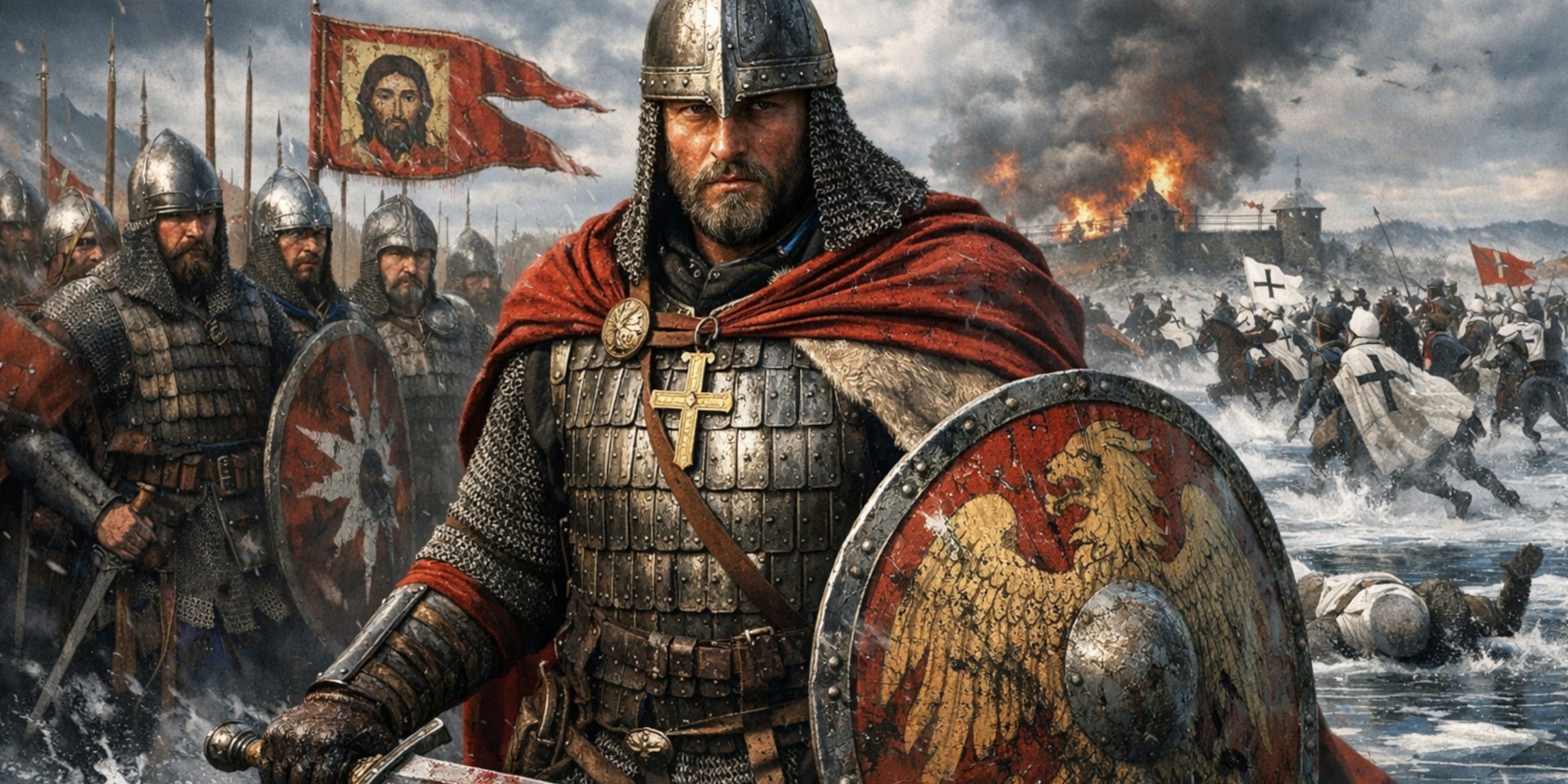
Few medieval rulers have been claimed so thoroughly by history, church, and nation as Alexander Nevsky. To some he is the saviour of Rus against crusading knights. To others he is the pragmatic prince who chose survival under Mongol overlordship over romantic ruin. As a historian, I find him fascinating precisely because he resists simplification. He was neither a spotless hero nor a cowardly collaborator. He was a man operating in a brutal century where survival required calculation, not sentiment.
Born in 1221, Alexander was the son of Prince Yaroslav II of Vladimir. He came of age just as the Mongol invasion shattered the political world of Rus. The old order burned. Cities fell. Loyalties fractured. In that landscape, Nevsky built his reputation.
Political Context and Early Life
Alexander ruled first in Novgorod, a republic of merchants who could be as difficult as any invading army. The city’s veche assembly had its own opinions about leadership, taxation, and war. He was expelled more than once, recalled more than once, and learned quickly that power in Rus was never straightforward.
The greater threat lay in two directions. From the east came the Mongol Golden Horde, whose campaigns had devastated Vladimir and Kiev. From the west came Latin Christian powers, notably the Teutonic and Livonian branches of the military orders, expanding into the Baltic.
Alexander’s career unfolded between these forces. His choices would define his reputation for centuries.
Major Battles and Military Acumen
The Battle of the Neva, 1240
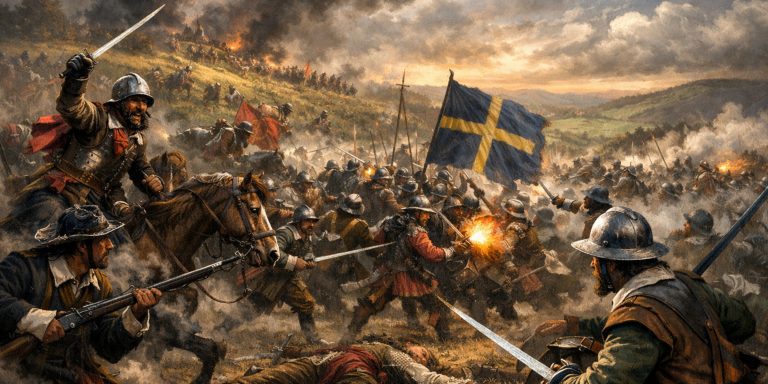
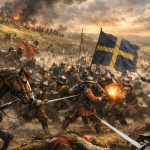
In 1240, Swedish forces landed near the Neva River. According to the chronicles, Alexander struck swiftly, surprising the invaders. The victory earned him the name Nevsky.
While the scale of the battle is debated, its symbolic value was immense. It secured Novgorod’s northern approaches and announced the arrival of a young and capable commander.
The Battle on the Ice, 1242
The confrontation on frozen Lake Peipus against the Teutonic Knights remains Nevsky’s most famous engagement.
Opponents
- Novgorodian and allied Rus forces
- Teutonic Knights and their Baltic allies
Traditional accounts describe heavily armoured knights advancing across the ice before being enveloped and pushed back. Modern historians are cautious about the dramatic imagery of mass drowning. The ice did not swallow an army whole. Still, the defeat halted westward crusading pressure into the Novgorod lands.
Nevsky’s handling of the battle reveals several traits:
- Careful use of terrain
- Controlled defensive posture followed by counterattack
- Understanding of enemy overconfidence
He did not seek reckless glory. He sought decisive containment.
Relations with the Mongols
Here lies the harder question. Nevsky travelled to the Golden Horde and secured confirmation as Grand Prince of Vladimir. He accepted Mongol suzerainty and enforced tribute collection.
To modern eyes, this may seem humiliating. Yet open rebellion would have meant annihilation. The Mongol military machine was unmatched. By cooperating, Nevsky preserved the institutional framework of Rus. He kept the Church intact. He avoided further devastation.
It was a cold calculation. Cold calculations sometimes save nations.
Arms and Armour of Alexander Nevsky’s Era
Direct artefacts belonging specifically to Nevsky are elusive, but the equipment of his time is well attested archaeologically.
Armour
Rus warriors of the 13th century commonly wore:
- Mail hauberks, often knee length
- Lamellar armour influenced by steppe traditions
- Conical helmets with nasal guards or face protection
- Round or almond shaped shields
The Mongol threat encouraged adaptability. Lamellar armour, constructed from small plates laced together, offered flexibility and solid protection. Archaeological finds from Novgorod confirm the presence of both mail and lamellar systems.
Swords and Weapons
The typical sword was a double edged arming sword of the Oakeshott Type XII or XIII family, broad bladed and suited to both cut and thrust. Scandinavian influence lingered in blade form and hilt style.
Other common weapons included:
- Spears for both cavalry and infantry
- Axes, including bearded types
- Maces, increasingly effective against armour
Teutonic opponents fielded similar arming swords but with heavier cavalry emphasis and strong lance tactics.
Nevsky’s forces were not technologically inferior. They were tactically disciplined and regionally adapted.
Governance and Religious Legacy
Alexander died in 1263 and was later canonised by the Russian Orthodox Church. His sainthood rests partly on his defence of Orthodoxy against Latin encroachment and partly on his perceived humility before God.
In later centuries, especially under Ivan the Terrible and Peter the Great, his image was reshaped into that of a foundational Russian hero. In the 20th century, Sergei Eisenstein’s film Alexander Nevsky turned him into a cinematic symbol of resistance against foreign aggression.
History and myth often intertwine. With Nevsky, the threads are tightly woven.
Artefacts and Where to See Them
Several key locations preserve objects and material culture linked to his era.
Alexander Nevsky Lavra, Saint Petersburg
Alexander Nevsky Lavra
His relics were transferred here in the 18th century. The monastery complex houses important ecclesiastical artefacts and memorial objects associated with his cult.
Novgorod State Museum
Novgorod State United Museum
This museum preserves helmets, mail fragments, swords, and birch bark documents from 13th century Novgorod. While not labelled as Nevsky’s personal possessions, they represent the military and civic world he governed.
Vladimir-Suzdal Museum Reserve
Vladimir-Suzdal Museum-Reserve
Holds artefacts from the principality of Vladimir, including weapons and ecclesiastical objects from the period of Mongol overlordship.
Latest Archaeology and Research
Excavations in Veliky Novgorod continue to reveal:
- Birch bark letters detailing civic life
- Weapon fragments including arrowheads and blade remains
- Armour components showing eastern and western influences
Recent studies have focused on trade networks linking Rus to the Baltic and the steppe. Metallurgical analysis of sword blades suggests a mixture of local forging and imported steel, reflecting a connected medieval economy rather than isolation.
There is ongoing debate over the exact scale of the Battle on the Ice. Some archaeologists question whether the engagement was smaller than later chronicles claim. Absence of mass battlefield remains has tempered older dramatic narratives.
As a historian, I find this refreshing. The truth is often quieter than legend. Quieter does not mean less important.
Character and Historical Assessment
Alexander Nevsky was not a romantic rebel. He was a survivor. He fought where victory was plausible. He compromised where resistance was futile. He strengthened institutions rather than chasing theatrical defiance.
That pragmatism preserved northern Rus at a time when other centres lay in ruin. It allowed cultural and religious continuity. Whether one admires or questions his submission to the Mongols, the outcome speaks for itself. Novgorod endured.
In the end, Nevsky’s greatness lies not in icy spectacle but in measured judgement. Medieval leadership rarely offered clean choices. He chose endurance over annihilation. History, on balance, has judged that decision kindly.