Who Was Aethelwulf?
Aethelwulf, King of Wessex, ruled from 839 to 858. He is often remembered simply as the father of Alfred the Great, which is rather unfair. It is a little like introducing Julius Caesar as the uncle of someone interesting.
In truth, Aethelwulf was one of the most important rulers in Anglo-Saxon England. He inherited a kingdom facing constant Viking attacks, political tension with Mercia, and the usual Anglo-Saxon habit of settling arguments with swords and suspiciously worded charters.
When he came to the throne, Wessex was already powerful, but still vulnerable. By the time he died in 858, he had preserved the kingdom, strengthened royal authority and laid the foundations that would later allow Alfred to survive and eventually dominate England.
Early Life and Family
Aethelwulf was the son of King Ecgberht of Wessex, the formidable ruler who had broken Mercian dominance after the Battle of Ellendun in 825.
As a young prince, Aethelwulf governed Kent and the south-eastern territories on behalf of his father. This gave him valuable experience of rule, diplomacy and military command long before he became king himself.
He married Osburh, daughter of Oslac, one of his leading nobles. Together they had several sons, a family alarmingly gifted at surviving turbulent politics:
- Aethelstan
- Aethelbald
- Aethelberht
- Aethelred
- Alfred, later known as Alfred the Great
There is a curious sense that Aethelwulf was training his sons for a future he knew would be difficult. Four of them would eventually become kings.
The Political World of Aethelwulf
When Aethelwulf became king, England was not a single country. It was a patchwork of kingdoms, alliances and grudges.
The major powers were:
- Wessex
- Mercia
- Northumbria
- East Anglia
- The surviving Welsh kingdoms
Mercia remained a rival, though less dangerous than it had once been. The greatest threat increasingly came from Viking raiders, who had moved beyond quick coastal attacks and were beginning to launch larger expeditions inland.
Aethelwulf faced the difficult task of defending Wessex while also keeping political control over Kent, Sussex, Surrey and Essex. Holding together such a kingdom in the ninth century required military skill, patience and a willingness to travel constantly. Medieval kings spent much of their lives on the road. They governed by appearing in person, dispensing justice and reminding everyone who was in charge.
Battles and Military Acumen
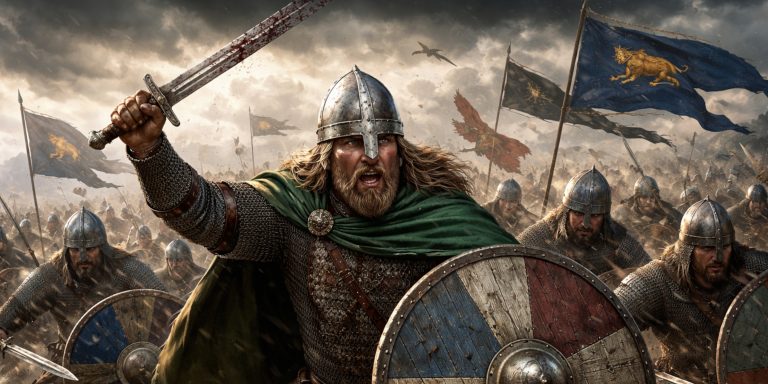
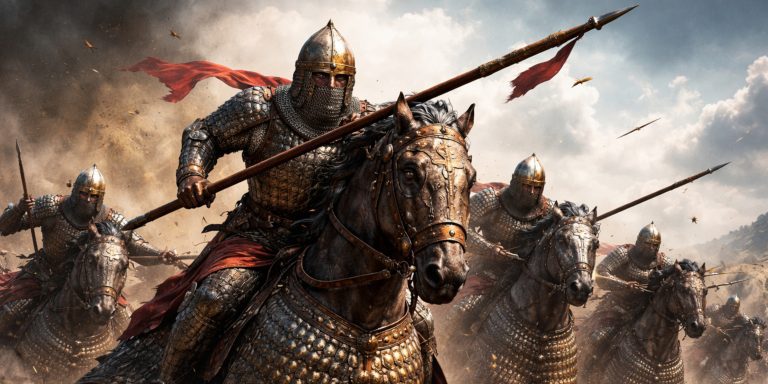
Aethelwulf’s reign was defined by warfare against Viking forces. He was not a reckless battlefield commander, nor a romantic hero charging into the front rank with his hair flowing majestically in the wind. Anglo-Saxon kings who tried that often ended up as an entry in a monastery chronicle.
Instead, Aethelwulf appears to have been a measured and capable strategist. He coordinated regional levies, worked with local ealdormen and fought only when conditions suited him.
The Battle of Carhampton, 843
One of the first major clashes of Aethelwulf’s reign came at Carhampton in Somerset.
A Viking force landed in the west and met the West Saxon army in battle. According to the Anglo-Saxon Chronicle, Aethelwulf’s men were defeated.
This defeat mattered because it showed how dangerous the Viking threat had become. These were no longer small bands of raiders looking for silver and sheep. They were increasingly organised warbands capable of defeating royal armies.
Even so, Aethelwulf learned from the experience. In the years that followed, Wessex improved its response to Viking incursions and became quicker at raising armies.
The Battle of Aclea, 851
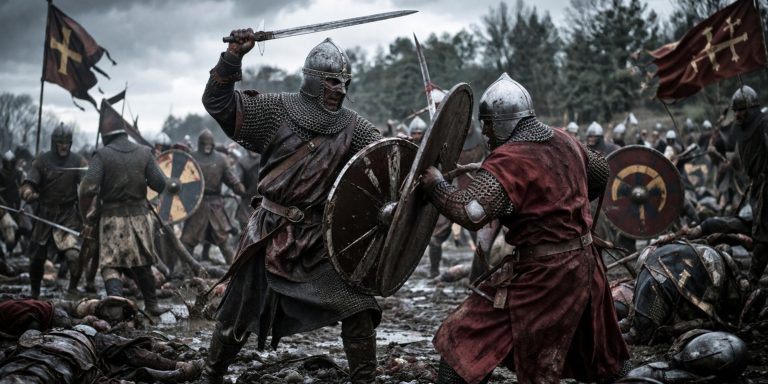
Aethelwulf’s greatest military success came in 851 at the Battle of Aclea, sometimes identified with Ockley in Surrey.
A large Viking army had landed in southern England after attacking Canterbury and London. Aethelwulf joined forces with his son Aethelbald and marched to confront them.
The Anglo-Saxon Chronicle describes it as the greatest slaughter of a heathen army ever seen up to that point.
The West Saxons won a decisive victory.
Several factors probably explain the success:
- Aethelwulf had time to gather a large army
- He coordinated the forces of Wessex and Kent effectively
- The battle may have taken place inland, limiting the Vikings’ ability to retreat to their ships
- His army was increasingly experienced after years of fighting raids
Aclea was more than a victory. It showed that Viking armies could be beaten in open battle. That lesson would become vital for Alfred and later West Saxon kings.
Other Campaigns and Defensive Measures
Aethelwulf fought Viking forces repeatedly throughout the 840s and 850s.
Among the major events of his reign:
- In 840, Viking fleets attacked Southampton and Portland
- In 851, a Viking army wintered in England for the first time
- Wessex increasingly relied on fortified settlements and rapid military mobilisation
- Aethelwulf worked closely with local noblemen such as Eanwulf of Somerset and Osric of Hampshire
Although the later burh system is usually associated with Alfred, its roots can be seen in Aethelwulf’s reign. He understood that defending Wessex required organisation as much as bravery.
Arms and Armour
The armies of Aethelwulf’s reign were Anglo-Saxon fyrd forces supported by the king’s household warriors and noble retainers.
Weapons
Common weapons used by Aethelwulf’s forces included:
| Weapon | Description |
|---|---|
| Spear | The most common weapon, used for both thrusting and throwing |
| Seax | A long fighting knife carried by many warriors |
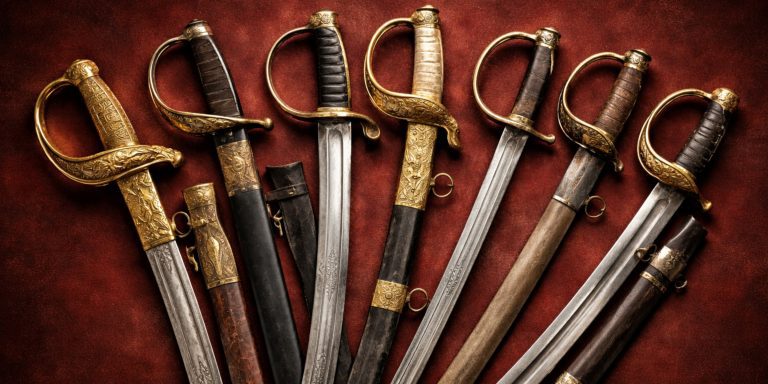
| Sword | A prestigious weapon used by nobles and elite retainers |
| Axe | Usually a one-handed axe, though larger Danish-style axes were beginning to appear |
| Shield | Round wooden shield with iron boss, essential for the shield wall |
The swords of Aethelwulf’s period were classic late Anglo-Saxon blades. Most were double-edged, pattern-welded weapons descended from earlier migration-era designs.
Particularly likely sword types include:
- Petersen Type X swords
- Early Carolingian-style swords imported from Francia
- Anglo-Saxon pattern-welded swords with broad blades and simple crossguards
A nobleman in Aethelwulf’s service might carry a beautifully decorated sword with silver inlay and a richly worked hilt. Such weapons were both practical and symbolic. They proclaimed status in a world where literacy was rare and a good sword spoke volumes.
Armour
Most ordinary warriors probably wore little armour beyond a shield and perhaps a padded tunic. Elite warriors and the king’s household troops, however, were better equipped.
| Armour | Likely Use |
| Mail shirt | Worn by elite warriors and noble retainers |
| Iron helmet | Conical helmets with nasal guards, similar to the one found at Coppergate |
| Shield | Round shield of wood and leather |
| Leather belt and sword baldric | Used to carry sword and equipment |
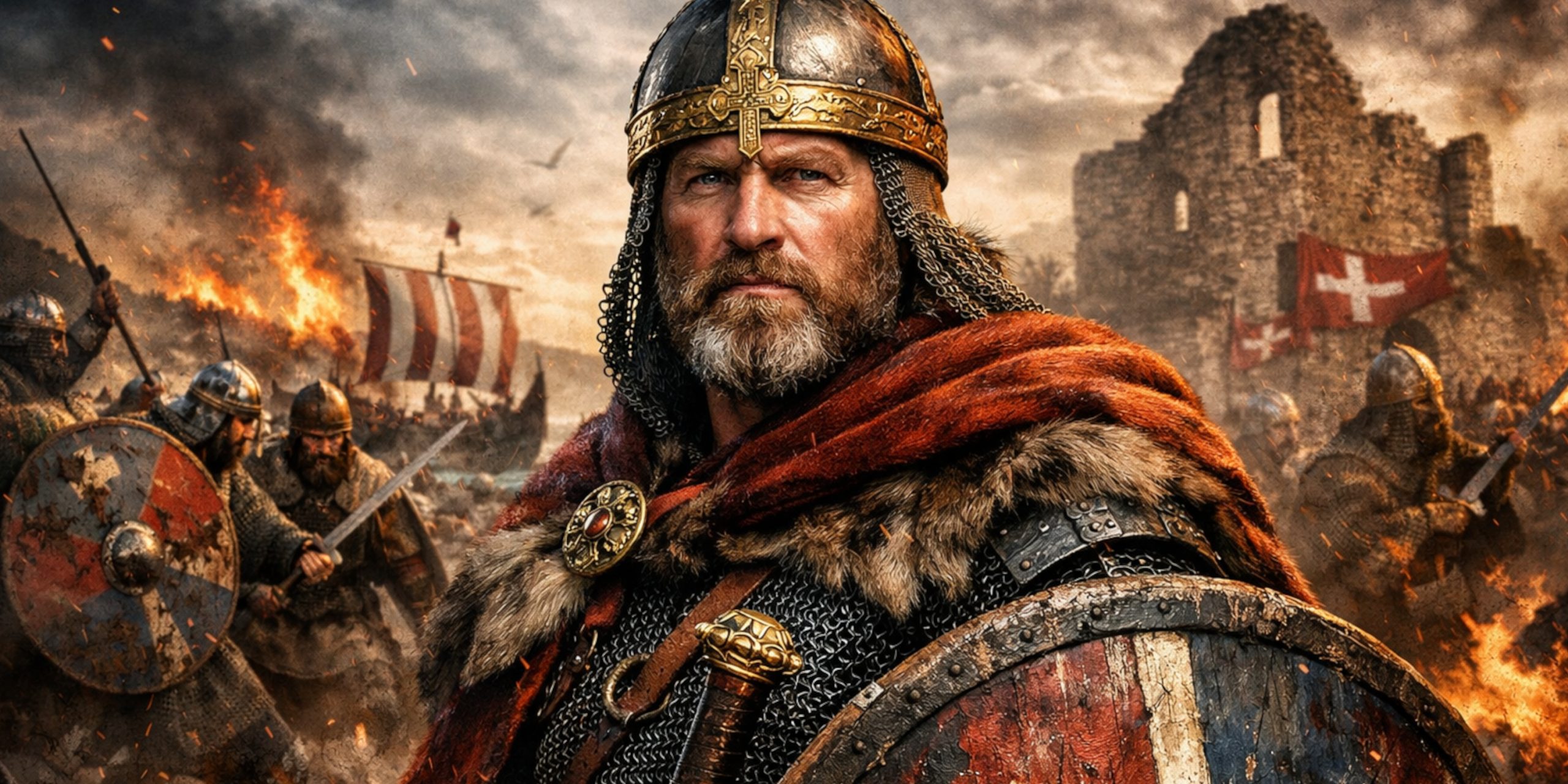
Mail remained expensive and relatively rare. A king such as Aethelwulf would almost certainly have worn a mail byrnie, perhaps with a decorated helmet and cloak clasp. He would have looked every inch the Anglo-Saxon war leader, though probably less polished than the rather theatrical versions often seen on television.
Aethelwulf’s Pilgrimage to Rome
In 855, Aethelwulf made the remarkable decision to travel to Rome.
This was an extraordinary undertaking. The journey took months and involved travelling through Frankish lands, crossing the Alps and dealing with the hazards of medieval roads, which were generally muddy, dangerous and in no sense deserving of the word road.
He took his young son Alfred with him.
In Rome, Aethelwulf met Pope Leo IV and made generous donations to the church. He also spent time at the court of Charles the Bald in Francia.
On his return journey, he married Judith, daughter of Charles the Bald. The marriage strengthened Wessex’s connections with the Carolingian world and raised the prestige of the West Saxon monarchy.
Some later writers criticised Aethelwulf for leaving England during a dangerous period. Yet his journey seems to have been politically astute. He returned with greater international status and valuable alliances.
Conflict with Aethelbald
When Aethelwulf returned from Rome in 856, he faced an unpleasant surprise. His son Aethelbald had taken control of part of Wessex and was apparently unwilling to give it back.
Rather than plunge the kingdom into civil war, Aethelwulf reached a compromise. He retained the eastern parts of the kingdom while Aethelbald ruled in the west.
This decision reveals much about his character. Aethelwulf was not weak, as older historians sometimes suggested. He was practical. He understood that a divided kingdom would be easy prey for the Vikings.
Avoiding civil war may have been one of his wisest decisions.
Death and Legacy
Aethelwulf died in 858.
He was buried first at Steyning, then later reburied at Winchester.
For centuries, he stood in the shadow of Alfred the Great. Yet modern historians increasingly recognise that Alfred inherited a kingdom that Aethelwulf had already strengthened.
Aethelwulf:
- Preserved Wessex during a dangerous period
- Won one of the earliest major victories over the Vikings
- Built alliances with Francia and Rome
- Passed on a stable kingdom to his sons
- Helped create the foundations of later English unity
Without Aethelwulf, there may never have been an Alfred the Great. History often remembers the builder of the cathedral and forgets the man who laid the foundations and spent years dealing with mud, timber and complaints from local landowners.
Artefacts and Where to See Them
No object can be definitively linked to Aethelwulf personally, but several important artefacts survive from his reign and world.
| Artefact | Location | Why It Matters |
| Aethelwulf Silver Penny | British Museum, London | Coins struck during his reign showing royal authority and minting in Wessex |
| Anglo-Saxon swords and weapons from the ninth century | British Museum, London | Examples of the arms used by his warriors |
| Coppergate Helmet | Yorkshire Museum, York | One of the best surviving Anglo-Saxon helmets, similar to those used in his reign |
| Alfred Jewel | Ashmolean Museum, Oxford | Slightly later than Aethelwulf, but reflects the artistic and royal culture created by his dynasty |
| Winchester and Canterbury charters | British Library, London | Original documents issued during or shortly after his reign |
| Anglo-Saxon treasures from Sutton Hoo and Staffordshire Hoard | British Museum and Birmingham Museum | Earlier than Aethelwulf, but useful for understanding the military culture of Anglo-Saxon kingship |
The silver pennies of Aethelwulf are particularly fascinating. They often show a simple royal portrait and inscription. They are small, worn and rather easy to overlook in a museum case. Yet these coins are among the few objects that passed directly through the hands of people living under his rule.
Latest Archaeology and New Discoveries
Recent archaeology has shed more light on the world in which Aethelwulf ruled.
Excavations in Hampshire, Dorset and Somerset have revealed new evidence of ninth-century defensive sites and settlements linked to the struggle against Viking attacks. Archaeologists increasingly believe that Wessex was already developing stronger local fortifications before Alfred’s famous reforms.
Recent studies of Anglo-Saxon coin hoards have also helped historians understand the economy of Aethelwulf’s reign. Hoards discovered in southern England show that Wessex maintained a surprisingly active and sophisticated silver currency despite the pressure of Viking raids.
One particularly important discovery in recent years has been the continuing study of the Viking camp at Repton and related ninth-century sites. Although these belong slightly after Aethelwulf’s death, they help explain the kind of threat he spent his reign trying to contain.
Archaeologists working in Wessex have also uncovered more evidence for royal estates, church centres and fortified settlements from the mid ninth century. These discoveries suggest that Aethelwulf’s kingdom was more organised and wealthier than older historians once believed.
A 2025 reassessment of Anglo-Saxon finds from southern England has further highlighted how widespread silver pennies, weapon burials and fortified estate centres were during the decades around Aethelwulf’s reign. In Suffolk, the discovery and scientific analysis of a hoard of more than 300 late Anglo-Saxon coins has offered new clues about royal authority and local wealth in eastern England.
The picture that emerges is of a king ruling not a backward and crumbling realm, but a resilient kingdom capable of adapting to crisis.
Contemporary Views
The Anglo-Saxon Chronicle praised Aethelwulf’s victory at Aclea and described the battle as:
“the greatest slaughter among the heathen host that we have heard tell of unto this present day”
Asser, writing later about Alfred, described Aethelwulf as:
“a religious and honourable king”
These descriptions are hardly unbiased. Medieval chroniclers had a strong tendency to admire kings who donated generously to monasteries. Even so, they suggest that Aethelwulf was respected both as a ruler and as a defender of his kingdom.
Takeaway
Aethelwulf is one of those figures who suffers from being surrounded by famous people. He was the son of Ecgberht and the father of Alfred. History often squeezes him awkwardly between the two.
Yet the more one studies his reign, the more impressive he becomes.
He faced a kingdom under immense pressure, survived repeated Viking attacks, won important victories and handed on a stronger realm than the one he inherited. That is not the work of a minor king.
If Alfred was the great architect of England, Aethelwulf was the man who made sure the walls did not collapse before the plans could even be drawn.