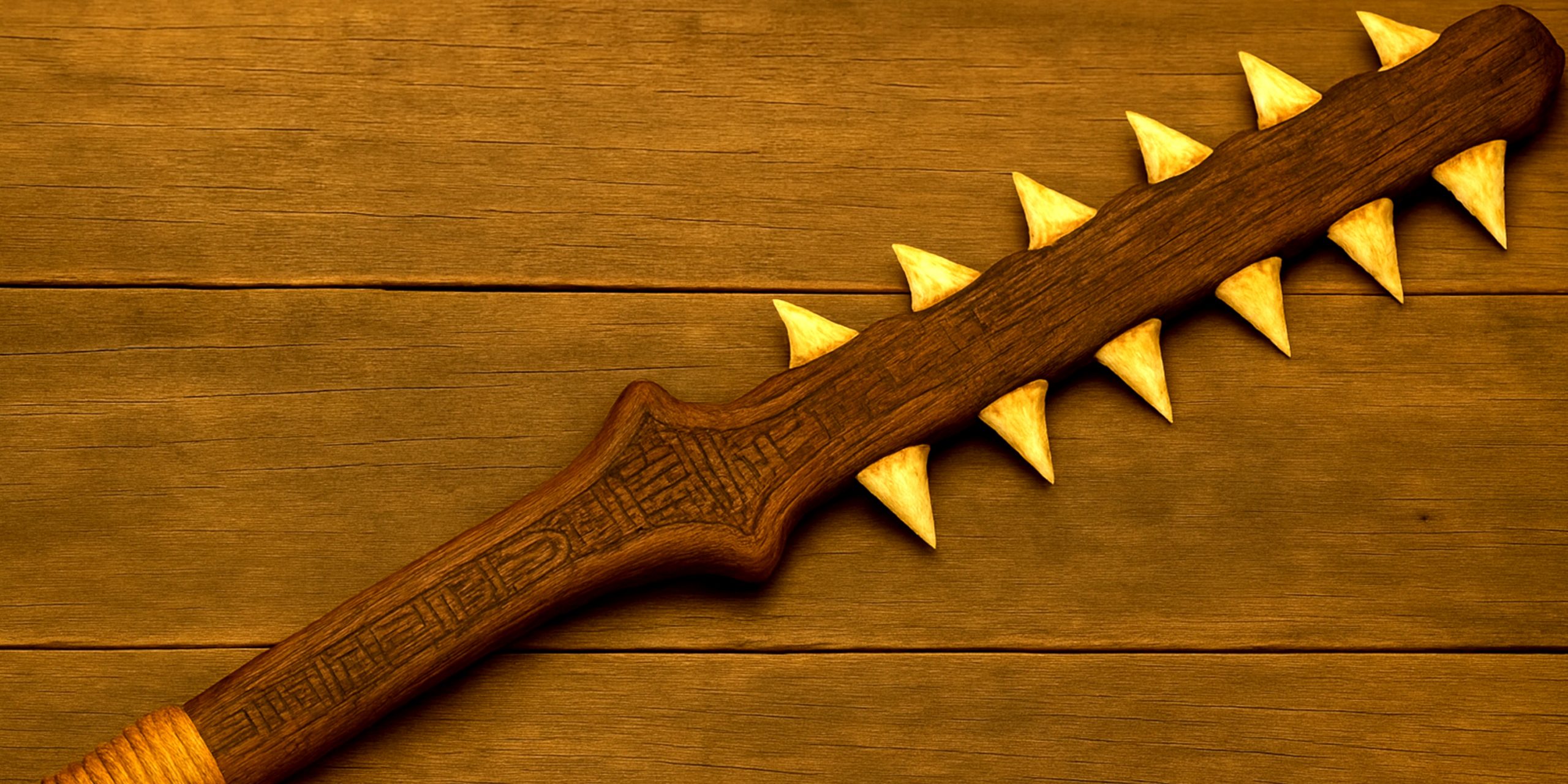
A weapon shaped by volcanic timber, ritual craft and lethal precision, the shark tooth variant of the macuahuitl sits slightly apart from its obsidian edged cousins. It carries the same unmistakable presence yet its anatomy and behaviour in combat shift in subtle ways that tell us a great deal about changing materials and battlefield needs in late Postclassic Mesoamerica.
The shark tooth macuahuitl was a wooden club fitted with rows of sharpened shark teeth set into long grooves along the sides. While obsidian dominated most Mexica bladed weapons, coastal access and tribute networks allowed shark teeth to circulate as prestige materials. The result was a weapon that traded a glassy slicing bite for a more fibrous and serrated cut. It was still a symbol of authority, but also practical enough for warfare and ceremonial combat.
Specification
General Characteristics
- Primary material: hardwood body
- Edge material: shark teeth, usually First Dorsal or Lateral teeth
- Construction: teeth set in resin or plant adhesives, often with fibre reinforcement
- Length range: 60 to 100 cm
- Weight: 1 to 2 kg depending on size and density
- Grip: wrapped cotton cloth or simple carved handle
Typical Dimensions Table
| Feature | Typical Measurement |
|---|---|
| Full length | 70 to 80 cm |
| Blade width | 8 to 12 cm |
| Tooth projection | 1 to 2 cm |
| Handle length | 15 to 20 cm |
History and Evolution
The shark tooth edged macuahuitl appears as a specialised variant documented in coastal regions tied to Mexica control. Obsidian was abundant in the central highlands, so its use dominated state supply networks. Shark tooth examples developed in communities where marine resources were plentiful or where teeth were offered as tribute.
Artwork from the Late Postclassic period shows warriors carrying weapons with alternating tooth shapes. These may represent this particular design. The lack of widespread archaeological survival stems from the wood and organic adhesives decaying in the humid climate. Written sources by early colonial observers mention variability in edge materials, supporting the idea that these weapons formed part of a wider toolkit rather than rare curiosities.
Advantages and Disadvantages
Advantages
- Serrated teeth produced ragged wounds that were difficult to close.
- Teeth resisted shattering more effectively than obsidian.
- Edges could be replaced individually instead of requiring full reblading.
- Lighter overall weight improved handling during prolonged fighting.
Disadvantages
- Shark teeth were less sharp than freshly knapped obsidian blades.
- Required steady tribute supply from coastal areas.
- Resin used to bind teeth softened under intense humidity.
- Less uniform cutting action compared with obsidian edged macuahuitl.
Comparison with Similar Weapons
| Weapon Type | Edge Material | Strengths | Weaknesses |
|---|---|---|---|
| Standard Mexica macuahuitl | Obsidian | razor fine cutting, clean slicing | brittle edges, frequent breakage |
| Shark tooth macuahuitl | Shark teeth | serrated durability, easier repair | less penetrating power |
| Polynesian leiomano | Shark teeth | short range control, compact striking | limited reach |
| Mayan clubs with inset jade or obsidian | Jade or obsidian | symbolic prestige, sharp edges | heavier and costly |
The shark tooth macuahuitl sits closest to the Polynesian leiomano in principle, yet differs in size and cultural function. It kept the long profile of the typical macuahuitl and served both offensive and ceremonial roles.
Legacy
Although overshadowed by the obsidian edged version, this variant survives in museum collections, codices and ethnographic parallels. Its construction displays the adaptability of Mesoamerican craftsmen who used whatever dangerous materials their environment offered. In modern historical circles the shark tooth weapon is sometimes misunderstood as a novelty, yet it reveals a more complex relationship between coastal and inland cultures within the Mexica sphere.
Where to See
Surviving or reconstructed examples appear in a small number of institutions.
- Museo Nacional de Antropología, Mexico City
- Museo del Templo Mayor, Mexico City
- Regional museums across Guerrero and Oaxaca showing coastal tribute items
- Several private collections in Europe and North America which occasionally loan pieces for temporary exhibitions
Collectors Guide
Availability
Original pre colonial examples rarely surface due to organic decay and strict export laws. Most items circulating in the market are twentieth century replicas. Authentic pieces almost never appear at public auction.
Identification Tips
- Examine the binding medium. True pre colonial adhesives show darkened, uneven organic texture.
- Shark teeth should display natural wear rather than uniform modern polishing.
- Hardwood bodies should show age cracks along the grain rather than clean modern carving.
Auction Prices Table
| Item Type | Typical Price Range | Notes |
|---|---|---|
| Authentic pre colonial example | Often not legally saleable | Usually restricted to museum institutions |
| Early twentieth century ethnographic replica | 800 to 2,000 GBP | Quality varies considerably |
| Modern artisan reproduction | 150 to 400 GBP | Good for display or educational use |
| Shark tooth sets for restoration | 20 to 60 GBP | Usually sourced from legal fishing by products |
Collector Advice
- Seek provenance from academic or museum linked dealers.
- Avoid pieces with perfectly aligned or machine cut tooth slots.
- Store in dry conditions to protect resin and wood.
- Expect notable variation since these were hand made items.