The Battle of Vitoria in June 1813 often gets reduced to a neat tale of Wellington outmanoeuvring Joseph Bonaparte with the elegance of a man organising drawers in a study. The reality is far richer. This was a sprawling, multi pronged assault that squeezed a French army until it buckled, dumped its treasure, and fled. Wellington’s plan worked with the kind of coordination that makes modern staff officers mutter respectful things into their coffee.
And yes, the French retreat was so chaotic that the abandoned wagons created a sort of battlefield car boot sale. One can hardly blame the Allies for taking a souvenir. You would have too.
Background
By mid 1813 French fortunes in Spain were thin. Napoleon had recalled his best units for the looming fight in central Europe, leaving Joseph with a mismatched assortment of troops and a staff quarrelling more than cooperating. Wellington, meanwhile, had supply lines running like clockwork from Portugal and saw his moment. He pushed through the mountains, outflanked French positions, and aimed to trap Joseph’s army and its enormous baggage train.
Joseph attempted to escort the treasure east. Wellington resolved to relieve him of it.
Forces
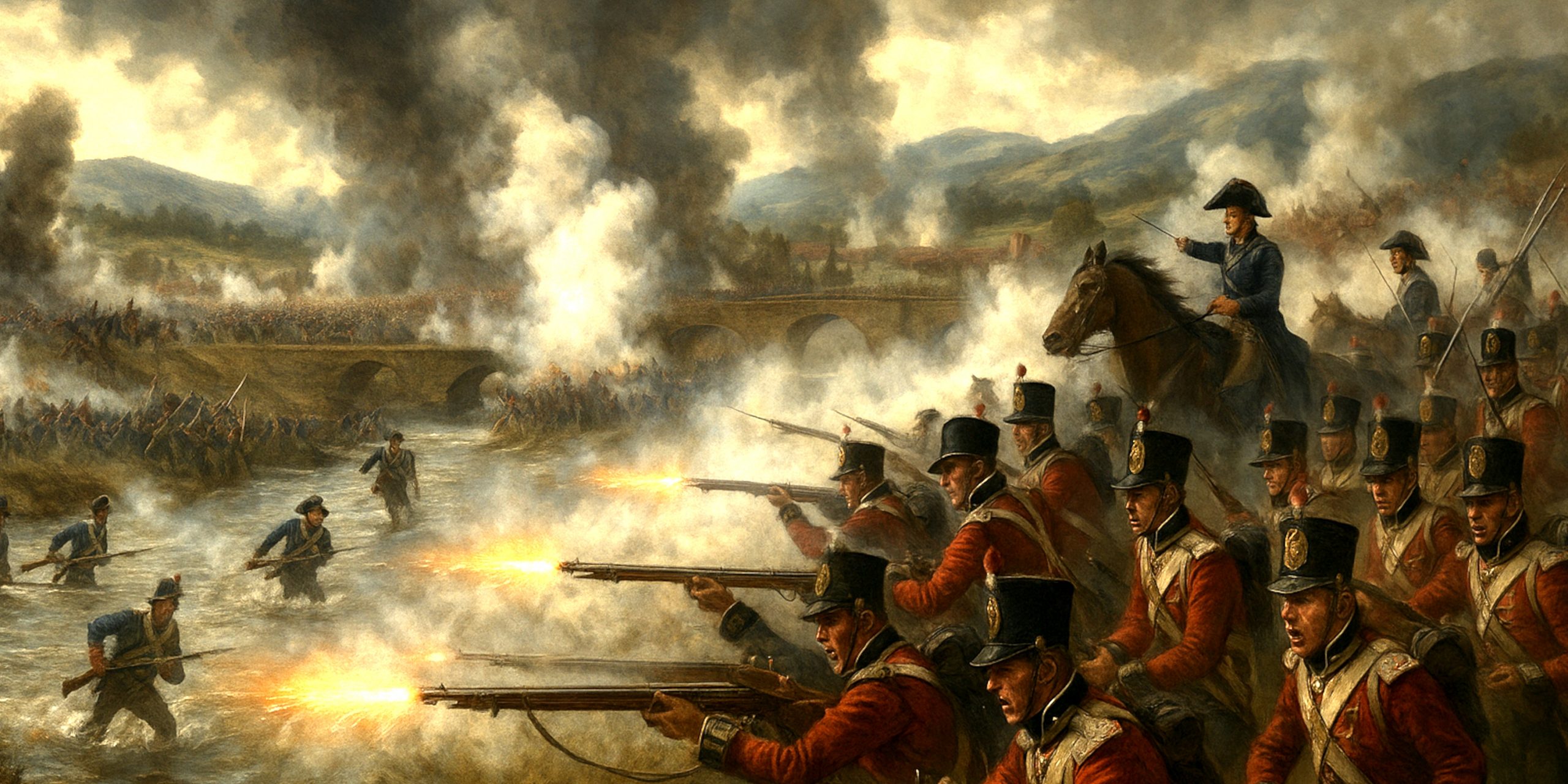
Vitoria featured one of the most complex multi column advances of the Peninsular War. Four Allied thrusts converged on Joseph’s scattered line along the Zadorra River. The French were stretched thin and shifting units from one threatened sector to another.
Leaders
| Side | Commanders | Notes |
|---|---|---|
| Allied | Arthur Wellesley, Marquess of Wellington | Directed four coordinated columns with surgical calm |
| Allied right | Sir Rowland Hill | Pressed the French right along the Zadorra |
| Allied centre left | Sir Thomas Picton | Short tempered, aggressive, effective as always |
| Allied left flank | Sir Thomas Graham and Sir John Cole | Executed the wide hook that shattered the French escape routes |
| French | King Joseph Bonaparte and Marshal Jourdan | Jourdan was unwell, Joseph overwhelmed, an unfortunate pairing |
Troop composition
| Army | Estimated Strength | Key Elements |
|---|---|---|
| Allied Army | About 80,000 | British line infantry, Portuguese brigades, Spanish divisions, mixed cavalry, solid artillery |
| French Army of Spain | About 58,000 | Mixed regulars, conscripts, overstretched cavalry, and artillery packed near the centre |
Arms and armour
Allied weapons
- India Pattern Brown Bess musket
- Baker rifle used by the 95th Rifles and other light units
- Cavalry sabres
- Portuguese forces equipped similarly, often with older stocks
- Artillery included 6 and 9 pounder guns, Congreve rockets in some roles
French weapons
- Charleville musket
- Shorter pattern muskets for voltigeurs
- Cavalry sabres
- AN XI Light Cavalry Sabre
- Straight heavy swords for cuirassiers
- Gribeauval system artillery, mainly 6 and 8 pounder pieces
Battlefield archaeology
Vitoria is not a site that produces grand museum displays, yet its archaeology is quietly revealing. Metal detector surveys show musket ball clusters along the Zadorra crossings that match the French attempts to delay Picton’s assaults. Recovered uniform buttons from multiple French regiments trace their staggered fallback routes. Fragments of broken lockboxes and personal items mark where the treasure convoy fell apart, a moment Wellington described with a mix of frustration and disbelief.
One must admire the soldiers who managed to maintain discipline through all this, though not many succeeded.
Contemporary quotes
Wellington summarised the victory with typical restraint:
“The enemy was driven from all his positions and pursued with considerable loss.”
Coming from him, that sentence is practically a victory parade.
Joseph Bonaparte was more candid:
“Everything is lost, save the honour of the King of Spain, which never existed.”
If ever a line captured the French mood that evening, this is it.
Battle timeline
Morning, 21 June 1813
Allied columns advance from four directions. French forces occupy the Zadorra line in poor alignment.
Late morning
Hill attacks the French right. Early pressure forces French units to shift reserves.
Midday
Picton pushes over the river crossings. Fierce musketry turns the centre into a grinder. The French line begins to creak.
Afternoon
Graham’s flank attack rolls toward the French rear. Joseph realises his army risks encirclement. Orders become confused.
Late afternoon
Allied pressure grows on all sectors. French formations collapse into disorder. The treasure convoy jams the escape roads.
Evening
Joseph’s army retreats in haste. The Allies capture artillery, wagons, treasure, documents, and nearly Joseph himself.
Outcome and legacy
Vitoria ended French control of Spain in a single day. Joseph’s army was broken, its prestige shredded, and its baggage plundered. Wellington marched into the Pyrenees with fresh momentum and Europe noted that Napoleon’s edges were fraying. The battle inspired Beethoven’s Wellington’s Victory, a rather loud and unsubtle piece, though it suits the spectacle of Joseph’s collapse rather well.
Watch the documentary: