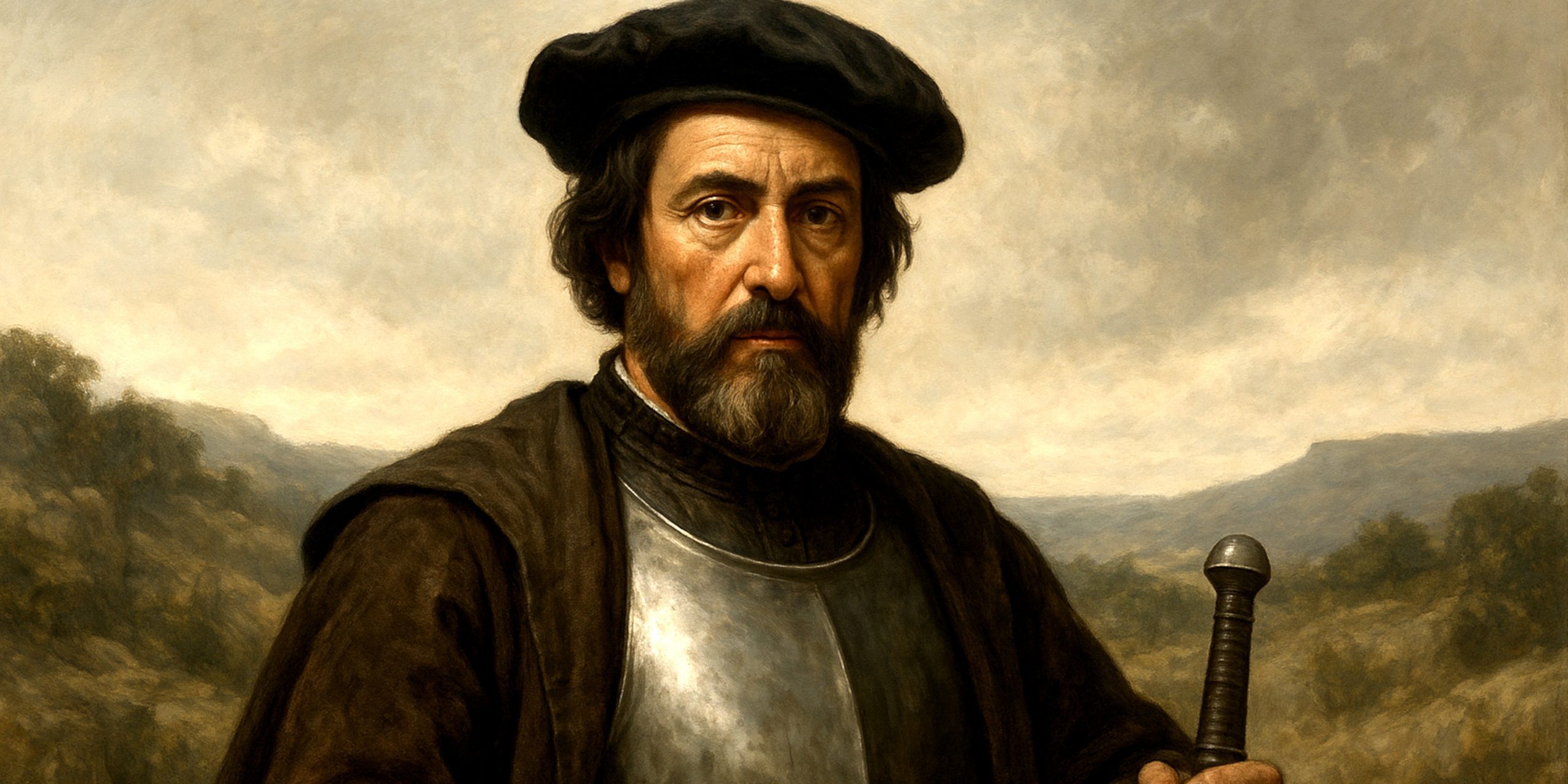
Hernán Cortés is one of those figures who refuses to sit quietly in the corner of history. Born in Medellín in Extremadura around 1485, he grew up in a region that seemed to mass-produce ambitious young men with a taste for adventure and a flexible approach to ethics. He tried studying law, discovered it was less thrilling than he hoped and instead set his sights on the Spanish Caribbean, where opportunity and danger tended to travel as a pair.
Early Years And Rise To Power
Cortés arrived in Hispaniola in 1504, eager, restless and very much prepared to make himself useful. He worked as a notary, collected land and favours and learned how colonial politics functioned. By 1511 he joined the expedition to Cuba, where he earned both status and a reputation for pushing his luck.
When Diego Velázquez selected him to lead a Mexican expedition in 1518, then tried to cancel it, Cortés responded in the most Cortés way possible. He ignored the order and sailed anyway, which set the tone for the rest of his career.
The Expedition To Mexico
Landing on the Gulf Coast in 1519 brought him face to face with a world far more complex than he expected. The Mexica Empire dominated central Mexico, an intricate political system supported by warfare, tribute and ritual. Cortés recognised quickly that force alone would doom him, so he focused on alliances, particularly with the Tlaxcalans, long-standing enemies of the Mexica.
His decision to scuttle his ships at Veracruz has been argued about for centuries. A bold motivational gesture, a reckless gamble or a theatrical flourish. Realistically, it was all of these at once.
The March On Tenochtitlan
The march inland stands among the most remarkable expeditions of the early modern period. Cortés and his forces crossed city states with sophisticated architecture, bustling markets and political structures that surprised even the more worldly Spaniards. Many of them admitted openly that the riches and engineering of central Mexico surpassed those at home.
Cortés’s first encounter with Motecuhzoma II in November 1519 was formal and courteous but utterly fragile beneath the surface. Both sides misread each other, and Cortés soon took the emperor hostage in an extraordinary act of political brinkmanship.
The Disaster And The Return
The situation exploded while Cortés was away confronting a force loyal to Velázquez. The massacre during the Tóxcatl festival enraged Tenochtitlan. By the time Cortés returned, his men were surrounded. The desperate retreat, remembered as La Noche Triste, cost the Spanish and their allies heavily. Tradition claims Cortés cried beneath a tree. One imagines he had plenty of reasons.
He regrouped, rebuilt his coalition and returned in 1521 to wage a grinding siege that devastated the city. Tenochtitlan fell in August, not through a single battle but through starvation, disease and relentless pressure.
The Aftermath
Cortés became governor of New Spain, though his authority eroded under the weight of court politics, jealous rivals and an increasingly suspicious monarchy. He spent years sending letters, treasure and reminders of his usefulness back to Spain, though the Crown seemed determined to keep him at arm’s length.
In later life he explored Central America, quarrelled with officials and pursued endless legal battles to defend his reputation. He died in 1547, wealthy but perpetually irritated that the world had not fully recognised his greatness.
Legacy
Cortés remains one of the most consequential figures in world history. His conquest reshaped the cultural, political and demographic landscape of the Americas with astonishing speed and catastrophic effect. He was bold, calculating, ruthless and deeply opportunistic, often all in the same afternoon.
Studying him requires accepting his contradictions. He was undeniably brilliant in strategy and diplomacy, yet he left a trail of destruction that continued for generations. The legacy of Hernán Cortés is not a simple story of heroism or villainy, but a complex interruption of human history whose reverberations are still felt today.
Watch the documentary: