Elizabeth: The Golden Age gives Cate Blanchett a crown, a country under threat and some exceptionally dramatic lighting. Subtlety was clearly unavailable that week.
Released in 2007 and directed by Shekhar Kapur, the film follows Elizabeth I as religious conspiracy, Spanish invasion plans and her attachment to Walter Raleigh threaten her carefully managed authority. It is a sequel to Elizabeth (1998), but its interests have shifted. Having shown a young woman learning to rule, Kapur now asks what ruling has cost her.
That is a promising question. The film answers it with a mixture of compelling performances, romantic invention and historical shortcuts. I find it most interesting when Elizabeth struggles to control her own image, and least convincing when European politics starts behaving like a personal dispute with excellent costumes.
Spoilers follow, including the ending.
What Is Elizabeth: The Golden Age About?
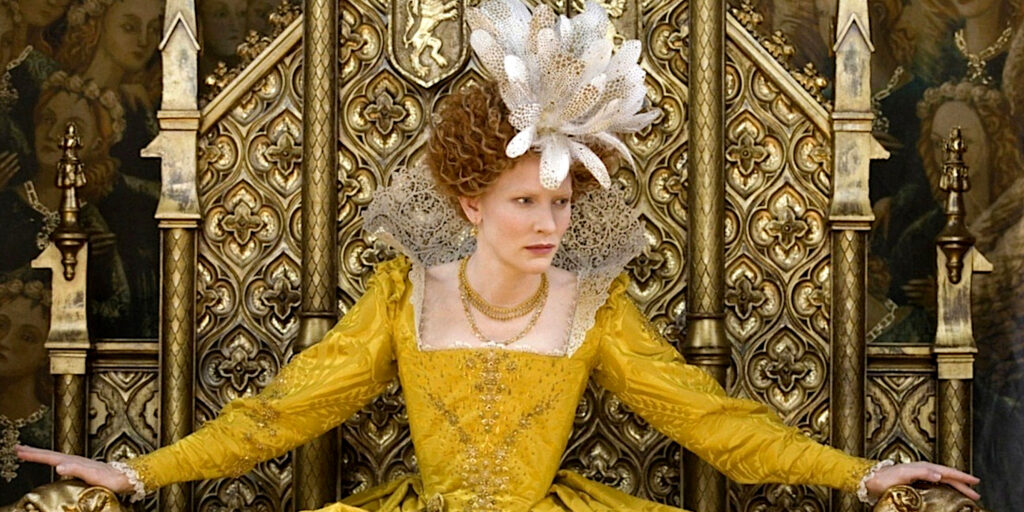
The story brings together three threats to Elizabeth’s position.
At home, Catholic conspirators hope to replace her with Mary, Queen of Scots. Abroad, Philip II of Spain prepares to challenge Protestant England. Inside her own court, Elizabeth becomes fascinated by Walter Raleigh, whose relationship with her lady-in-waiting, Bess Throckmorton, exposes the limits of royal control.
Geoffrey Rush returns as Francis Walsingham, the adviser attempting to keep the queen alive while she negotiates a much less manageable problem: wanting things she cannot safely have. The film connects its political and romantic plots through Elizabeth’s fear of betrayal. filmsandfestivals.britishcouncil.org
The stakes are deliberately uneven. A secret romance cannot rival an invasion fleet in practical importance, but to this Elizabeth, both threaten the authority on which her identity depends.
That makes emotional sense. Whether the screenplay always earns the connection is another matter.
Cate Blanchett Makes the Queen Worth Watching
Blanchett’s strongest moments come when Elizabeth’s public confidence briefly slips.
She can silence a room, then look painfully uncertain once its occupants have left. Her Elizabeth understands the performance of monarchy so thoroughly that stepping outside it seems almost impossible. Even apparent spontaneity feels watched.
I prefer these uneasy moments to the grand declarations. The speeches are delivered with formidable control, but hesitation gives us someone to think about after the music stops.
The performance also exposes a weakness in the writing. Elizabeth is perceptive enough to manage threats to her throne, yet the romantic plot sometimes requires her to become surprisingly unobservant. Blanchett makes the emotional injury credible, even when the route towards it feels arranged.
Her performance earned an Academy Award nomination for Actress in a Leading Role. oscars.org
Walter Raleigh, Bess and the Limits of Royal Favour
Clive Owen’s Raleigh introduces movement into a court obsessed with restraint. He offers travel, risk and an existence beyond carefully supervised rooms. His appeal to Elizabeth is easy to understand.
The difficulty is that the film gives him so much freedom and glamour that he can feel less like a complicated courtier than an escape route with facial hair.
Abbie Cornish’s Bess makes the triangle more interesting. Elizabeth encourages intimacy around her, then discovers that other people’s feelings cannot be recalled by royal command. Bess wants a private life, but her proximity to the queen makes privacy a political issue.
There is a historical foundation here. Raleigh secretly married Bess in 1591, and Elizabeth discovered the marriage in 1592. Both were imprisoned in the Tower of London. Crucially, this happened after the Spanish Armada of 1588, rather than alongside it as the film’s compressed narrative suggests.
The film’s suggestion of an intense romantic triangle should also be treated cautiously. Royal favour, flirtation and patronage do not give us reliable access to Elizabeth’s private feelings.
Mary, Queen of Scots Gives the Film Its Hardest Choice
Samantha Morton brings a welcome stillness to Mary. In a film that frequently announces its importance through scale, she makes restraint count.
Mary represents a problem Elizabeth cannot solve comfortably. Keeping her alive leaves a rival claimant available to conspirators. Executing her means authorising the death of another anointed queen, with consequences that extend beyond personal dislike.
The historical Mary was implicated in the assassination conspiracy of 1586 and convicted of treason. Elizabeth signed her death warrant, and Mary was executed on 8 February 1587. Her death followed years of captivity and mounting political pressure.
The film conveys the emotional weight of that decision more effectively than its procedural complexity. It understands that removing a threat does not necessarily make the person responsible feel secure.
For me, this is where the drama has the most substance. Elizabeth must act, but action gives her no clean escape from responsibility.
How Historically Accurate Is Elizabeth: The Golden Age?
The film uses real people and crises, but substantially rearranges their chronology and meaning. Its broad setting is recognisable. Its connections between events require considerably more caution.
| Subject | Film’s treatment | Historical distinction |
|---|---|---|
| Raleigh and Bess | Their relationship unfolds alongside the Armada crisis | Their secret marriage took place in 1591 and was discovered in 1592 |
| Mary’s execution | A central step towards the climactic confrontation | Mary was executed in February 1587, before the Armada campaign |
| Tilbury | Part of Elizabeth’s transformation into a warrior queen | Her visit followed the principal naval fighting |
| Spanish defeat | A spectacular sequence of fire, danger and deliverance | Fighting, disrupted plans and the hazardous return voyage all mattered |
The chronology matters because it changes the story’s argument. Events separated by years become a single ordeal through which Elizabeth supposedly reaches a final understanding of herself. That is useful dramatic construction, but an unreliable guide to how her reign unfolded.
Historical drama inevitably selects and compresses. The useful question is whether those choices reveal something persuasive about the past. Here, they often reveal more about the film’s preferred version of Elizabeth.
The Spanish Armada: Spectacle Takes Command
The Armada sequences provide the film with its largest images and its simplest emotional release. After enclosed rooms and concealed intentions, danger becomes visible.
As cinema, the change of scale is effective. As an explanation of naval warfare, it is limited.
The real campaign involved repeated engagements and an invasion plan dependent on joining the fleet with the Duke of Parma’s army. English fireships scattered the Spanish formation off Calais, fighting followed at Gravelines, and the fleet eventually attempted the difficult return around Scotland and Ireland. Storms and wrecks compounded its losses.
The film turns this complicated campaign into something closer to a heroic set piece. Raleigh receives a prominence that suits the romantic narrative, while collective effort and operational problems become harder to see.
I enjoy the visual ambition. I would still like the sailors, commanders and logistics to receive slightly more credit than the weather and Clive Owen.
Elizabeth at Tilbury: A Powerful Image With Awkward Timing
Blanchett’s armoured Elizabeth is one of the film’s defining images. It makes authority immediately legible: the queen places herself before armed men and claims the courage required to lead them.
The historical visit to Tilbury took place on 9 August 1588, using the English calendar then in use, after the main naval engagements. Invasion fears persisted, so the occasion still had a serious military purpose. It was not Elizabeth personally directing the fleet towards victory.
That distinction improves the scene’s historical meaning. Her task was to sustain confidence and demonstrate commitment while danger remained uncertain.
The film prefers the clarity of an inspirational climax. The real situation offers something more politically interesting: a ruler making herself visible because reassurance was part of governing.
Religion and Spain Need More Room
The portrayal of Philip II is among the film’s weakest choices.
Jordi Mollà is given severity, religious intensity and relatively little room to suggest a ruler whose decisions belong to a wider political world. Spain becomes an ominous presence rather than a society or a state with competing pressures.
The visual contrast is equally forceful. Elizabeth receives radiance and movement; Philip is surrounded by oppressive darkness. We understand the intended judgement very quickly. We then spend quite a while being reminded of it.
My objection is less that the film takes England’s side than that it makes its opposition so easy to dismiss. A more persuasive Philip would have strengthened Elizabeth’s story by giving her a more credible adversary.
Why the Costumes and Visual Design Work
The costumes are doing serious narrative work.
Elizabeth’s elaborate silhouette establishes distance between the monarch and everyone around her. Clothing becomes a way to organise attention, conceal vulnerability and insist upon status.
That is why the quieter scenes can feel unexpectedly exposed. Once the ceremonial presentation falls away, the difference between the woman and the office becomes harder to ignore.
Alexandra Byrne won the Academy Award for Costume Design for the film. It is an achievement that supports the drama rather than merely decorating it.
The wider visual style is more uneven. Monumental interiors and carefully arranged figures produce memorable compositions, but sometimes I want a conversation to develop before another image tells me how significant it is.
Elizabeth: The Golden Age Ending Explained
The ending presents Elizabeth accepting the identity around which the film has organised her struggles: a queen whose public role must take precedence over personal fulfilment.
The Armada’s defeat supplies political vindication. Raleigh and Bess represent a domestic future she cannot share. Her attention to their child allows the film to suggest tenderness surviving disappointment.
My reading is that this is an act of accommodation rather than uncomplicated happiness. Elizabeth finds a way to continue by making duty the centre of her identity.
That gives the film emotional closure. It should not be mistaken for evidence that the historical Elizabeth reached one final, settled understanding of her life. The ending completes Kapur’s character arc, not the historical record.
Is Elizabeth: The Golden Age Worth Watching?
Yes, particularly for Blanchett, Morton and the visual storytelling around royal identity.
It is less satisfying when its romantic triangle overwhelms its politics, or when Spain becomes a convenient backdrop for English self-belief. The film can make Elizabeth fascinating without making the world around her equally convincing.
I would watch it for the tension between a commanding public image and a much less secure private self. That tension survives the compressed dates and excessive spectacle.
The most revealing moments are often the smallest: Elizabeth waiting for an answer, studying someone’s expression, or realising that authority cannot guarantee affection. Blanchett makes those moments worth staying for.