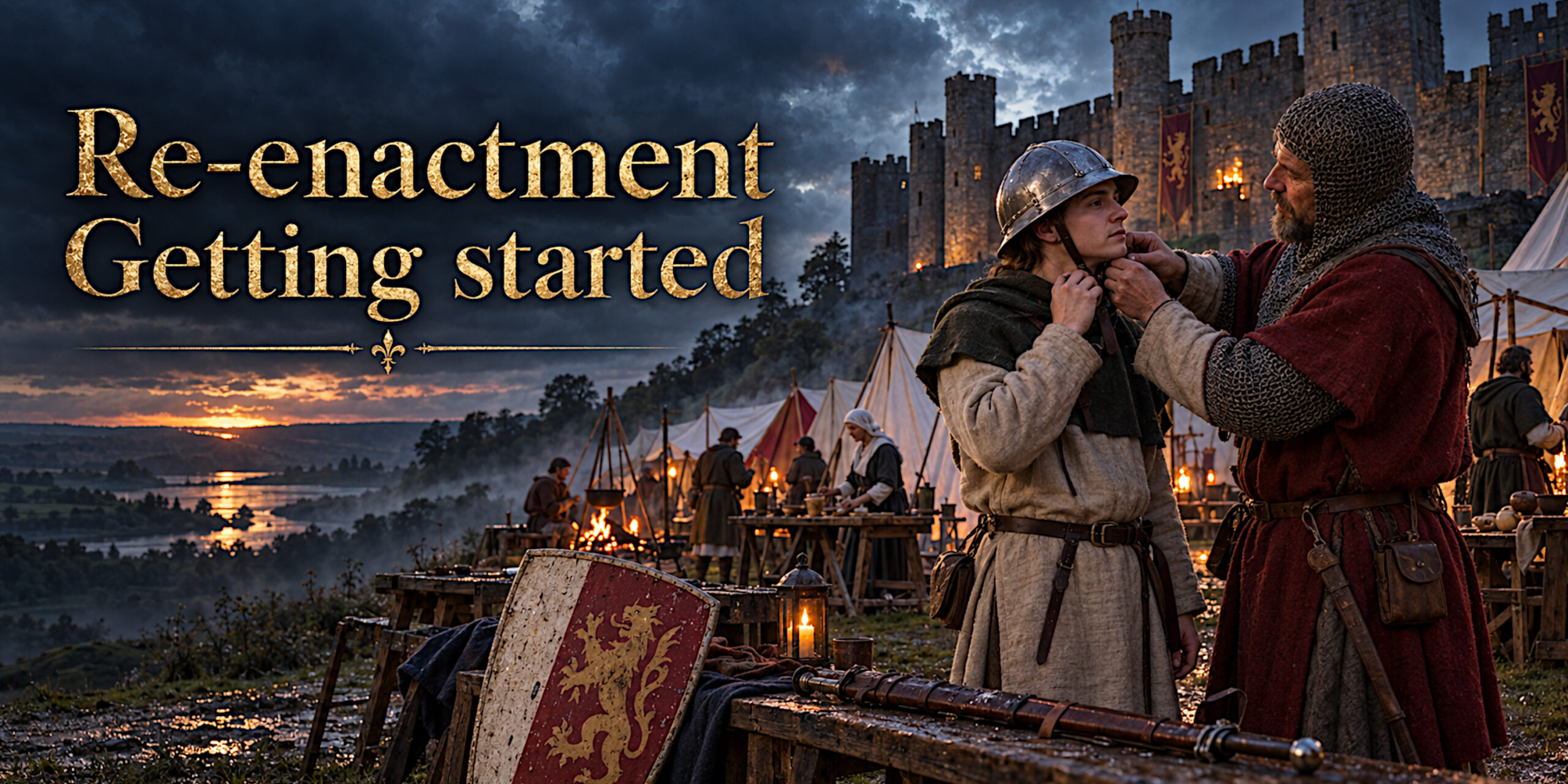
Historical re-enactment has a way of making small details matter. A badly fitted shoe becomes considerably more interesting after six hours on your feet. A woollen cloak stops being a picturesque accessory when the weather turns. Suddenly, the practical questions behind museum objects become rather personal.
For beginners, the best starting point is finding a welcoming group before buying clothing, weapons or camping equipment. Choose a period that interests you, visit a training session or public event, and ask what you can borrow while you learn.
You do not need armour, combat experience or an encyclopaedic knowledge of medieval belt fittings. Curiosity, patience and a willingness to help pack the van will take you surprisingly far.
What Does Historical Re-enactment Involve?
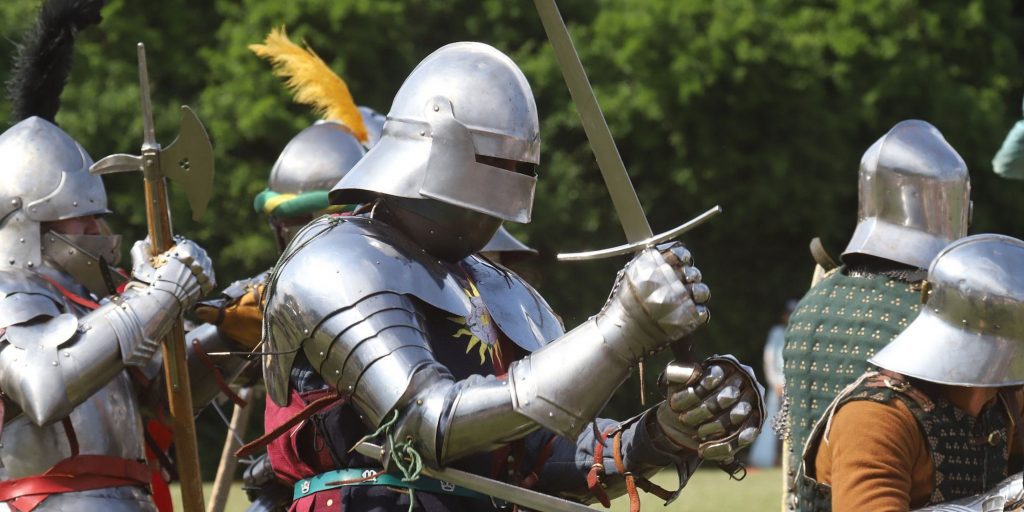
Historical re-enactment reconstructs aspects of the past through clothing, equipment, activities and public interpretation. Depending on the group, that might mean a battlefield display, a working craft demonstration or a carefully researched domestic setting.
There are several ways to participate.
| Activity | What it involves | What to ask before joining |
|---|---|---|
| Battle re-enactment | Training, drill and controlled combat under society rules | What assessments and protective equipment are required? |
| Living history | Presenting everyday activities, trades and social life | Which civilian roles need more people? |
| Historical crafts | Reconstructing techniques such as weaving, woodworking or leatherwork | Are beginners taught, and are tools available? |
| Public interpretation | Explaining objects, people and historical events to visitors | What research and presentation support is provided? |
| Experimental work | Testing a particular historical question through reconstruction | How are methods and findings recorded? |
These activities overlap, but they are not interchangeable. Making a meal over a fire can reveal practical difficulties without becoming a formal archaeological experiment. Equally, an impressive battle display involves compromises for safety, time and audience understanding.
I find re-enactment most convincing when participants explain those compromises openly. Knowing where the reconstruction ends is part of understanding the history.
Choose a Historical Period That Fits Your Life

An interest in a particular century helps. So does having a group within reasonable travelling distance.
Before committing, consider the clothing you would enjoy wearing, the activities you want to learn and how often you can attend. A distant regiment with magnificent uniforms may be less useful than a friendly local society that trains twice a month.
| Period | Possible interests | Practical considerations |
|---|---|---|
| Roman | Military equipment, drill, cooking and civilian trades | A complete military impression can involve substantial equipment |
| Early medieval | Anglo-Saxon, Viking Age and Norman life, crafts and combat | Clothing and accessories need to match a particular place and date |
| Later medieval | Archery, infantry, armour, textiles and household life | A civilian portrayal can offer a more manageable start than an armoured role |
| British Civil Wars | Pike, musket, artillery and seventeenth-century society | Ask about drill, role requirements and specialist training |
| Napoleonic | Regimental life, uniforms, music and civilian interpretation | Uniform details and equipment depend closely on the unit portrayed |
| Twentieth century | Military service, civilian life and the Home Front | Sensitive interpretation and precise equipment research are important |
Avoid beginning with an elaborate character who happens to own every expensive object you admire. An ordinary person, portrayed consistently, usually tells visitors more than a wandering collection of exceptional artefacts.
History already contains enough implausibly well-equipped aristocrats.
How to Find a Historical Re-enactment Group
Start with an established society’s official website, then contact its local groups or affiliated units.
Useful UK starting points include:
| Organisation | Historical focus | Where to begin |
|---|---|---|
| Regia Anglorum | Early medieval life, including Anglo-Saxon, Norse and Norman portrayals | Use its local group finder and discuss the activities that interest you |
| The Vikings | Early medieval warfare, clothing, crafts and daily life | Follow the joining links to find a nearby group |
| The Sealed Knot | The British Civil Wars | Contact a regiment about soldier and civilian roles |
| The Napoleonic Association | French Revolutionary and Napoleonic military and social history | Browse its units and membership information |
These organisations offer different routes into participation. Check the individual group’s expectations rather than assuming that membership, equipment or training arrangements are identical.
Smaller independent groups can also be excellent. Look for recent activity, clear joining information and people who answer beginner questions without treating them as an examination.
Questions to Ask Before Joining
A good first conversation should leave you knowing what happens next.
Ask about:
- Trial visits: Can you attend a training session before committing?
- Loan kit: What clothing and equipment can beginners borrow?
- Costs: What are the membership fees, local subscriptions and likely additional expenses?
- Training: Who teaches new members, and how is readiness assessed?
- Authenticity: Is there a written clothing guide or someone who approves purchases?
- Commitment: How many training sessions and events are members expected to attend?
- Participation: What civilian, craft and support roles are available?
- Access and family arrangements: What facilities, age restrictions and adjustments apply?
- Insurance: What activities does the society’s cover include, and what conditions apply?
Notice how the answers are delivered. Firm standards are useful. Humiliating newcomers is not a historical skill.
What Re-enactment Gear Should You Buy First?
Buy towards an agreed portrayal, rather than assembling a generic “historical” outfit.
Before spending money, establish the approximate date, location, occupation and social position you will represent. Ask your group to approve patterns, materials and significant purchases.
Regia Anglorum, for example, explicitly advises members to consult its authenticity officers before acquiring kit and says that basic loan equipment is often available locally.
A sensible buying order looks like this:
| Priority | Purchase | Why it belongs here |
|---|---|---|
| First | Basic clothing approved by your group | Creates a coherent foundation for your portrayal |
| Early | Suitable footwear | Fit matters throughout a long event |
| Early | Appropriate weather protection | Helps make outdoor participation comfortable |
| Next | Essential personal items | Eating equipment, headwear or a belt, where appropriate |
| Later | Tools and accessories for your chosen role | Adds detail based on what you actually do |
| After consultation | Weapons and protective equipment | Must satisfy both historical and activity requirements |
| Once committed | Tent and larger camp equipment | Avoids a costly purchase before you understand event arrangements |
Borrowing gives you time to discover what suits you. Second-hand equipment can also be useful, provided the group checks its suitability and condition.
A bargain stops being one when you have to buy the correct item afterwards.
Choosing Swords, Weapons and Armour
A sword is an understandable temptation, especially on a website called Seven Swords. It still deserves to wait.
A weapon needs to suit both the portrayal and the activity. A Viking Age sword, a later medieval arming sword and a seventeenth-century military sword belong to different historical settings. Their reproductions may also be made for entirely different uses.
Display replicas, sharp cutting swords, re-enactment weapons and HEMA trainers should never be assumed interchangeable.
Before buying, ask the group’s responsible officer about the exact requirements. Regia’s published guidance, for instance, describes weapon-specific training, inspections and approval procedures. Those are its arrangements, not a universal standard for every society.
The same caution applies to armour. Correct fit, coverage and suitability matter more than looking impressive in a photograph. A blunt edge alone does not make a weapon suitable for contact use.
Your first useful piece of equipment may turn out to be a pair of shoes. This is less romantic than a sword, but your feet have a persuasive argument.
How Much Does Historical Re-enactment Cost?
There is no reliable single starting price. Costs depend on your period, role, access to loan equipment, sewing skills and travel arrangements.
Rather than budgeting for one dramatic shopping trip, divide the expense into three parts.
| Cost category | What to include |
|---|---|
| Joining and learning | Membership, local subscriptions and travel to training |
| Personal kit | Clothing, footwear, repairs and any approved specialist equipment |
| Event attendance | Transport, food, accommodation or camping, and incidental expenses |
Ask an active member of your prospective group what a realistic first season costs with loan kit and without it. Request a short essential list separately from optional upgrades.
Travel deserves particular attention. A modest outfit used at nearby events may cost less overall than inexpensive kit accompanied by repeated journeys across the country.
Making clothing can reduce expenditure, but buy fabric only after checking the pattern and material requirements. Several metres of unsuitable cloth remain several metres of unsuitable cloth, however enthusiastically purchased.
You Do Not Have to Fight

Civilian interpretation deserves equal attention. Cooking, textile production, trade, household work and maintenance help explain how historical communities functioned.
Possible interests include:
- Spinning, weaving, embroidery and clothing repair.
- Food preparation and period cooking.
- Leatherwork, woodworking and appropriate metalworking.
- Writing, accounting and manuscript-related demonstrations.
- Games, music and storytelling.
- Explaining replica objects and the evidence behind them.
Choose an activity that you enjoy enough to research. Being able to explain why a tool has a particular shape is often more engaging than displaying a table full of objects with uncertain stories.
Finding Re-enactment Events to Visit
Visit an event as a spectator before deciding how you want to participate. Watch the public display, then spend time in the camps and craft areas.
Useful places to check include:
| Event source | What it can offer |
|---|---|
| English Heritage’s events calendar | Historical activities at heritage sites |
| English Heritage’s jousts and tournaments listings | Medieval displays and encampments |
| Battle of Evesham | A thirteenth-century-focused festival with battle and living-history activities |
| Society and regimental calendars | Public displays and opportunities to meet members |
English Heritage describes encampments and historical skills alongside its medieval spectacles, while Evesham’s official programme includes camp demonstrations as well as battle performances. Both are useful settings for looking beyond the fighting. English Heritage
Check current dates, booking conditions and access information directly before travelling. A spectator ticket does not automatically permit participation.
When approaching a group, choose a quiet moment. Someone putting on a helmet for an imminent display may be friendly, but their availability is about to become limited.
What to Expect at Your First Event
Agree your role and arrival arrangements beforehand. Find out what kit is being supplied, where you will sleep and who will help you settle in.
For a first event, prepare:
- Approved clothing and any agreed loan kit.
- Food and drinking arrangements.
- Suitable bedding and weather protection.
- Personal medication and necessary modern essentials.
- A change of clothes for travelling home.
- Time to help set up and pack away.
Keep essential modern items accessible, even where display rules require them to be discreet.
Expect periods of waiting, repeated questions from visitors and practical jobs between scheduled activities. Public history includes carrying things across fields. Occasionally, it includes carrying the same things back because someone has reconsidered where the tent should go.
Learning to Judge Historical Accuracy
Useful questions to ask about an item or interpretation include:
- What evidence supports it?
- Does that evidence belong to the right period and region?
- Is it typical, unusual or disputed?
- Which details have been reconstructed?
- What has been changed for safety or practicality?
Museum collections, excavation reports, surviving objects and contemporary images can all contribute. Each has limitations. An image may simplify construction; an excavated object may survive without the materials once attached to it.
Be willing to revise your understanding. Changing an outfit because stronger evidence has emerged is a sign that the research is working.
Re-enactment can help us explore how clothing, tools and equipment behave. It cannot reproduce the full experience of living in a past society. That distinction leaves plenty of room for enthusiasm without claiming more than the evidence allows.
Common Beginner Questions
Can I join without owning any kit?
Ask before buying anything. Some groups have loan equipment, though availability, sizing and borrowing conditions vary.
Do I need to know a lot of history?
You need a willingness to learn. Start with your role and the objects you use, then build your knowledge gradually.
Can children take part?
Some societies offer family participation. The Sealed Knot, for example, advertises family membership arrangements. Check supervision, safeguarding and activity restrictions with the specific group. The Sealed Knot
Must I camp in a historical tent?
Ask the organiser. Accommodation and camping arrangements depend on the event and your role.
What is the best first step?
Contact a nearby group and arrange a visit. Spend an afternoon with the people before spending money on the equipment. You will learn more about whether the hobby suits you from that conversation than from any shopping list.