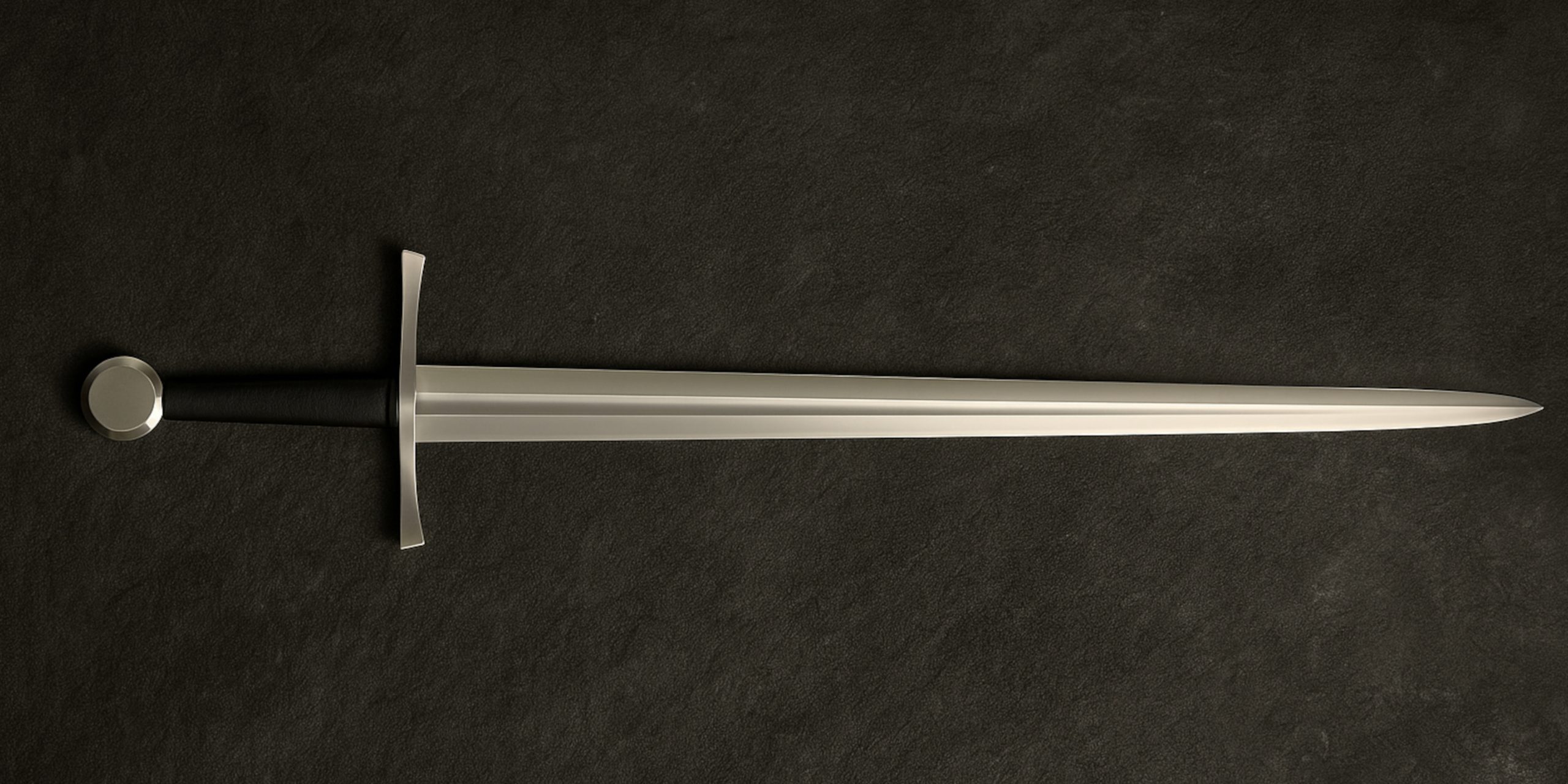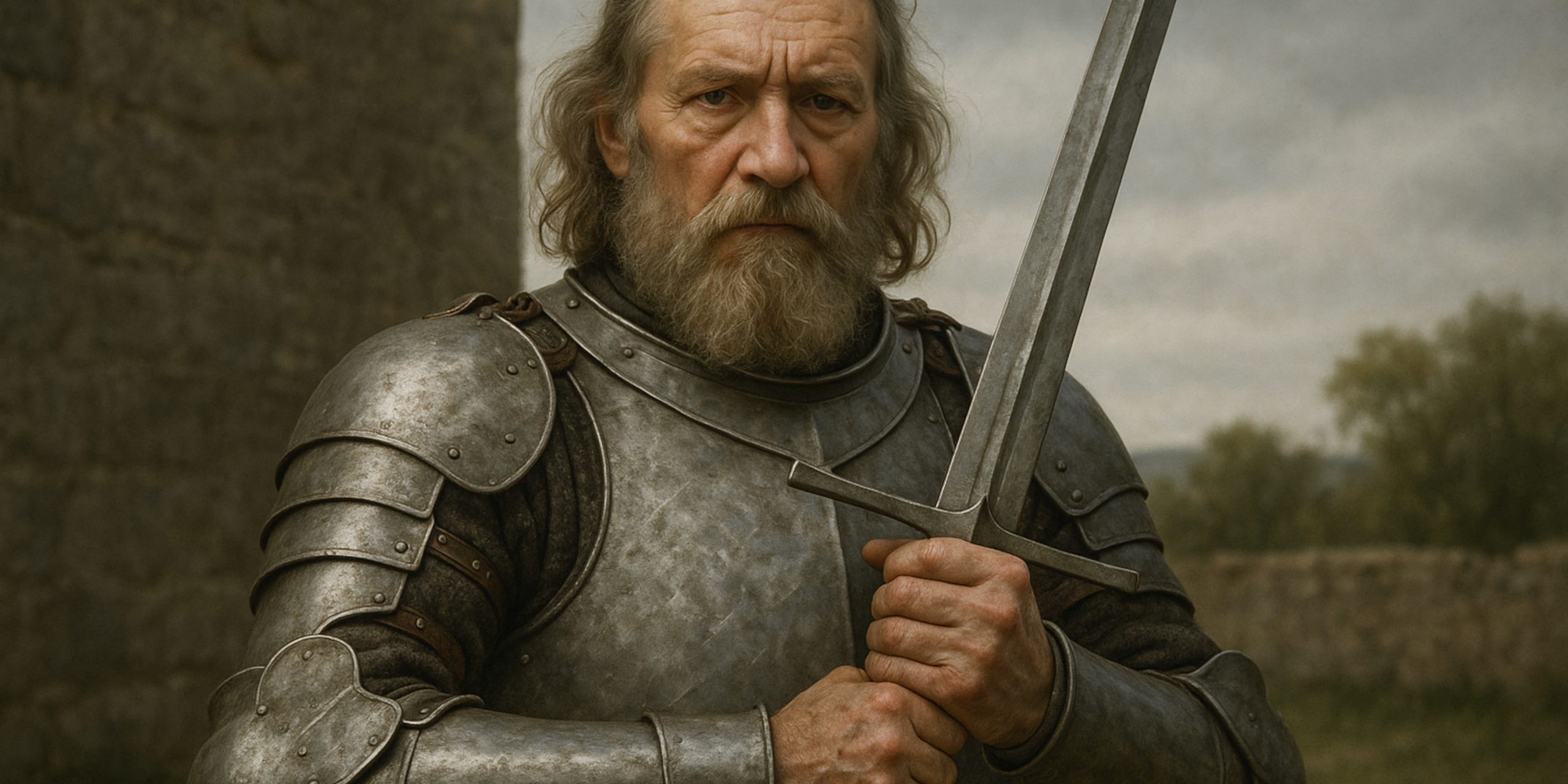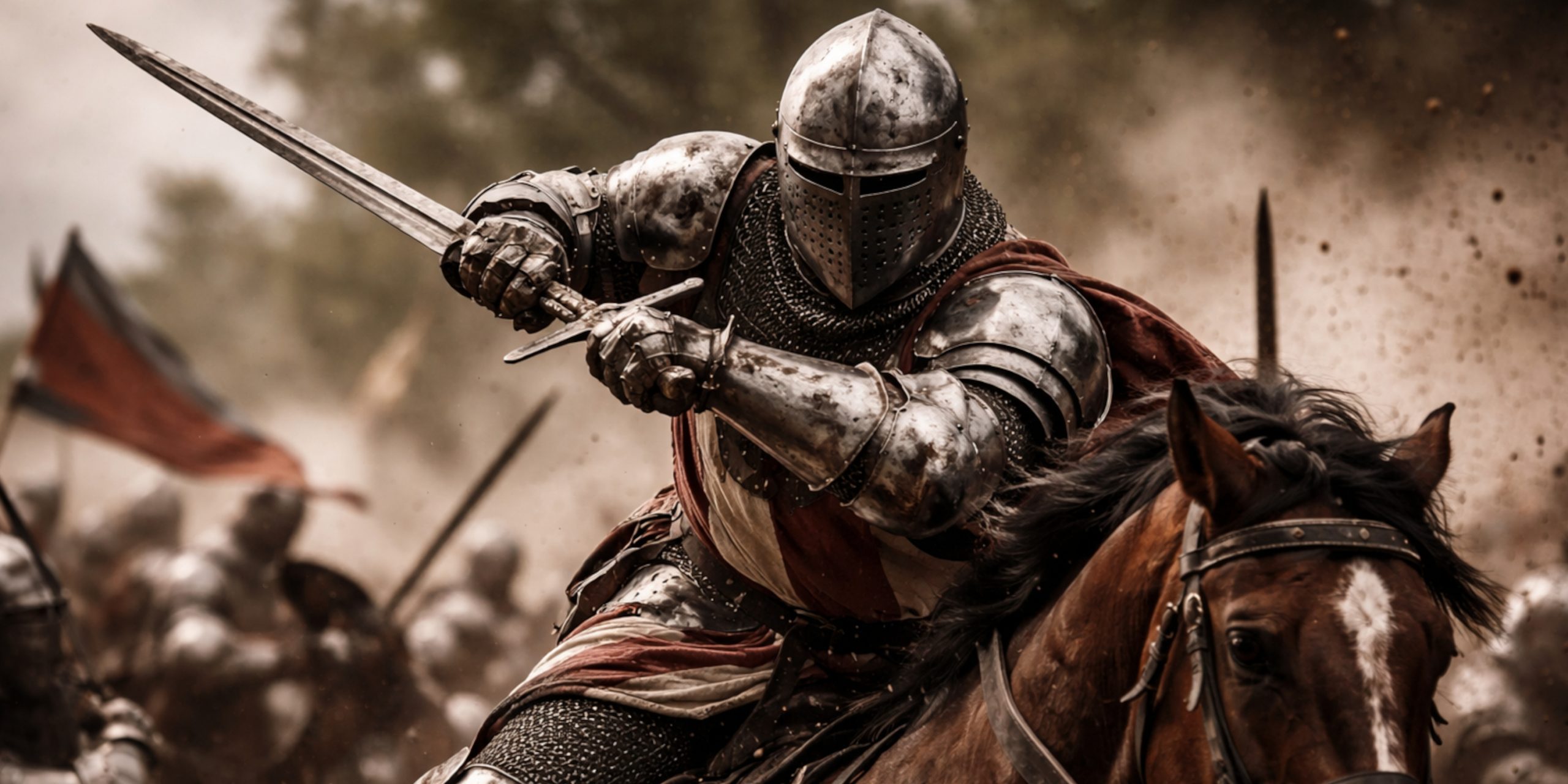
The longsword sits at the centre of late medieval European warfare and martial culture. It is one of those weapons that has been romanticised almost beyond recognition, yet the reality is more interesting. This was not simply a knight’s battlefield tool. It was a versatile weapon used in war, personal defence, judicial duels, and highly refined fencing systems.
What stands out is its balance between reach, control, and adaptability. Unlike earlier arming swords, the longsword was built to be used with two hands, though it could be wielded one-handed in certain situations. It reflects a period where armour, tactics, and martial theory were evolving quickly.
Specifications
| Feature | Typical Range |
|---|---|
| Overall Length | 100 to 130 cm |
| Blade Length | 80 to 100 cm |
| Weight | 1.1 to 1.8 kg |
| Grip Length | 15 to 25 cm |
| Balance Point | 5 to 10 cm from guard |
| Blade Type | Double-edged, straight |
Key characteristics
- Long grip allowing two-handed use
- Straight double-edged blade for cutting and thrusting
- Often tapered for improved point control
- Crossguard and pommel for hand protection and balance
Despite its reputation, the longsword was not excessively heavy. It relied on handling and precision rather than brute force.
History and Evolution
Early Development
The longsword began to emerge in the late 13th century as armour improved and battlefield demands shifted. Earlier swords struggled against mail and transitional plate, so blades became longer and more rigid.
Peak Period
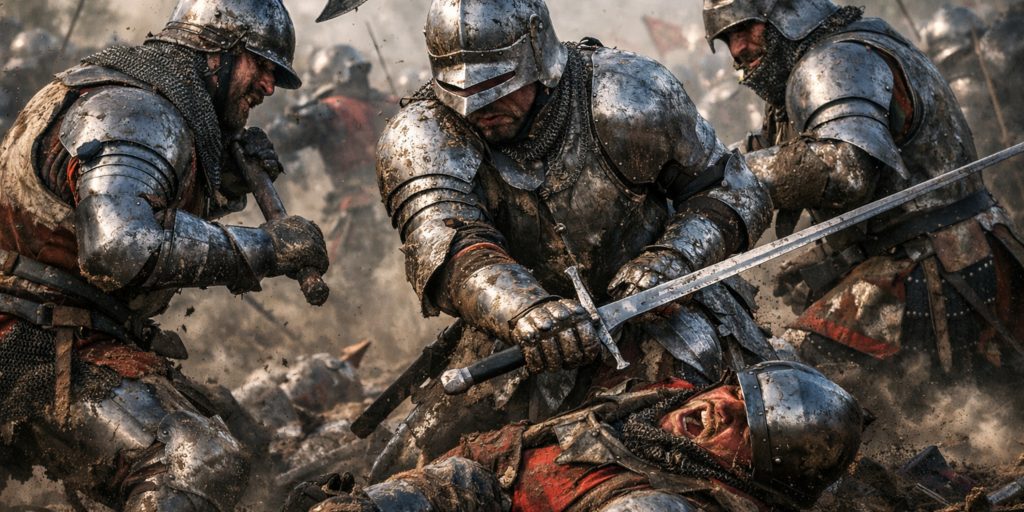
The 14th and 15th centuries represent the height of longsword use. This coincides with the development of German and Italian fencing traditions, preserved in manuals by masters such as Johannes Liechtenauer and Fiore dei Liberi.
These treatises show that longsword combat was highly technical, combining strikes, thrusts, grappling, and half-swording techniques.
Late Decline
By the 16th century, the longsword began to fade from battlefield use as firearms spread and specialised civilian weapons such as rapiers gained popularity. However, it remained in use for training, duelling traditions, and ceremonial contexts.
Oakeshott Typology and Longsword Classification
Ewart Oakeshott’s typology provides one of the most useful frameworks for understanding longsword development. Several types are closely associated with longsword forms.
| Type | Characteristics | Period |
|---|---|---|
| Type XIIa | Broad blade, strong cutting ability, longer grip | 13th to 14th century |
| Type XIIIa | Wide, parallel edges, great cutting power, often called “great swords” | 13th to 14th century |
| Type XVa | Narrow, stiff blade, optimised for thrusting against armour | 14th to 15th century |
| Type XVIa | Balanced cut and thrust design with reinforced point | 14th century |
| Type XVIIIa | Tapered blade, refined balance, versatile combat use | 15th century |
| Type XVIIIb | Longer, more slender blades, excellent reach and thrusting ability | 15th century |
Interpretation
- Earlier types prioritised cutting power
- Later types show a clear shift toward thrusting and precision
- Blade geometry reflects changes in armour and fighting techniques
Longsword Variants
The term “longsword” covers a range of related weapons rather than a single fixed design.
Common variants
- Hand-and-a-half sword
- Slightly shorter grip
- Usable with one or two hands
- Bastard sword
- Often used interchangeably with longsword
- Typically lighter and more versatile
- Great sword
- Larger and heavier
- Designed for battlefield dominance and reach
- Estoc
- Specialised thrusting weapon
- Often square or triangular in cross-section
- German langes Schwert
- Associated with Liechtenauer tradition
- Emphasis on fluid, technical fencing
- Italian spada longa
- Used in Fiore’s system
- Strong integration of grappling and leverage
Advantages and Disadvantages
Advantages
- Excellent reach and leverage
- Versatile, capable of cutting, thrusting, and grappling
- Effective against a range of armour types
- Highly adaptable to different combat scenarios
Disadvantages
- Requires training and technique to use effectively
- Less practical in tight formations or confined spaces
- Slower than smaller one-handed weapons in close quarters
- Not ideal for prolonged one-handed use
Combat Use and Technique
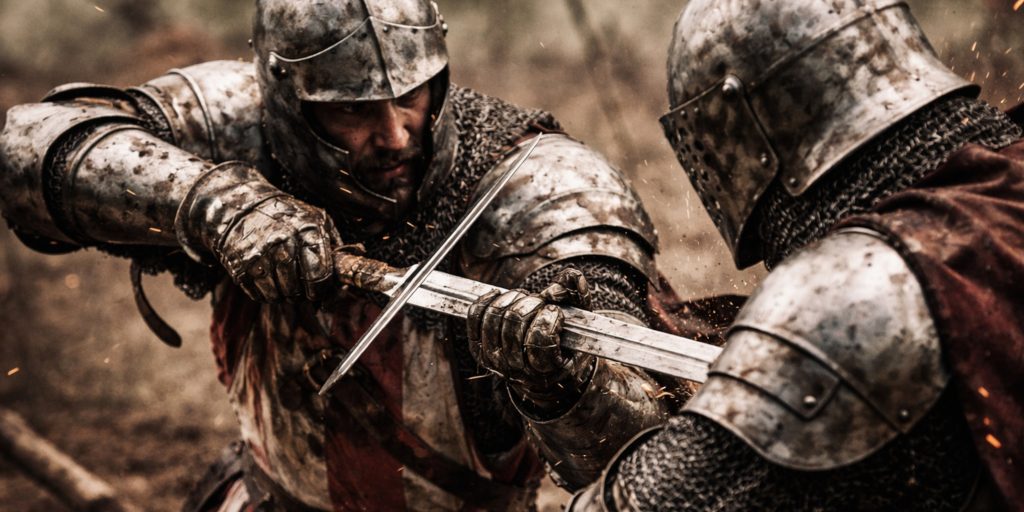
Longsword fencing was far more sophisticated than many assume.
Core techniques
- Cutting with edge alignment and body mechanics
- Thrusting to weak points in armour
- Half-swording, gripping the blade for precision control
- Mordhau, using the sword as a blunt weapon
- Grappling and disarming integrated into combat
This blend of techniques shows that the longsword was part of a complete martial system rather than just a striking weapon.
Comparison with Similar Weapons
| Weapon | Key Difference | Use Case |
|---|---|---|
| Arming Sword | Shorter, one-handed | Shield-based combat |
| Claymore | Larger and heavier | Battlefield shock weapon |
| Rapier | Narrow, thrust-focused | Civilian duelling |
| Falchion | Single-edged, chopping power | Infantry use |
| Estoc | No cutting edge, thrust only | Anti-armour combat |
The longsword sits between these extremes, offering both power and finesse.
Legacy
The longsword remains one of the most studied and reconstructed weapons in historical martial arts today.
Its legacy includes:
- Revival through Historical European Martial Arts groups
- Continued academic interest in medieval combat systems
- Influence on modern depictions of knights and warriors
- Presence in films, games, and literature
There is a certain irony here. A weapon once designed for survival has become a subject of study, almost like a language being rediscovered.
Martial Tradition & Manuals
Medieval combat masters meticulously documented longsword techniques:
| Master | Contribution | Period |
|---|---|---|
| Johannes Liechtenauer | Founded the German school of longsword combat. | 14th Century |
| Fiore dei Liberi | Authored Fior di Battaglia, detailing armoured and unarmoured combat. | 15th Century |
| Joachim Meyer | Expanded techniques in Renaissance-era manuals. | 16th Century |
These texts underpin HEMA (Historical European Martial Arts), a global movement reviving historical combat.
The Longsword in Modern HEMA
HEMA enthusiasts breathe new life into ancient techniques:
- Tools: Use feders (flexible training swords) and synthetic/steel replicas.
- Practice: Sparring, tournament competitions, and meticulous study of historical stances (e.g., posta di donna).
- Philosophy: Combines athletic rigour with scholarly research, far beyond theatrical re-enactment.
Collecting Longswords: A Guide
Key Considerations
| Factor | Advice |
|---|---|
| Historical Accuracy | Opt for replicas mirroring period designs (e.g., Oakeshott typology). |
| Craftsmanship | Trusted makers: Albion, Arms & Armor, Regenyei. |
| Balance | A well-made blade feels agile, not unwieldy. |
| Materials | High-carbon steel (e.g., 5160) for functionality; avoid decorative stainless steel. |
Types of Longswords
| Category | Purpose |
|---|---|
| Wall-hanger | Purely decorative; unsuitable for combat. |
| Battle-ready | Functional, forged blades for cutting practice. |
| HEMA Feder | Flexible, blunted tips for safe sparring. |
Cultural Legacy
| Realm | Examples |
|---|---|
| Literature | The Lord of the Rings, Arthurian legends. |
| Film & TV | The Witcher, Kingdom of Heaven. |
| Video Games | Dark Souls, For Honor. |
| Academia | Bridges history, metallurgy, and martial philosophy. |
The longsword transcends its medieval origins. It is a testament to craftsmanship, a bridge to martial traditions, and a cultural icon that captivates historians, collectors, and fighters alike. Whether admired in a glass case or wielded in a sparring ring, it remains a timeless symbol of prowess and artistry.
Where to See Longswords Today
Notable locations
- Royal Armouries, Leeds
- British Museum, London
- Wallace Collection, London
- Kunsthistorisches Museum, Vienna
- Musée de l’Armée, Paris
These collections often display original examples spanning different Oakeshott types, offering a clear view of how designs evolved.
Collector’s Guide and Auction Prices
The market for longswords varies widely depending on authenticity, condition, and provenance.
Original Historical Pieces
| Category | Price Range |
|---|---|
| Fragmentary blades | £3,000 to £8,000 |
| Complete but worn examples | £10,000 to £40,000 |
| High-quality museum-grade pieces | £50,000 to £150,000+ |
Modern Reproductions
| Type | Price Range |
|---|---|
| Entry-level replicas | £150 to £400 |
| Functional HEMA swords | £400 to £900 |
| High-end custom pieces | £1,000 to £5,000+ |
What collectors look for
- Provenance and documented history
- Blade geometry and typology accuracy
- Condition, especially original fittings
- Maker marks or inscriptions
A well-preserved longsword with clear typological features will always attract strong interest.
Takeaway
The longsword is often treated as a symbol rather than a tool, but its real story lies in its adaptability. It evolved alongside armour, tactics, and martial theory, and it reflects a period where combat was as much about knowledge as strength.
If you strip away the myth, what remains is a weapon that rewards skill, precision, and understanding. That, more than anything, explains why it continues to fascinate.