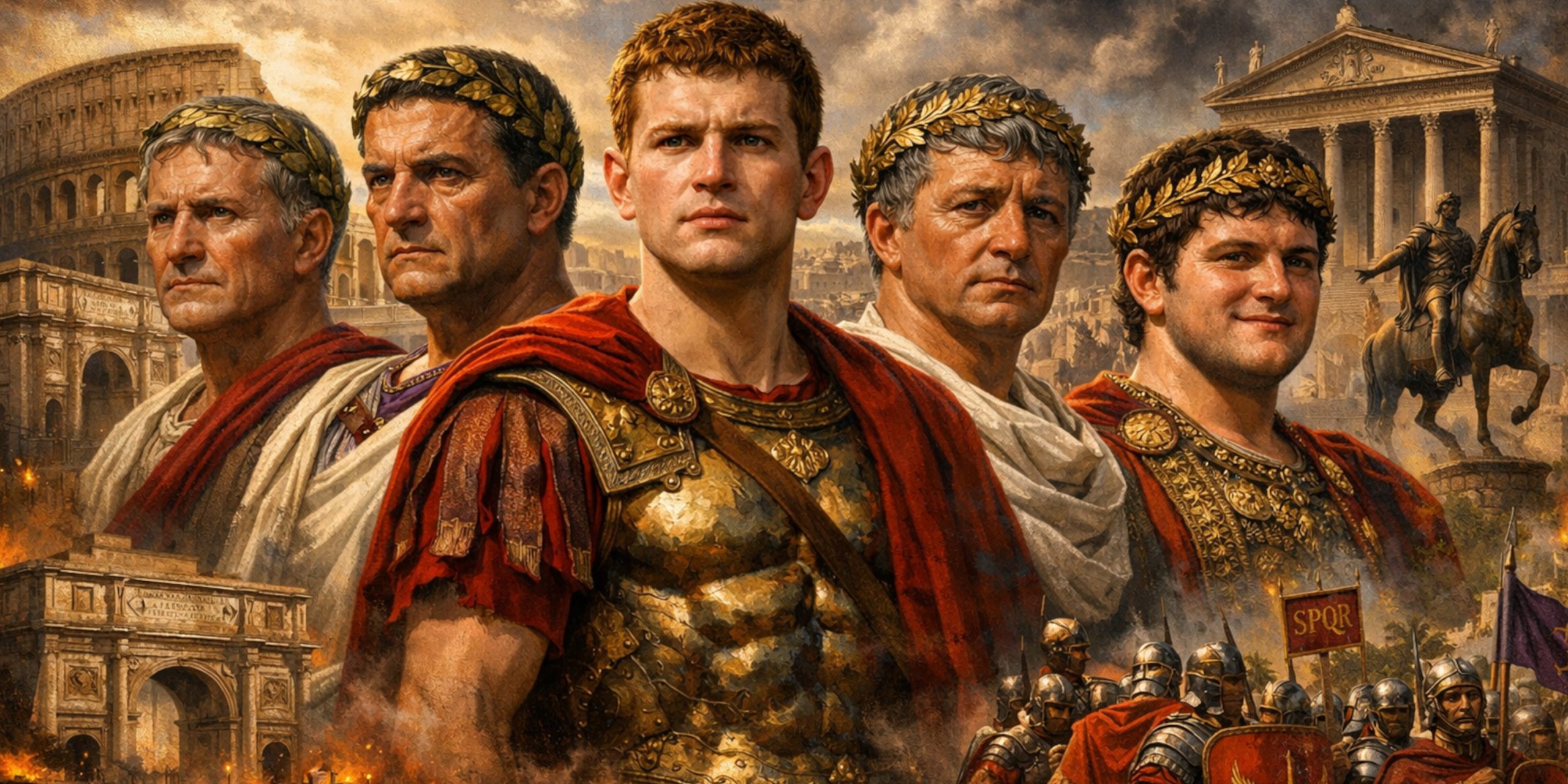
The family that built the Roman Empire, inherited it, quarrelled over it, poisoned each other over it, and then somehow still managed to rule for nearly a century.
The Julio-Claudian dynasty ruled Rome from 27 BC to AD 68. It began with Augustus, the adopted son of Julius Caesar, and ended with Nero, whose death left the empire in chaos and several ambitious men eyeing the throne with the enthusiasm of gulls around a dropped loaf.
This was Rome’s first imperial family. They created the model of emperorship that every later ruler would either follow or fail to live up to. The dynasty gave Rome peace, expansion, immense wealth and some of the finest public buildings in the ancient world. It also produced paranoia, family feuds, murders, exile, theatrical vanity and a rather alarming enthusiasm for solving political problems with poison.
As a historian, I have always found the Julio-Claudians impossible to resist. They are simultaneously impressive and faintly ridiculous. They built an empire that lasted centuries, yet often behaved like a family incapable of surviving a single awkward dinner.
Who Were the Julio-Claudians?
The dynasty took its name from two great Roman families:
- The Julii, the family of Julius Caesar and Augustus
- The Claudii, an ancient and fiercely aristocratic Roman clan
The two families became linked through marriage and adoption. Roman politics often worked this way. Blood mattered, but so did legal adoption, alliances and the ability to appear respectable while quietly removing inconvenient relatives.
The Julio-Claudian emperors were:
- Augustus, ruled 27 BC to AD 14
- Tiberius, ruled AD 14 to 37
- Caligula, ruled AD 37 to 41
- Claudius, ruled AD 41 to 54
- Nero, ruled AD 54 to 68
Each emperor was related in some way to Augustus. The family tree is so tangled that one eventually reaches the point where everyone seems to be an uncle, cousin, nephew, adopted son or deeply suspicious stepmother.
Augustus: The Founder
Early Life and Rise to Power
Augustus was born Gaius Octavius in 63 BC. He was the grand-nephew and adopted heir of Julius Caesar. When Caesar was assassinated in 44 BC, Octavian was only eighteen. Most Roman politicians assumed he would be brushed aside. This proved to be one of the great misjudgements in history.
Quiet, careful and outwardly modest, Octavian defeated every rival who stood against him. He formed an alliance with Mark Antony and Lepidus, then discarded Lepidus and defeated Antony and Cleopatra at the Battle of Actium in 31 BC.
By 27 BC, Octavian had become Augustus, Rome’s first emperor.
Augustus and the New Empire
Augustus understood that Romans hated kings. Julius Caesar had learned that lesson the hard way, with several knives and a senate chamber floor. Augustus therefore avoided calling himself king.
Instead, he presented himself as:
- Princeps, meaning “first citizen”
- Commander of the Roman armies
- Defender of Roman traditions
In reality, he controlled everything.
Augustus reorganised the army, created a professional civil service, reformed taxation and expanded the empire. He also embarked on an enormous building programme.
He famously claimed:
“I found Rome a city of brick and left it a city of marble.”
For once, an ancient ruler was not exaggerating terribly.
Rome under Augustus gained:
- New temples and forums
- Roads and aqueducts
- A standing army of roughly 250,000 men
- Greater stability after decades of civil war
Yet Augustus also ruled through fear and careful management. Political opponents vanished from public life with remarkable speed. Family members who disappointed him were exiled. His daughter Julia was banished for scandalous behaviour, which appears to have consisted largely of enjoying herself too publicly.
Tiberius: The Reluctant Emperor
Tiberius, Augustus’ stepson, became emperor in AD 14.
He was a brilliant general and an able administrator, but one senses immediately that he disliked both people and being emperor. Unfortunately, the two came together rather inconveniently.
Tiberius was:
- Intelligent
- Experienced
- Suspicious
- Intensely private
At first, he governed well. He kept Rome financially stable and avoided reckless wars. He strengthened the empire’s frontiers and managed the provinces effectively.
Yet over time, Tiberius became increasingly withdrawn and distrustful. He eventually left Rome and retired to the island of Capri, leaving much of the government in the hands of the Praetorian prefect Sejanus.
This was a mistake of impressive proportions.
Sejanus used his position to eliminate rivals and increase his own power. Eventually Tiberius turned on him, had him executed and then spent the rest of his reign seeing conspiracies everywhere.
Roman historians paint Tiberius as dark, secretive and cruel. Some of this was probably exaggerated by hostile writers. Tacitus in particular never met a gloomy emperor he could not make gloomier.
Caligula: The Emperor Who Went Too Far
Caligula, whose real name was Gaius, became emperor in AD 37.
At first, Rome adored him. He was young, charismatic and the son of the popular Germanicus. Crowds welcomed him enthusiastically. For a brief moment, it seemed the empire had finally acquired a ruler who was both competent and pleasant.
This did not last.
After a serious illness, Caligula’s behaviour became increasingly erratic. Ancient sources accuse him of:
- Cruelty
- Extravagance
- Executing rivals on a whim
- Declaring himself a god
- Humiliating senators for sport
There is even the famous story that he planned to make his horse, Incitatus, a consul.
The truth is uncertain. He may have been mocking the senate rather than genuinely promoting a horse to high office. Frankly, given some of the senators available, one can see why he may have considered the experiment.
Caligula spent enormous sums on games, palaces and extravagant spectacles. He alienated the senate, the army and eventually the Praetorian Guard.
In AD 41, he was assassinated.
He had ruled for less than four years.
Claudius: The Unlikely Success
After Caligula’s death, the Praetorian Guard found Claudius hiding behind a curtain in the imperial palace.
This is not, perhaps, the grand entrance one imagines for an emperor.
Claudius had long been dismissed by his family. He had a limp, a stammer and various physical disabilities. Roman aristocrats, never known for their kindness, assumed he was foolish.
They were wrong.
Claudius proved to be one of the most capable Julio-Claudian rulers.
He:
- Expanded the empire into Britain
- Reformed the legal system
- Improved the bureaucracy
- Built roads, harbours and aqueducts
The conquest of Britain began in AD 43. Claudius himself travelled to the province and returned to Rome in triumph.
He also built the great harbour at Ostia, improving Rome’s grain supply. Few things frightened Roman emperors more than the possibility of a hungry mob.
Claudius relied heavily on freedmen and imperial officials rather than senators. This made government more efficient, but deeply offended the Roman elite. Roman senators liked to imagine they were essential. Claudius quietly proved otherwise.
The Women of the Dynasty
The Julio-Claudian women were among the most powerful figures in Roman history.
Roman society officially excluded women from politics. In practice, imperial women exercised enormous influence behind the scenes.
Important figures included:
- Livia, wife of Augustus
- Agrippina the Elder
- Agrippina the Younger
- Messalina
- Julia, daughter of Augustus
Livia
Livia, Augustus’ wife, was intelligent, composed and politically formidable. Ancient rumours accused her of poisoning rivals to ensure that her son Tiberius became emperor.
There is no firm evidence for this, although one suspects that if Livia had wished to poison someone, she would have done it efficiently and without leaving clues for Tacitus.
Messalina
Messalina, wife of Claudius, became notorious for scandal and intrigue. Roman writers describe her as wildly promiscuous and dangerously ambitious.
Much of this may have been exaggerated. Roman historians often treated powerful women with all the fairness of a modern tabloid. Still, Messalina certainly plotted against rivals and was eventually executed.
Agrippina the Younger
Agrippina the Younger, mother of Nero, was perhaps the most formidable woman of them all.
She married Claudius, persuaded him to adopt Nero, then helped place her son on the throne.
For a time, Agrippina dominated the government. Coins even showed her beside Nero, an extraordinary display of female power in Rome.
Eventually Nero grew tired of his mother’s influence.
He had her murdered.
The Julio-Claudians had an unfortunate habit of treating family gatherings as opportunities for assassination.
Nero: The End of the Dynasty
Nero became emperor in AD 54 at the age of sixteen.
At first, his reign seemed promising. Guided by his mother Agrippina, the philosopher Seneca and the prefect Burrus, Nero governed moderately and sensibly.
Then, rather disastrously, he began to take a greater interest in ruling personally.
Nero loved:
- Music
- Poetry
- Chariot racing
- Theatre
- Himself
He considered himself a great artist. Unfortunately, his talents appear to have been rather less impressive than his confidence.
Roman elites found his public performances embarrassing. The emperor was expected to lead armies and govern an empire, not spend evenings singing on stage while the audience politely prayed for the performance to end.
The Great Fire of Rome
In AD 64, a great fire devastated Rome.
Ancient rumours claimed Nero started it himself so that he could rebuild the city. There is no reliable evidence for this. He was not even in Rome when the fire began.
The famous story that Nero “fiddled while Rome burned” is also nonsense. Violins had not yet been invented, which does rather complicate the tale.
Nero did, however, use the destruction to build his enormous Golden House, the Domus Aurea. This vast palace contained gardens, lakes and extravagant decorations.
It made Nero appear selfish and out of touch at precisely the wrong moment.
To divert blame, Nero persecuted Christians. This was the first major Roman persecution of the new religion.
The Fall of Nero
By AD 68, Nero had alienated almost everyone.
The senate despised him. The army had lost confidence in him. Provincial governors rebelled.
When the Praetorian Guard abandoned him, Nero fled Rome.
Faced with capture, he committed suicide.
According to tradition, his final words were:
“What an artist dies in me.”
One feels, perhaps unfairly, that this was not the most pressing issue at the time.
With Nero’s death, the Julio-Claudian dynasty ended.
Government and Power Under the Dynasty
The Julio-Claudians created the basic structure of the Roman Empire.
They established:
- A permanent imperial office
- Professional armies loyal to the emperor
- An imperial bureaucracy
- Greater control over the provinces
The senate continued to exist, but its real power steadily declined. Emperors still pretended to respect it. Senators still pretended they mattered. Both sides maintained the performance with admirable determination.
The Praetorian Guard also became increasingly important. Originally created to protect the emperor, it soon discovered that it could make and unmake emperors as well.
This was not an encouraging development.
The Julio-Claudian Legacy
The Julio-Claudians left a complicated legacy.
They brought Rome stability after the civil wars of the late Republic. Under their rule, the empire expanded, cities flourished and Roman culture reached extraordinary heights.
Yet they also established many of the darker habits of imperial government:
- Court intrigue
- Political purges
- Personality cults
- Rule through fear
- Dangerous struggles over succession
Later emperors inherited both the strengths and the weaknesses of the system they created.
As a female historian, I find the dynasty fascinating partly because it reveals how power really worked in Rome. Officially, Rome was a world of stern male senators and noble republican values. In reality, it was a place shaped by ambitious mothers, clever wives, frightened emperors, ambitious guards and exhausted administrators trying to keep the machinery of empire from collapsing.
Behind the marble statues and grand speeches were human beings, vain, frightened, brilliant and often absurd. That, perhaps, is why the Julio-Claudians remain so compelling.
Their empire changed the world. Their family would not have survived a long weekend together.