The Dynasty That Built Baghdad
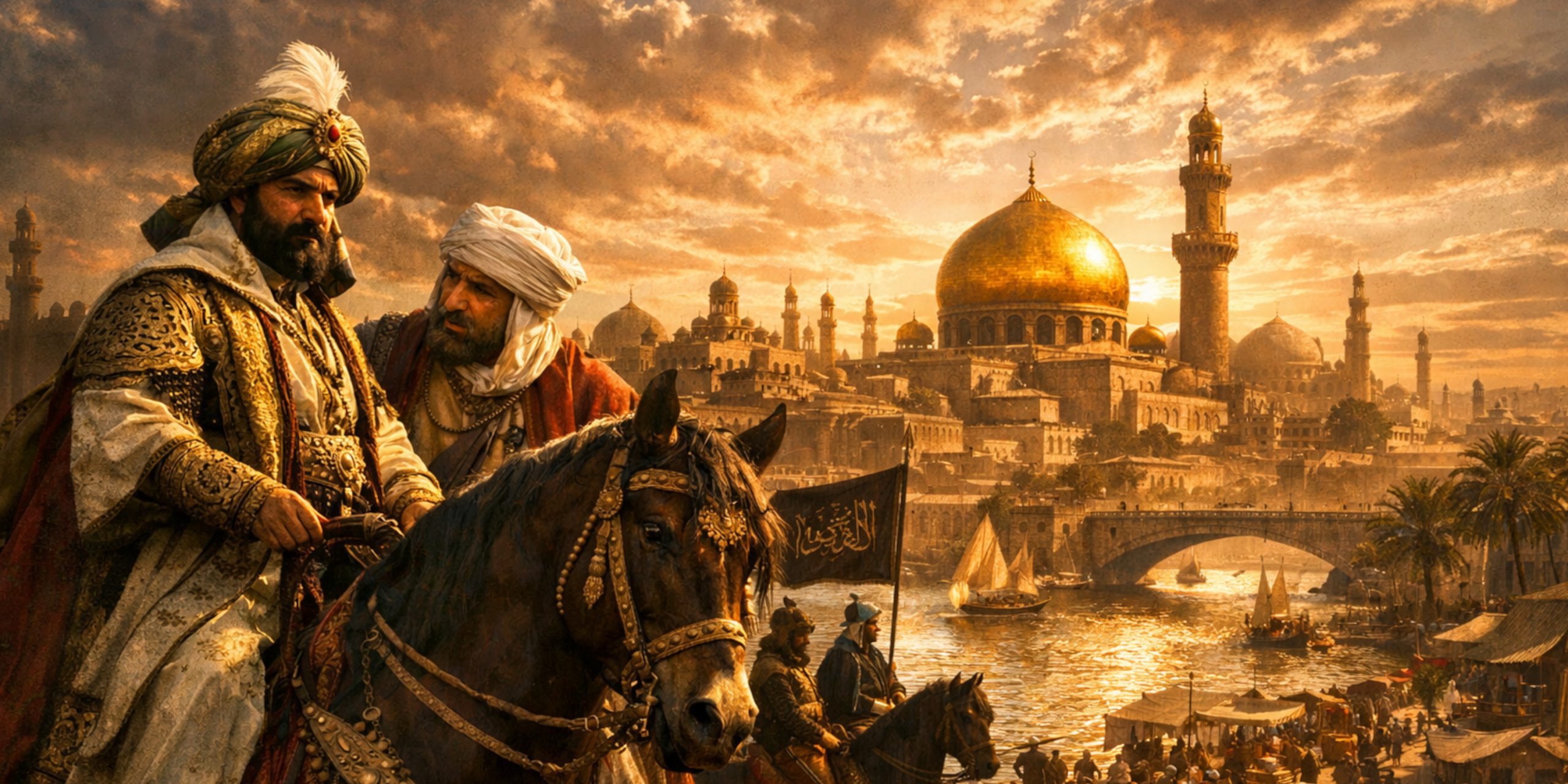
The Abbasid Dynasty ruled much of the Islamic world from 750 to 1258, and in one rather awkward afterlife survived ceremonially in Cairo until 1517. They began as revolutionaries, swept aside the Umayyads, built Baghdad, patronised scholars, commanded armies, quarrelled endlessly with one another, and eventually watched their great capital fall to the Mongols.
That, admittedly, is the brisk version.
The Abbasids were descendants of al-Abbas, the uncle of the Prophet Muhammad. By claiming a closer familial connection to the Prophet than the Umayyad rulers, they gathered support from groups who felt excluded or disappointed by Umayyad rule. Persians in Khurasan, Shi’a sympathisers, non-Arab Muslims and a fair number of people who simply wanted rid of the existing regime all rallied to the Abbasid cause.
When the Abbasids seized power in 750, they inherited a vast empire stretching from North Africa to Central Asia. They also inherited all the usual problems that come with ruling an enormous empire: rebellious governors, ambitious generals, religious disputes, taxes, and the persistent difficulty of getting messages from one end of the empire to the other before everyone involved had either changed sides or died.
The Abbasid Revolution
The Abbasid rise began in eastern Iran and Khurasan. The movement was carefully organised and led by Abu Muslim, a brilliant and rather alarming revolutionary figure whose loyalty to the Abbasids was eventually rewarded in the traditional manner, by being murdered once he had become too powerful.
In 750, the Abbasids defeated the Umayyads at the Battle of the Zab. The first Abbasid caliph, Abu al-Abbas al-Saffah, entered Kufa and declared a new era.
Al-Saffah’s nickname means “the Blood-Shedder”, which is not the sort of title one gives a ruler who is expected to enjoy gardening and poetry. It reflected the ruthless destruction of Umayyad opposition. Most of the Umayyad family was hunted down and killed, though one survivor escaped to Spain and founded the Umayyad Emirate of Cordoba.
The Abbasids were more inclusive than the Umayyads. Persian officials, scholars and administrators became central to the state. Arabic remained the language of government, but Persian customs, court ceremony and political ideas increasingly shaped the dynasty.
Baghdad, The Greatest City in the World
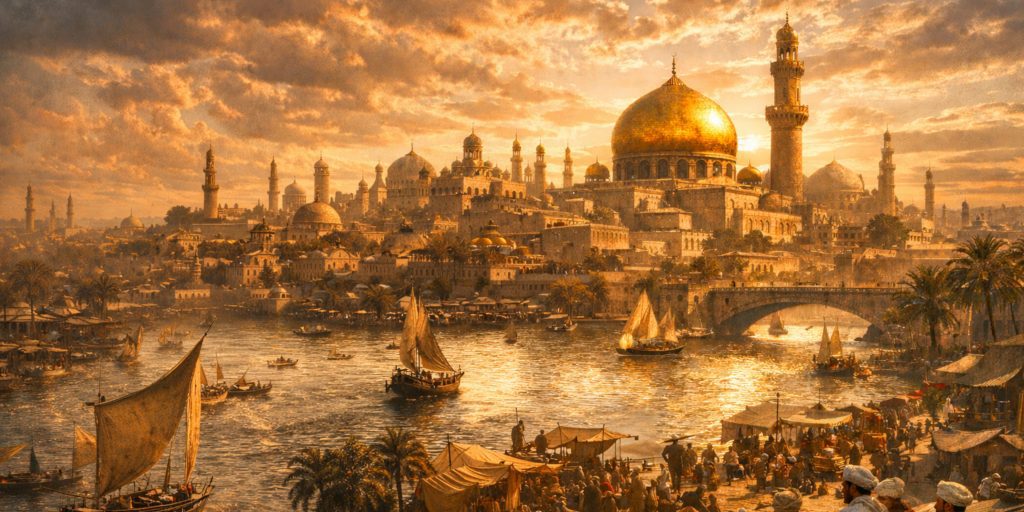
The second caliph, al-Mansur, founded Baghdad in 762. He chose a site on the Tigris close to old Persian imperial centres and major trade routes. Baghdad was planned as a circular city with walls, gates and a palace complex at its centre.
There is something wonderfully ambitious about founding an entirely new capital and simply assuming it will become the centre of the world. In the Abbasid case, rather annoyingly for their rivals, it worked.
By the ninth century Baghdad had become perhaps the richest and most sophisticated city on earth. Merchants arrived from India, China, East Africa, Byzantium and western Europe. The city’s markets sold spices, books, silk, glass, carpets, ivory and enough perfumes to make a modern department store look rather restrained.
Baghdad was also a city of libraries, mosques, observatories and hospitals. Streets were lit at night. Water was carried through canals. Scholars debated philosophy while merchants argued over prices and officials tried, usually without complete success, to keep order.
The city was not perfect. Medieval cities rarely were. Baghdad could be crowded, noisy, politically dangerous and prone to riots. Yet compared with most contemporary capitals it was dazzling.
The Great Abbasid Caliphs
Al-Mansur (754-775)
Al-Mansur was the real founder of Abbasid power. He built Baghdad, strengthened the government and ruthlessly removed rivals. One suspects he would have been absolutely intolerable at dinner parties, but undeniably effective.
Harun al-Rashid (786-809)
Harun al-Rashid became the most famous Abbasid ruler, partly because he genuinely presided over a glittering court and partly because later writers turned him into a legend.
He appears repeatedly in One Thousand and One Nights, wandering Baghdad in disguise and encountering all manner of strange adventures. The historical Harun was less whimsical and more politically minded, but his reign did coincide with great prosperity.
Harun maintained relations with rulers as distant as Charlemagne. He expanded trade, supported learning and strengthened the empire’s prestige.
Al-Ma’mun (813-833)
Al-Ma’mun was one of the most intellectually ambitious Abbasid rulers. After winning a bitter civil war against his brother, he encouraged scholarship, philosophy and science.
Under his rule the famous House of Wisdom in Baghdad flourished. Greek, Persian and Indian texts were translated into Arabic. Scholars studied mathematics, medicine, astronomy and philosophy.
Al-Ma’mun admired reason and debate, though rather less charmingly he also tried to impose his own religious views on others. His attempt to force scholars to accept particular doctrines created resentment and controversy.
The House of Wisdom and the Islamic Golden Age
If one wishes to understand why the Abbasids matter, this is the heart of it.
The Abbasid period is often called the Islamic Golden Age. Baghdad became a centre of learning where scholars from different backgrounds worked together. Muslims, Christians, Jews and others translated ancient texts and expanded on them.
The House of Wisdom was not simply a library. It was a research centre, translation bureau and meeting place for intellectuals.
Among the achievements of the Abbasid age:
- Al-Khwarizmi developed algebra and gave us the word “algorithm”. Every modern computer owes him a debt, which is a rather pleasing revenge by the ninth century upon the twenty-first.
- Abbasid astronomers mapped the stars and improved the astrolabe.
- Physicians such as al-Razi and later Ibn Sina advanced medicine and wrote texts used in Europe for centuries.
- Geographers described lands from Spain to China.
- Paper-making spread from China into the Islamic world, making books far cheaper and more common.
- Philosophers studied Aristotle and Plato, preserving ideas that might otherwise have vanished.
The Abbasids did not merely preserve knowledge. They changed it, argued with it and improved it.
Government and Society
The Abbasid Empire was ruled by the caliph, but in practice much power lay with viziers, governors and military commanders.
The most famous vizier family was the Barmakids, who served Harun al-Rashid before suffering a sudden and dramatic fall from favour. Their destruction remains one of history’s more elegant reminders that serving powerful rulers can be hazardous to one’s continued existence.
Society under the Abbasids was diverse.
- Arabs remained influential, especially in religion and politics.
- Persians became central to administration and culture.
- Turks increasingly served in the army.
- Christians and Jews often worked as doctors, translators and officials.
- Merchants prospered through long-distance trade.
- Enslaved people formed an important but grim part of the economy.
Women in the Abbasid world could sometimes hold considerable influence, especially within the royal court. Several mothers of caliphs shaped politics behind the scenes. Zubayda, the wife of Harun al-Rashid, was famous for her wealth, intelligence and charitable works.
As a historian, I find it impossible not to notice how often these women appear briefly in the sources, accomplish something extraordinary, and are then hustled politely into the margins by male chroniclers who preferred to discuss battles.
Religion and Power
The Abbasids presented themselves as defenders of Islam, but religion within the empire was rarely simple.
Sunni Islam became dominant, though Shi’a groups continued to challenge Abbasid authority. Religious scholars, known as ulama, gradually gained influence. By the tenth century the caliphs were still important, but religious authority increasingly belonged to scholars and jurists.
The Abbasids also governed large numbers of Christians, Jews and other communities. These groups paid special taxes but were generally allowed to practise their own faiths.
Tolerance under the Abbasids was real, though not unlimited. Conditions varied according to the ruler, the period and the political mood. Medieval governments, one quickly learns, were perfectly capable of being enlightened on Tuesday and rather less so by Thursday.
Armies, Warfare and Expansion
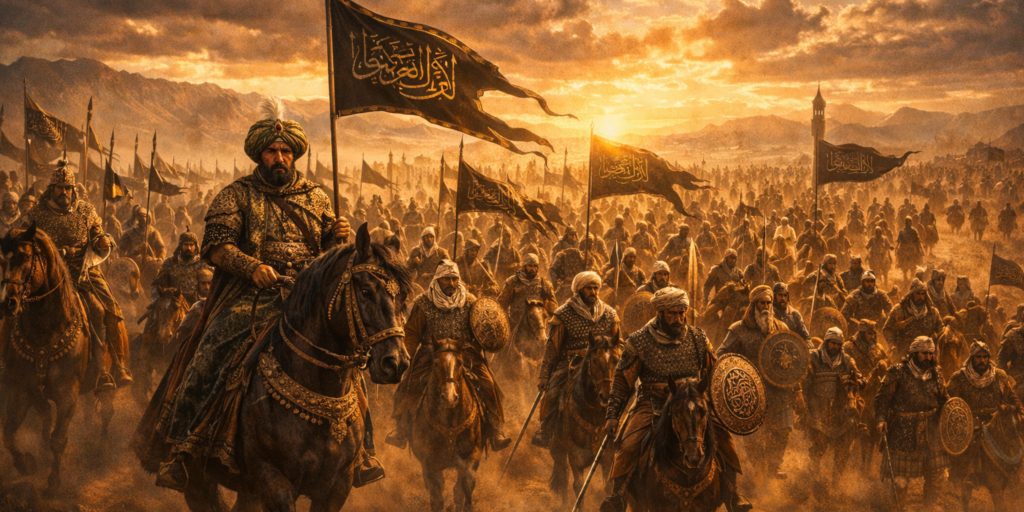
The Abbasids inherited a vast military machine. Early Abbasid armies included Arab, Persian and Khurasani troops. Later caliphs relied increasingly on Turkish slave soldiers, known as ghilman or mamluks.
These troops were highly effective but politically dangerous. Giving armed men immense power and then hoping they remain politely obedient has rarely worked well in history.
The Abbasids fought:
- The Byzantine Empire on the frontier of Anatolia.
- Rebellions in Persia, Iraq and North Africa.
- Rival Muslim dynasties.
- Nomadic peoples in Central Asia.
One of their most important victories came at the Battle of Talas in 751 against the Tang Chinese. The battle helped secure Abbasid influence in Central Asia and may have contributed to the spread of paper-making westward.
Yet the empire gradually became harder to control. Distant provinces developed their own rulers and armies. Spain, North Africa and parts of Persia slipped from Abbasid control.
Decline of the Abbasids
The Abbasids did not collapse suddenly. They declined slowly, untidily and with remarkable determination.
From the ninth century onward, regional rulers gained power. Turkish generals dominated the court. Rival dynasties such as the Buyids and Seljuks took control of Baghdad while leaving the caliphs in place as symbolic figures.
By the eleventh century the caliph was often more a spiritual leader than an effective ruler. He still had prestige, but rather like a ceremonial monarch with an especially troublesome cabinet, he no longer truly controlled events.
Economic problems also weakened the empire. Trade routes shifted. Irrigation systems suffered. Provinces stopped paying taxes.
Then came the Mongols.
The Fall of Baghdad, 1258
In 1258 Hulagu Khan, grandson of Genghis Khan, marched on Baghdad. The last Abbasid caliph, al-Musta’sim, failed to prepare properly for the attack.
The Mongols besieged the city and captured it after only a short resistance.
What followed was catastrophic. Much of Baghdad was destroyed. Libraries were burned. Scholars were killed. The caliph himself was executed.
Later writers claimed the Tigris ran black with the ink of destroyed books and red with blood. The image may be exaggerated, but not by very much.
The fall of Baghdad marked the end of the Abbasid caliphate as a great political power. It remains one of the most dramatic collapses in medieval history.
The Abbasids in Cairo
The dynasty did not disappear entirely. Surviving members of the Abbasid family fled to Egypt, where the Mamluk rulers established ceremonial Abbasid caliphs in Cairo.
These later Abbasids had little real power, but they provided legitimacy to the Mamluk sultans. The line continued until 1517, when the Ottoman Empire conquered Egypt.
By then the Abbasids were more memory than monarchy.
Art, Architecture and Culture
The Abbasid world produced remarkable art and architecture.
Key features included:
- Great mosques with vast courtyards and elegant arches.
- Decorative calligraphy and geometric design.
- Palaces in Baghdad and Samarra.
- Fine ceramics, textiles and metalwork.
- Illustrated manuscripts.
The city of Samarra, briefly the Abbasid capital in the ninth century, is particularly famous for its spiral minaret at the Great Mosque.
Abbasid literature also flourished. Poets such as Abu Nuwas wrote verses full of wit, wine and scandalous behaviour. Courtly literature, history and storytelling reached new heights.
Quite frankly, if one wished to live in the medieval world as a scholar, poet or mildly disreputable intellectual, Abbasid Baghdad was probably the place to be.
Legacy of the Abbasid Dynasty
The Abbasids changed the world.
They created one of the greatest centres of learning in history. They helped preserve and develop ancient knowledge. They shaped Islamic civilisation and influenced Europe, Asia and Africa.
Without the Abbasids there would be no Baghdad as the legendary city of scholarship, no great translation movement, and perhaps no route by which much of Greek philosophy and science passed into medieval Europe.
The dynasty also left behind a more complicated legacy: political violence, court intrigue, religious conflict and imperial decline.
Empires rarely leave tidy stories. The Abbasids certainly did not.
Still, when I think of the Abbasid Dynasty, I think first of Baghdad in its prime. Lamps burning late into the night. Scholars arguing in libraries. Merchants shouting in the markets. Poets composing verses. Somewhere, inevitably, a court official insisting that everything is under control while the empire quietly catches fire around him.
In other words, a civilisation at its most brilliant, and most human.