Who Was Batu Khan?
Batu Khan was one of the most important, and frankly most feared, rulers of the thirteenth century. A grandson of Genghis Khan and son of Jochi, he led the Mongol armies into Eastern Europe and laid the foundations of what became the Golden Horde.
He is often remembered as the man who brought the Mongols to the gates of Europe. That is true, but it only tells half the story. Batu was not simply a conqueror thundering west with fire and horsemen. He was also a patient political operator, an organiser of empire, and a ruler who understood that holding territory mattered more than merely terrifying it.
By the time of his death in around 1255, Batu controlled a vast domain stretching from the steppes north of the Black Sea to the forests of Russia. Princes, kings and merchants alike found themselves adjusting their plans around the wishes of one Mongol ruler camped somewhere on the Volga.
Batu Khan rarely appears in European popular history with the same larger-than-life reputation as Genghis Khan or Kublai Khan. Yet for people living in Poland, Hungary or the Rus principalities in the 1240s, Batu was the Mongol leader who seemed almost unstoppable. To them, he was not a distant legend. He was a very real and very alarming problem.
Batu Khan’s Early Life and Family
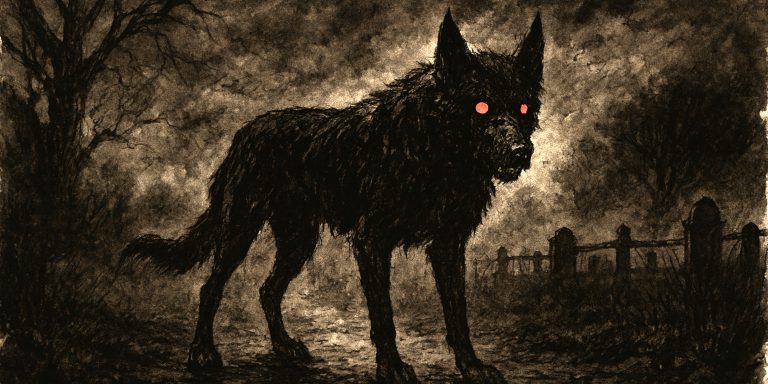
Batu was born around 1207 to 1209, probably in the eastern Mongol territories. He was the son of Jochi, the eldest son of Genghis Khan. Jochi’s relationship with his father was famously awkward and strained, thanks to lingering doubts over whether he was truly Genghis Khan’s biological son. Medieval dynastic politics had all the warmth and generosity of a wolf fight in winter.
When Jochi died before Genghis Khan, his lands were divided among his sons. Batu inherited the western portion of Jochi’s ulus, or domain. This included the great western steppe lands that would later become the Golden Horde.
Although Batu belonged to the senior line of Jochi’s descendants, he was never Great Khan of the Mongol Empire. Instead, he ruled as a powerful regional khan. In practice, however, his authority in the west made him one of the most influential men in Eurasia.
Batu worked closely with the brilliant Mongol general Subutai, perhaps the finest military strategist of the age. If Batu was the prince and political leader, Subutai was the cold, methodical mind turning plans into victories.
The Rise of Batu Khan and the Founding of the Golden Horde
After the death of Genghis Khan, the Mongol Empire expanded under his successors. In 1235, the Great Khan Ogedei ordered a major campaign into the west. Batu Khan was placed in command.
The campaign began with the destruction of the Volga Bulgars and then the conquest of the Rus principalities. City after city fell.
- Ryazan in 1237
- Vladimir in 1238
- Kiev in 1240
The Mongols didn’t just wage war. They dismantle political systems. Russian princes who survived were forced to submit, pay tribute and travel to Batu’s court for confirmation of their authority.
By the 1240s Batu established his capital at Sarai, on the lower Volga River. From there he created what historians later called the Golden Horde.
The Golden Horde was not simply a horde in the popular sense of the word. It was a functioning state.
It had:
- Taxation and tribute systems
- Trade routes linking Europe and Asia
- Diplomatic contacts with Byzantium, the Islamic world and western Europe
- A ruling elite of Mongol nobles supported by Turkic peoples of the steppe
Sarai grew into one of the largest cities in Eurasia. Medieval travellers described it as wealthy, crowded and full of merchants. This was not the image many Europeans had of the Mongols. They imagined endless horsemen and burning villages. Batu, however, was also building an empire.
Battles and Military Acumen
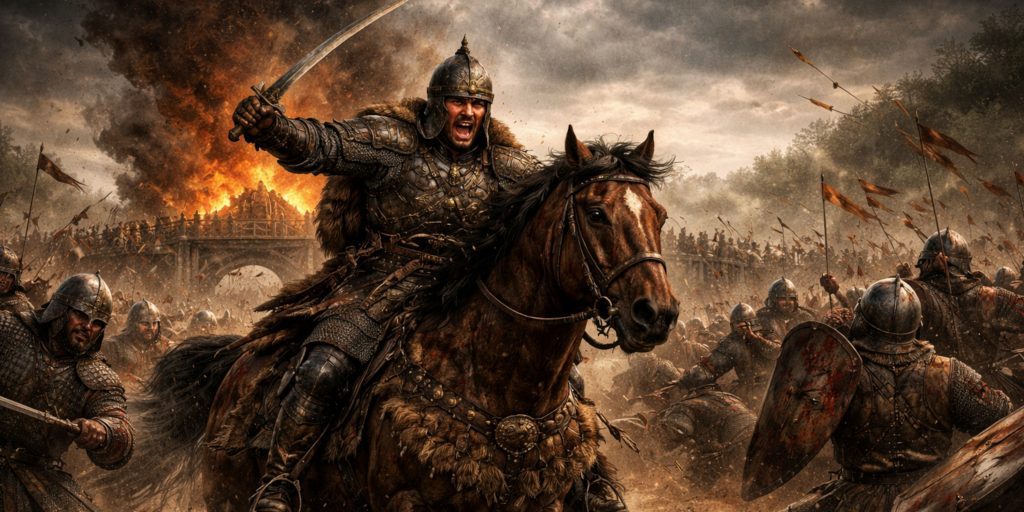
Batu Khan’s military reputation rests on a campaign that remains astonishing even today. Between 1236 and 1242, the Mongols crossed thousands of miles, defeated multiple kingdoms and repeatedly outmanoeuvred armies that often outnumbered them.
Batu’s strength was not reckless aggression. It was control.
He understood how to coordinate separate forces across enormous distances. He used speed, deception and intelligence gathering with almost frightening efficiency. Mongol scouts rode far ahead, gathering information about roads, rivers, supplies and enemy movements.
Where European commanders often relied on one large battle, Batu preferred a series of smaller operations designed to confuse and isolate his enemies.
The Conquest of the Rus
The Rus principalities were divided and suspicious of one another. Batu exploited this perfectly.
Instead of facing a united army, he defeated each principality in turn. Ryazan was overwhelmed after a short siege. Vladimir fell soon after. Kiev, once one of the greatest cities in Eastern Europe, was taken in 1240 after a brutal assault.
Contemporary chroniclers described the destruction with horror. One Russian account claimed:
“There was no one left in Kiev to lament the dead.”
The Mongols used siege engines, scaling ladders and Chinese-style artillery techniques learned elsewhere in the empire. European chroniclers often imagined the Mongols as pure cavalry. In reality, Batu’s armies were remarkably adaptable.
The Battle of Legnica, 1241
One of Batu Khan’s subordinate armies defeated a coalition of Polish and German forces at Legnica in April 1241.
Although Batu himself may not have been present, the battle was part of his wider campaign.
The Mongols lured the European knights into disorder, used clouds of arrows to weaken them, then attacked from several directions at once. Duke Henry II of Silesia was killed.
The battle demonstrated a recurring Mongol strength. They could provoke an enemy into charging, then punish that decision with brutal precision. Medieval knights often fought with courage, but courage alone is not terribly useful when half your army has galloped after a feigned retreat and the other half cannot see through the smoke and dust.
The Battle of Mohi, 1241
The greatest of Batu Khan’s victories came at the Battle of Mohi in Hungary.
The Hungarian king, Bela IV, assembled a large army and camped near the River Sajo. Batu and Subutai trapped the Hungarian force by attacking from several directions and crossing the river at unexpected points.
The Hungarians were surrounded and crushed.
Many thousands died. The Mongols then devastated much of Hungary. Villages, towns and monasteries were destroyed. Europe briefly believed that the entire continent might be next.
What makes Mohi especially remarkable is the level of planning involved. Subutai coordinated multiple attacks over several miles while Batu directed the main force. It was a battle won through timing and discipline rather than simple numbers.
Why Batu Khan Turned Back
In 1241, after reaching deep into Europe, the Mongols suddenly withdrew.
For centuries people wondered why. The most likely reason was the death of the Great Khan Ogedei in Mongolia. Batu and the other princes were expected to return east for the election of a new ruler.
Europe was fortunate. Had Batu remained in Hungary and continued west, there is a very real possibility that Austria, Germany and perhaps northern Italy would have faced invasion.
That said, the Mongols were not invincible. They were operating far from their base, in unfamiliar terrain, and in lands less suited to steppe warfare. Europe escaped partly through luck, partly through distance, and partly because Mongol politics became more important than Mongol conquest.
Arms and Armour
Batu Khan and his warriors fought as part of the Mongol military system, one of the most effective in history.
Batu Khan’s Personal Equipment
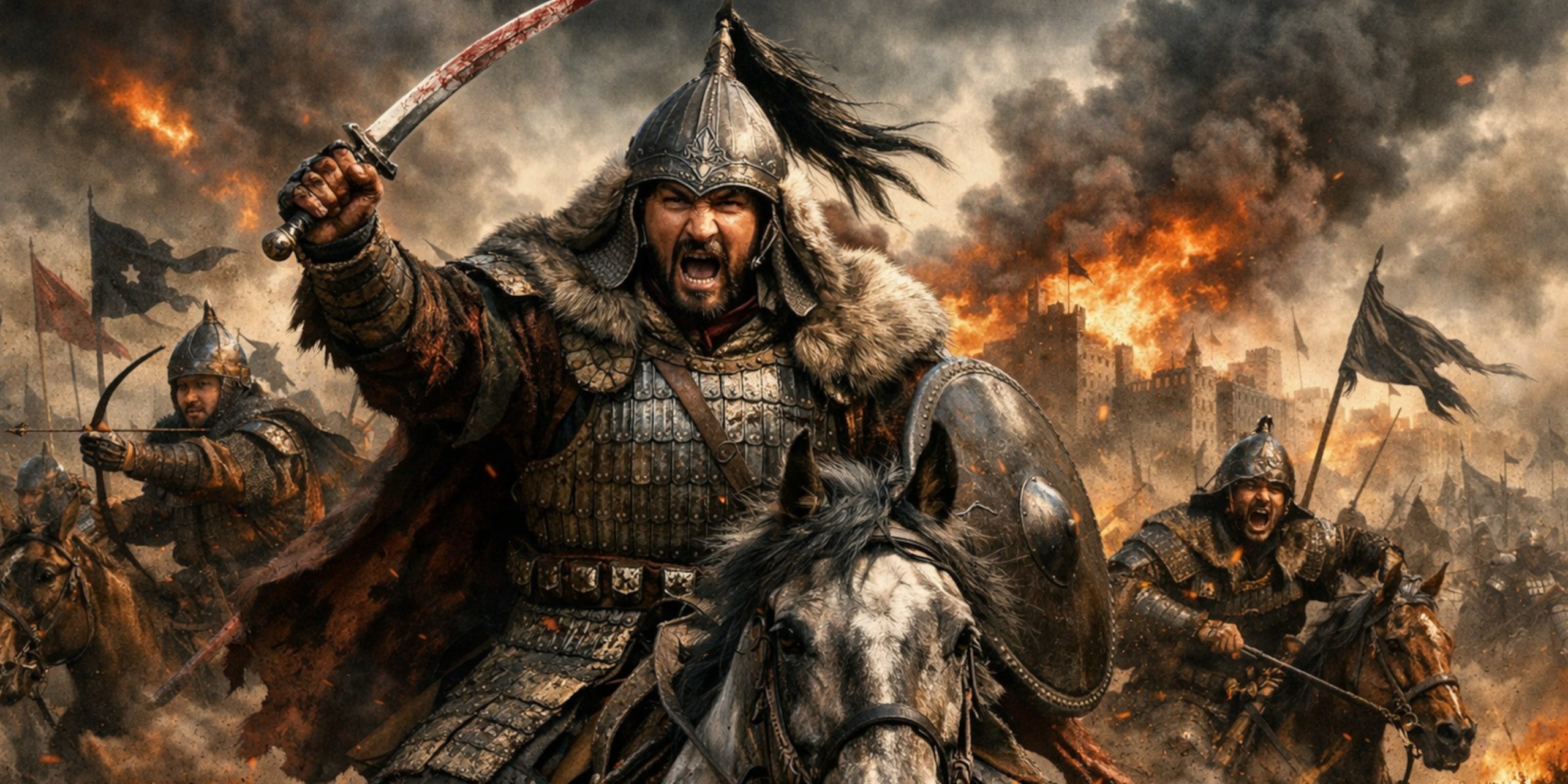
A ruler like Batu likely wore high-status armour made from:
- Hardened leather reinforced with iron plates
- Lamellar armour made of overlapping metal or rawhide plates
- Silk garments beneath armour, which could help prevent arrowheads embedding deeply
- A conical iron helmet, sometimes with a nasal guard or neck protection
His armour would have been practical rather than decorative. Mongol commanders valued mobility. A European knight might have looked more imposing, but Batu’s armour allowed him to ride, shoot and command for long periods.
Weapons Used by Batu Khan and His Army
| Weapon | Description | Use |
|---|---|---|
| Composite bow | Short, powerful bow made from wood, horn and sinew | Main battlefield weapon, effective from horseback |
| Sabre | Curved sword suited to mounted combat | Used in close combat after arrow volleys |
| Lance | Long cavalry spear | Used during charges or against fleeing enemies |
| Axe and mace | Secondary weapons | Useful against armoured opponents |
| Lasso | Rope weapon used by some horsemen | Used to drag enemies from horseback |
The Mongol composite bow was perhaps the deadliest weapon in Batu’s army. It could fire farther and harder than many European bows. Mongol horse archers could shoot while riding at full speed, even turning in the saddle to fire behind them.
The sabres used by Mongol cavalry were usually slightly curved and optimised for slashing from horseback. These weapons influenced later steppe and eastern European sword designs.
Horses and Mobility
Every Mongol warrior usually had several horses. This allowed Batu’s army to travel extraordinary distances.
A Mongol force could appear where enemies least expected, move quickly after battle, and keep fighting while opponents were still struggling to organise supplies.
Batu’s armies did not carry long baggage trains in the European style. They lived off their herds and moved with remarkable speed. To medieval observers this must have seemed almost supernatural. One day the Mongols were rumours beyond the horizon. The next day they were outside your city walls.
Batu Khan as a Ruler
After his campaigns, Batu spent much of his reign ruling from Sarai.
He demanded tribute from Russian princes but often allowed them to keep their thrones if they remained loyal. This was a clever approach. Batu understood that local rulers could govern more effectively than distant Mongol officials.
He also encouraged trade across his lands. Merchants travelling between Europe and Asia often found the Golden Horde safer than many smaller kingdoms. Roads were protected and trade was profitable.
Batu maintained tense relations with other Mongol princes, particularly Guyuk Khan. There were bitter rivalries within the Mongol elite, and Batu spent much of his later life balancing politics as carefully as he had once directed armies.
It is tempting to think of Batu only as a destroyer. Yet he was also a builder. He created the political structure that allowed the Golden Horde to survive for more than two centuries.
Contemporary Descriptions of Batu Khan
Western and Russian chroniclers often described Batu with fear. They rarely met him in person, yet his reputation spread rapidly.
The Franciscan traveller Giovanni da Pian del Carpine visited the Mongol world a few years after Batu’s campaigns. He wrote of Batu as one of the most powerful princes in the empire.
Another chronicler described Batu’s authority in almost mythic terms:
“All peoples trembled before him.”
Naturally, medieval chroniclers were not always known for understatement. They had a tendency to describe every invading army as endless and every enemy leader as either Satan himself or the end of civilisation. Even so, Batu clearly left a deep impression.
Artefacts and Where to See Them
There are no surviving objects that can be identified with absolute certainty as Batu Khan’s personal possessions. That is frustrating, though perhaps not surprising for a ruler who lived in a mobile court and whose empire shifted constantly.
However, there are many artefacts from his reign and from the early Golden Horde that help us understand his world.
Artefacts to Look For
- Mongol lamellar armour plates
- Iron helmets from the thirteenth century steppe
- Composite bow fragments
- Golden Horde silver coins
- Horse harnesses and stirrups
- Decorative belt fittings and weapons from elite burials
Museums and Collections
Some of the best places to see artefacts from Batu Khan’s era include:
- The State Historical Museum in Moscow
- The Hermitage Museum in Saint Petersburg
- The National Museum of the Republic of Tatarstan in Kazan
- The National Museum of Mongolia in Ulaanbaatar
- Regional museums near the site of Sarai in southern Russia
The Hermitage holds several steppe-era weapons and horse fittings. The museum in Kazan is particularly valuable because it contains finds linked to the Golden Horde and the Volga region.
There is something oddly moving about seeing a Mongol stirrup or arrowhead in a museum case. Such small objects once travelled across half a continent and helped reshape history.
Latest Archaeological Findings
Archaeology has transformed what we know about Batu Khan and the Golden Horde.
Excavations at the site of Sarai, near the lower Volga, have uncovered:
- Large brick buildings
- Workshops and markets
- Imported pottery from Persia and China
- Coins from across Eurasia
- Sophisticated water systems
These finds show that Sarai was far more than a temporary camp. It was a wealthy and organised city.
Recent excavations in Russia and Kazakhstan have also uncovered burial sites connected to the Mongol elite. These graves contain horse equipment, weapons and jewellery that reveal a mixture of Mongol, Turkic and Islamic influences.
Archaeologists have also used aerial surveys and satellite imaging to trace the routes used by Mongol armies across Eastern Europe. In some places, traces of burned settlements from the campaigns of 1237 to 1241 have been identified.
Perhaps the most surprising discovery is how connected Batu’s world really was. Artefacts from China, Persia and Europe appear together in Golden Horde sites. Batu’s empire sat at the centre of a vast network linking east and west.
For all the destruction of his campaigns, Batu also helped create one of the great crossroads of the medieval world.
Batu Khan’s Legacy
Batu Khan died around 1255, probably near the Volga.
His successors continued to rule the Golden Horde, and Russian princes remained under its authority for generations. The political map of Eastern Europe was transformed by his campaigns.
The rise of Moscow, the decline of Kiev, and the shape of Russia itself were all influenced by Batu Khan and the Golden Horde.
In western Europe, Batu became a figure of near-legend. Medieval writers remembered him as the terrifying Mongol prince who almost conquered Europe.
As a historian, I find Batu fascinating because he sits awkwardly between categories. He was not merely a conqueror and not merely a statesman. He was both. Brutal, intelligent, patient and often ruthless.
There is no point pretending otherwise. Batu’s campaigns brought immense suffering. Cities were destroyed and countless people died. Yet he also built something lasting from that violence.
Few rulers have changed the history of so many countries so quickly. Fewer still are remembered so dimly today.
That perhaps is the strangest thing about Batu Khan. He altered the fate of Europe, Russia and the steppe, yet he still stands in the shadow of his grandfather. History can be oddly unfair like that.