There are few instruments of punishment that linger in the imagination quite like the rack. It appears in films, novels, and museum displays with a grim confidence, as if its presence alone confirms everything we suspect about the cruelty of the past.
Yet the reality is more precise, and in some ways more unsettling. The rack was not a symbol of medieval chaos. It was a calculated tool, employed with bureaucratic intent, often under legal authority, and frequently documented with a tone that borders on administrative indifference.
It was not used everywhere, nor constantly, but where it did appear, it served a very specific purpose. It was designed to extract information, not simply to punish.
What Was the Rack
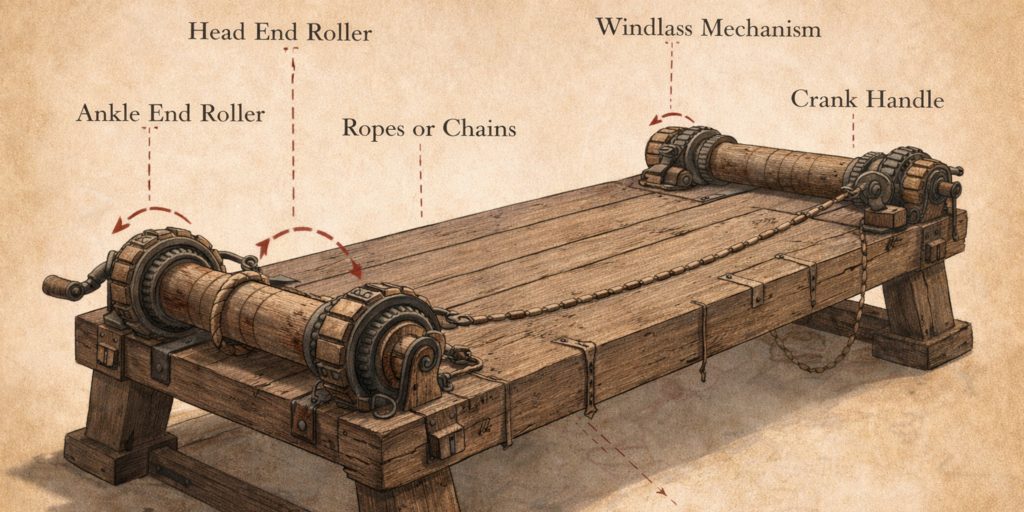
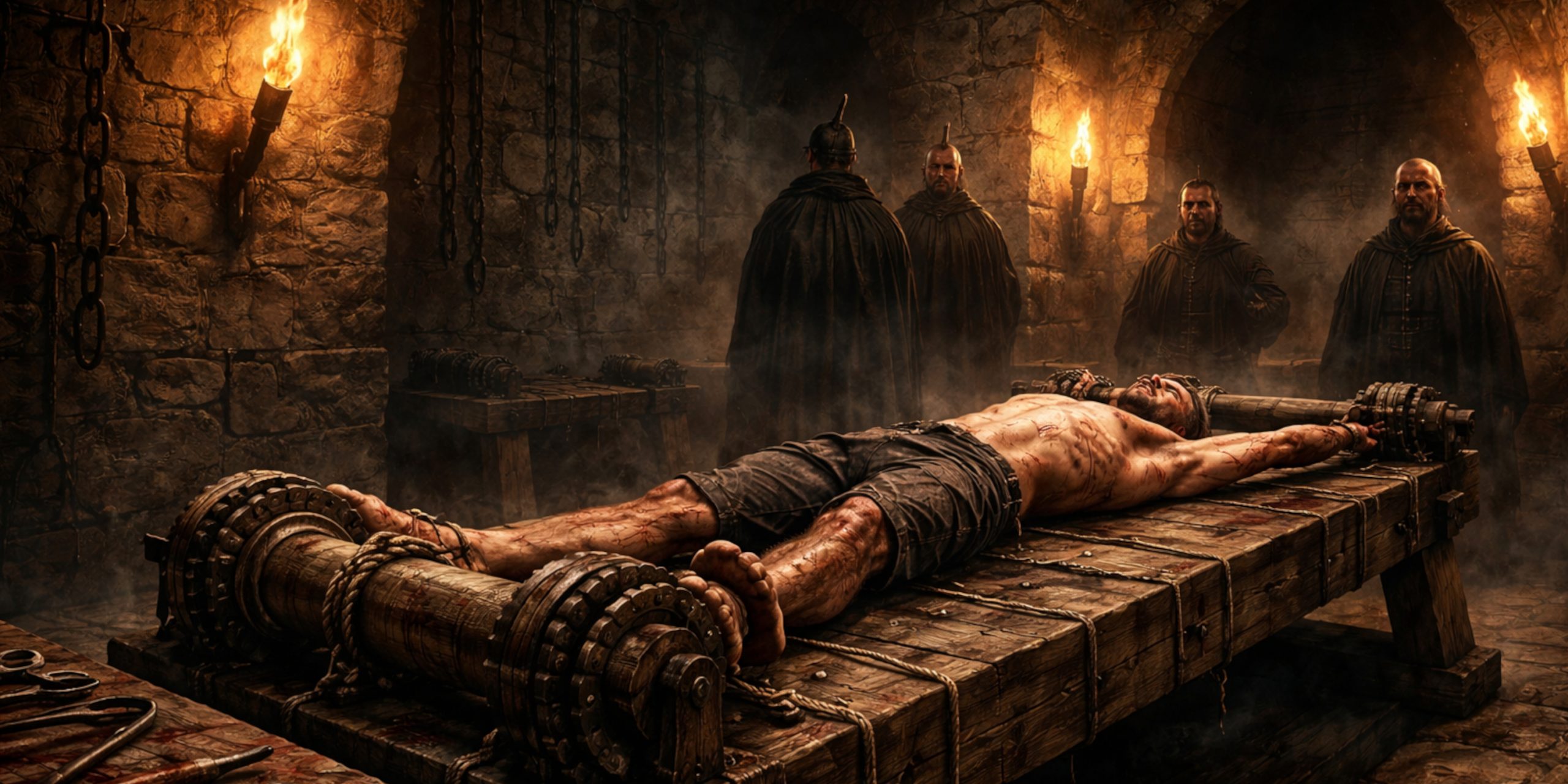
At its simplest, the rack was a rectangular wooden frame fitted with rollers at either end. The victim’s wrists were tied to one roller, the ankles to another. Turning the rollers gradually stretched the body.
There was no theatrical flourish required. The horror lay in the slow, deliberate increase in tension.
Key features included:
- A sturdy wooden frame, often reinforced with iron fittings
- Rollers or windlasses to control tension
- Ropes or chains attached to limbs
- A mechanism allowing gradual, incremental stretching
The process was not intended to be swift. It relied on time, control, and the steady application of force.
How It Worked in Practice
The rack did not immediately dismember its victim. That is a common exaggeration. Instead, it inflicted progressive damage.
As tension increased:
- Joints began to dislocate
- Ligaments and tendons stretched or tore
- Muscles weakened and failed
- The spine endured extreme strain
Eventually, the body could no longer sustain the pressure. Whether the subject spoke or not often determined how far the process continued.
There is a certain cold efficiency in this. Pain was not incidental. It was the method.
Where and When It Was Used
The rack is most closely associated with late medieval and early modern Europe, particularly in England and parts of continental Europe.
It is often linked with:
- The Tower of London
- State interrogations under Tudor rule
- Religious and political investigations
Contrary to popular belief, its use was not widespread across all of medieval Europe. In England, for instance, torture was not part of common law. It required special authorisation, typically from the monarch or the Privy Council.
That alone tells you something. The rack was not a village curiosity. It was a state instrument.
The Rack in England
In England, the rack became most infamous during the Tudor period.
One of the most cited cases is that of Guy Fawkes following the Gunpowder Plot of 1605. His interrogation was formally authorised, and records indicate a progression in severity.
A note from King James I’s council reportedly instructed:
“If he will not otherwise confess, the gentler tortures are to be first used… and so by degrees proceeding to the worst.”
There is something chilling in that phrasing. It reads like a procedural guideline rather than an act of violence.
Another reference comes from Sir William Waad, Lieutenant of the Tower, who oversaw such interrogations. His correspondence shows a careful attention to method, not spectacle.
Contemporary Attitudes and Justifications
Torture, including the use of the rack, was often justified as a means of securing truth in matters of state security or heresy.
The logic rested on a belief that the guilty would break under pressure, while the innocent might endure. This assumption, as one might expect, was deeply flawed.
The English jurist Sir Edward Coke later criticised such practices, stating:
“There is no law to warrant tortures in this land.”
His objection reflects a growing discomfort, even among contemporaries, with the use of devices like the rack.
On the continent, where legal torture was more formally embedded in judicial systems, the justification was framed as part of due process. That does not make it less brutal, only more organised.
Myths and Misconceptions
The rack has accumulated its fair share of exaggeration.
Some common myths include:
- That it was a standard punishment across all medieval courts
- That victims were routinely torn apart
- That it was used casually or frequently
In reality:
- Its use was relatively rare and often restricted
- Complete dismemberment was not the typical outcome
- It required official approval in many regions
This does not soften its brutality. If anything, the restraint makes it more deliberate.
Archaeology and Physical Evidence
Surviving racks are rare, though a few examples and reconstructions exist, particularly in museum settings.
Evidence comes from:
- Tower of London records and inventories
- Written accounts and interrogation notes
- Engravings and early illustrations
The absence of widespread physical remains has encouraged speculation, but the documentary evidence is strong enough to confirm both its existence and its use.
One might say the rack survives more vividly in paper than in wood.
The Rack in Culture and Memory
The rack has endured in popular imagination as a shorthand for medieval cruelty. It appears in everything from Victorian horror to modern fantasy.
That persistence says less about the Middle Ages and more about how later generations have chosen to remember them.
It is easier to picture a dark chamber and a creaking frame than to consider the paperwork, the permissions, and the quiet signatures that made it possible.
A Historian’s View
There is a temptation to treat the rack as a relic of a more barbaric age, safely distant and morally resolved.
That feels a little too convenient.
What stands out is not just the pain it caused, but the calm, structured way in which it was employed. The rack was not chaos. It was control.
If there is any dry humour to be found, it lies in the paperwork. One imagines a clerk carefully noting the progress of an interrogation while someone nearby is being stretched on a wooden frame. History has a talent for pairing the mundane with the monstrous.
Takeaway
The rack remains one of the most recognisable instruments of torture, not because it was everywhere, but because it represents something precise and uncomfortable.
It shows how authority, fear, and procedure can combine into something quietly devastating.
It was never just a device. It was a method, and a decision.
And those tend to leave a longer shadow than the wood ever could.