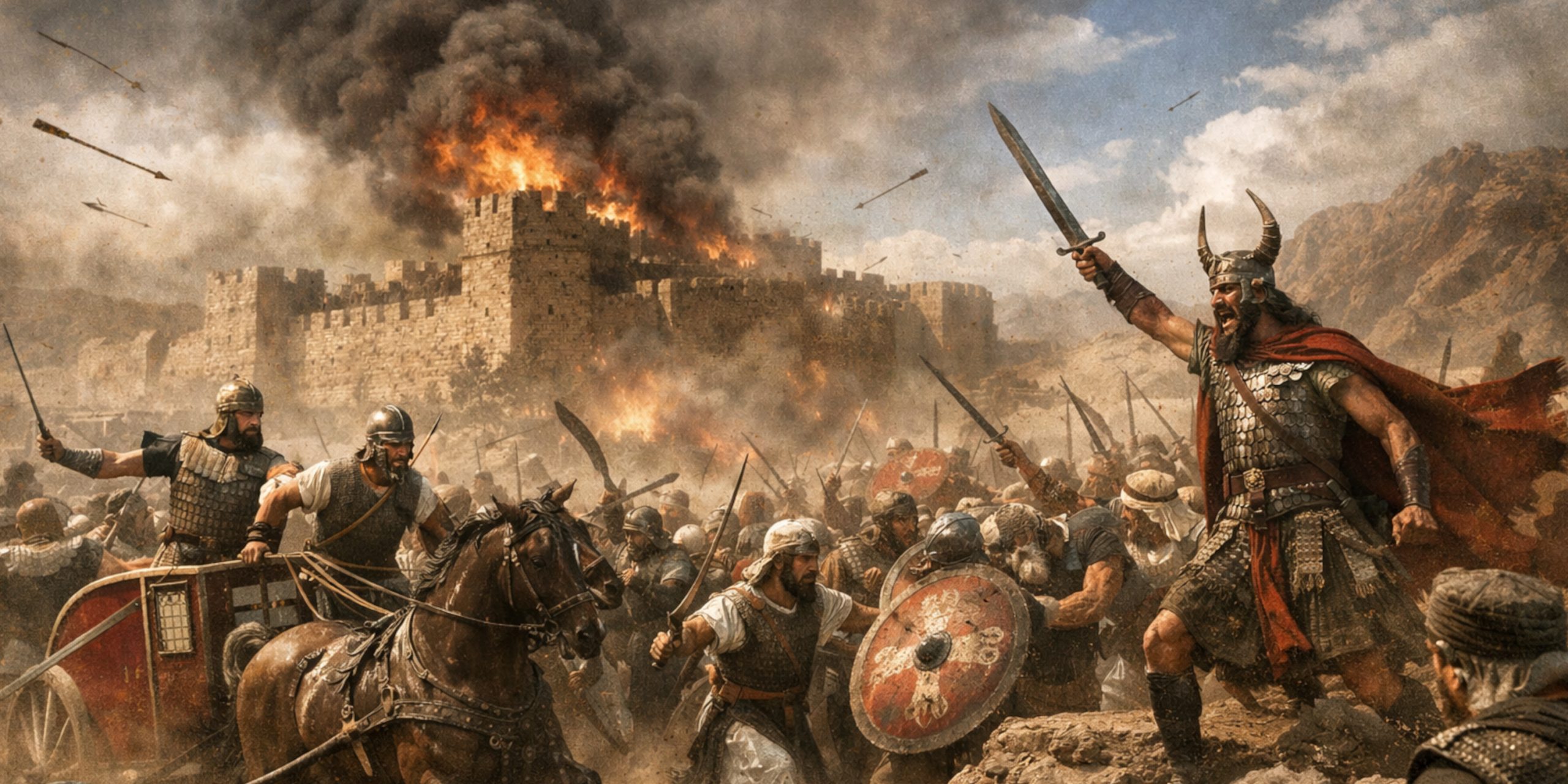
The so called Battle of Moab is less a single neatly contained clash and more a campaign of revolt. It belongs to the turbulent 9th century BC, when kingdoms in the Levant rose and fell with alarming regularity. At its centre stands the Moabite king Mesha and his rebellion against Israelite dominance following the death of King Ahab of Israel.
What makes this episode so compelling is that we possess two competing voices. The Hebrew Bible tells one version. The Moabites, through the Mesha Stele, tell another. Both are self assured. Both claim divine favour. As historians, we read them side by side and resist the temptation to crown either as fully triumphant.
Historical Background
Moab lay east of the Dead Sea, a plateau kingdom with agricultural wealth and strategic roads. It had long fallen under the influence, and at times domination, of the northern Kingdom of Israel. According to the biblical account in 2 Kings 3, Moab paid heavy tribute to Israel under Ahab.
After Ahab’s death, Mesha of Moab seized his opportunity. Israel, now under Jehoram, formed a coalition with Judah and Edom to crush the rebellion. The campaign that followed moved across harsh desert terrain and culminated in a brutal siege.
The story does not end in simple conquest. In fact, it ends in confusion, sacrifice, and withdrawal. Which, if one is honest, is often how ancient wars concluded.
Forces
Precise numbers are not recorded in reliable contemporary military registers, so we must rely on textual clues and comparative context. These were not vast imperial armies on the scale of Assyria, but they were serious regional forces.
Coalition of Israel, Judah, and Edom
| Kingdom | Estimated Composition | Notes |
|---|---|---|
| Israel | Core heavy infantry, chariots | Dominant partner |
| Judah | Supporting infantry | Allied under Jehoshaphat |
| Edom | Light infantry, desert fighters | Local terrain knowledge |
Moab
| Kingdom | Estimated Composition | Notes |
|---|---|---|
| Moab | Fortified garrisons, field infantry | Defensive posture |
| Elite Guard | Royal retainers | Likely stationed at Kir-hareseth |
The Israelite army likely fielded several thousand troops, including chariot units which were a symbol of power and prestige. Moab’s strength lay in fortified cities and defensive terrain.
Leaders and Command Structure
Coalition
- Jehoram of Israel
King of Israel, son of Ahab. Politically pragmatic, militarily determined. - Jehoshaphat of Judah
Allied monarch. His participation signals the seriousness of the campaign. - King of Edom
Likely a vassal ruler cooperating under Judah’s influence.
Moab
- King Mesha
A formidable regional ruler. His own inscription presents him as divinely chosen by Chemosh to throw off Israelite control.
One cannot help admiring Mesha’s confidence. Few defeated kings commission victory monuments. He clearly believed he had earned the right.
Arms and Armour
The combatants were equipped in the manner typical of the Levantine Iron Age.
Swords
- Short iron or bronze leaf shaped swords
- Early straight iron blades influenced by Canaanite traditions
- Dagger variants for close quarters
While not yet the long iron blades of later classical warfare, these were effective cutting weapons designed for tight infantry engagements.
Other Weapons
- Spears with bronze or iron heads
- Composite bows
- Sling stones
- Chariots for command mobility and shock
Armour
- Scale armour for elite warriors
- Bronze helmets for officers
- Leather or textile defensive garments for common infantry
- Large round or rectangular shields
Moabite defenders inside fortified positions would have relied heavily on missile weapons. Siege warfare in this period was ugly, intimate, and exhausting.
The Campaign and Battle Timeline
Phase One: Revolt
Mesha halts tribute payments to Israel. This is both economic and symbolic defiance.
Phase Two: Coalition Mobilisation
Jehoram forms alliance with Judah and Edom. The army marches through the wilderness route south of the Dead Sea.
Phase Three: Desert Crisis
The coalition faces a severe water shortage. According to the biblical account, prophetic intervention predicts deliverance. Water arrives, though the mechanics remain debated.
Phase Four: Advance into Moab
Coalition forces devastate Moabite territory, destroying fields and wells. This is economic warfare designed to cripple resistance.
Phase Five: Siege of Kir-hareseth
The campaign narrows to a final fortified stronghold. Mesha attempts a breakout, fails, then performs a dramatic sacrifice of his eldest son upon the city wall.
Phase Six: Withdrawal
The biblical account states that “great wrath” fell upon Israel, and the coalition withdrew. The Mesha Stele instead celebrates Moabite liberation.
One side calls it divine anger. The other calls it national triumph. History allows room for stalemate.
Archaeology
The most significant artefact connected to the conflict is the Mesha Stele, discovered in 1868 and now housed in the Louvre.
This inscription records Mesha’s victories over Israel and credits the Moabite god Chemosh for restoring national strength. It even references the “House of Omri,” aligning with biblical references to the dynasty of Ahab.
Archaeological surveys of Moabite sites show destruction layers consistent with 9th century conflict. However, evidence does not clearly demonstrate complete Israelite victory. On balance, the material record suggests a contested campaign with significant upheaval.
Contemporary Sources and Quotes
From 2 Kings 3:
“And there was great indignation against Israel: and they departed from him, and returned to their own land.”
From the Mesha Stele:
“Omri was king of Israel, and he oppressed Moab many days… But I triumphed over him and over his house.”
These lines are wonderfully partisan. Each side invokes divine backing. Each declares vindication. It is a reminder that ancient history is often propaganda chiselled in stone.
Historical Significance
The Battle of Moab campaign illustrates several key realities of the Iron Age Levant:
- Regional powers were fragile and constantly contested
- Tribute systems were vulnerable to succession crises
- Religion and warfare were inseparable in political rhetoric
Israel did not permanently subdue Moab after this episode. Moab remained a distinct political entity for generations. Mesha, whether victor or survivor, ensured his legacy endured.
As a historian, I find this episode refreshing precisely because it resists tidy conclusions. No overwhelming battlefield slaughter defines it. Instead we see strategy, desperation, religious theatre, and political messaging. It feels real.
Takeaway
The Battle of Moab was not a simple clash of armies but a struggle over sovereignty, tribute, and divine favour. The campaign ended ambiguously, yet its impact was lasting.
Thanks to the Mesha Stele and biblical narrative, we glimpse two proud kingdoms telling their stories with conviction. Between them lies the historian’s task, careful comparison, scepticism, and perhaps a quiet smile at the audacity of ancient kings who always seemed to win, at least on their own monuments.
Watch the documentary: