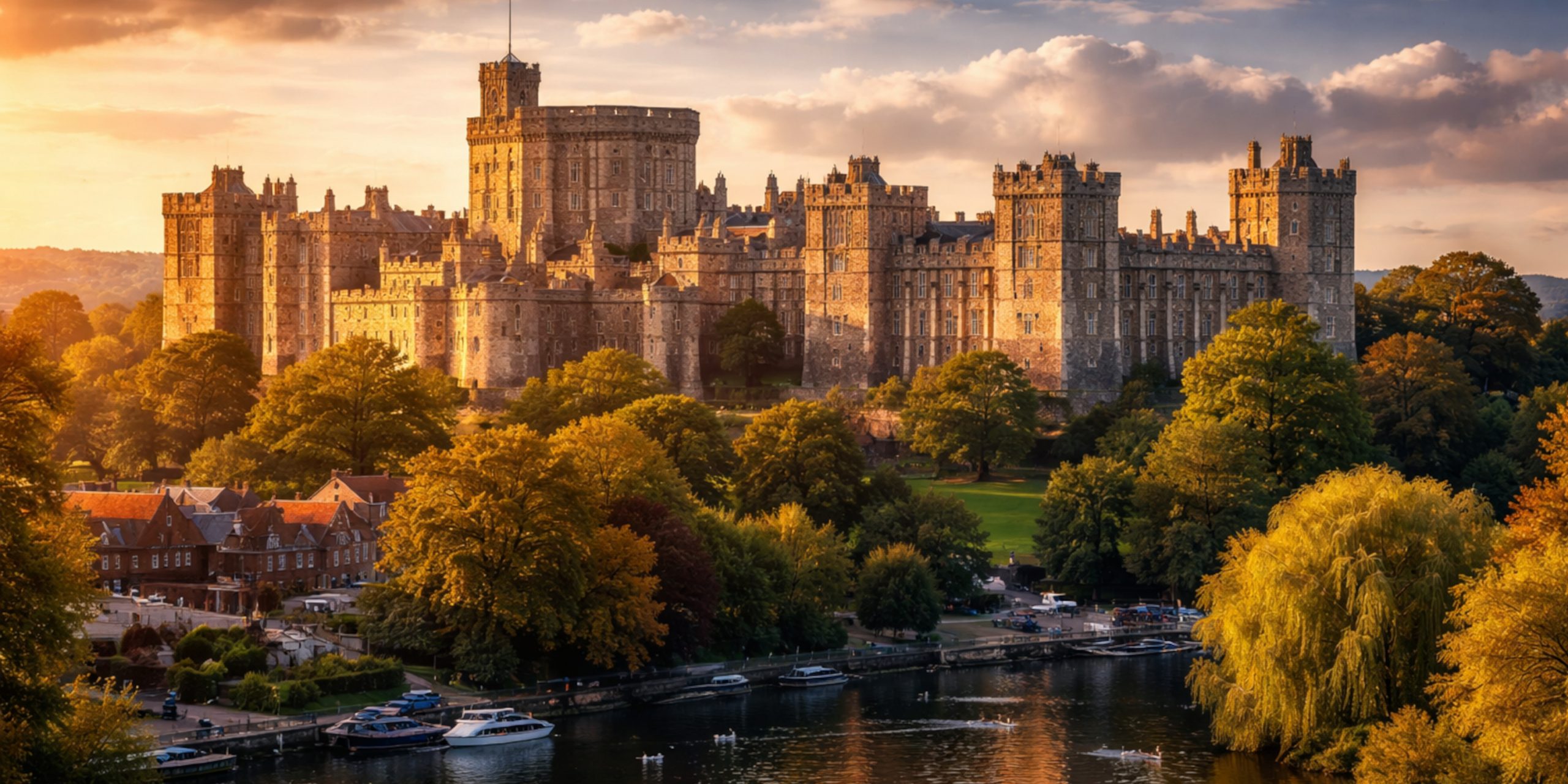
Few buildings in Britain can claim what Windsor Castle can. It has stood since the eleventh century, endured rebellion and civil war, housed monarchs in triumph and in crisis, and remains an active royal residence. It is not a romantic ruin. It is a working fortress, palace and symbol.
As a historian, I find Windsor compelling because it is not frozen in one era. It is Norman stone layered with Georgian confidence, Victorian grandeur and modern restoration. It feels lived in, sometimes grand, occasionally awkward, and entirely human despite its scale.
Norman Foundations
Windsor Castle began life under William the Conqueror around 1070. It was one of a ring of motte and bailey fortresses securing London and the Thames corridor. The original structure was timber. Practical, fast to build, and unmistakably military.
The strategic reasoning was clear. The site overlooks the River Thames and commands a key route west from London. Control Windsor, and you controlled movement and communication.
Stone replaced timber under Henry II in the twelfth century. From that point, Windsor ceased to be a temporary fortification and became a permanent royal stronghold.
Medieval Expansion and Prestige
The thirteenth and fourteenth centuries transformed Windsor into something grander.
Under Edward III, born at Windsor, the castle became the heart of chivalric England. He rebuilt much of it in lavish Gothic style and founded the Order of the Garter in 1348. The chapel later rebuilt as St George’s Chapel remains the spiritual centre of that order.
Edward’s works were vast and expensive. Chroniclers noted the scale of construction with awe. One contemporary record describes the king’s intent to create a palace “fit for the splendour of his crown”. It was not subtle.
St George’s Chapel
St George’s Chapel is among the finest examples of Perpendicular Gothic architecture in England. Begun under Edward IV and completed under Henry VIII, it houses royal tombs including Henry VIII, Charles I and Queen Elizabeth II.
Its fan vaulting is delicate yet muscular. If medieval masons had egos, this was their moment.
The English Civil War and the Great Siege
Siege of 1642 to 1643
During the Civil War, Windsor declared for Parliament. Royalist forces attempted to retake it but failed. The castle’s defences, strengthened over centuries, proved effective.
Charles I was later imprisoned there in 1647 before his execution. The symbolism is difficult to ignore. A king confined within walls built by his ancestors.
A Parliamentary officer wrote that Windsor was “of great strength and consequence”. He was correct. Its position and fortifications made it invaluable.
After the execution of Charles I, he was buried quietly in St George’s Chapel. No ceremony. No pomp. A stark moment in a building accustomed to grandeur.
Restoration and Georgian Reimagining
With the Restoration of Charles II, Windsor became a stage for royal image management. Charles remodelled the State Apartments in baroque splendour inspired by France. He was keenly aware of how monarchy needed theatre.
In the eighteenth century, George III made Windsor his principal residence. His attachment reshaped the castle’s domestic character. It became less a fortress, more a home.
Victorian Grandeur
Queen Victoria and Prince Albert left a strong imprint. Albert modernised interiors and expanded facilities. Victoria wrote in her journal that Windsor was “the dear old Castle”, a phrase that reveals genuine affection.
The castle in the nineteenth century balanced ceremony and private life. State visits unfolded beneath chandeliers while family grief played out in quieter rooms.
The Fire of 1992
On 20 November 1992, fire broke out in the Private Chapel. It raged for fifteen hours, damaging over one hundred rooms.
The restoration was meticulous. Historic fabric was conserved where possible. Lost interiors were recreated with sensitivity. The crisis led to public funding debates and eventually the decision to open Buckingham Palace to visitors to support restoration costs.
Windsor emerged renewed, not diminished.
Sieges and Military Significance
While not constantly under attack, Windsor’s strength mattered.
- Civil War occupation and Royalist attempts
- Strategic deterrence in medieval power struggles
- Symbolic stronghold during political unrest
Unlike castles that faded into irrelevance, Windsor adapted. It shifted from fortress to palace without losing its defensive backbone.
Occupants Timeline
Eleventh to Thirteenth Century
- William the Conqueror establishes the fortress
- Henry II rebuilds in stone
- Henry III enhances domestic apartments
Fourteenth to Fifteenth Century
- Edward III transforms it into a royal palace
- Edward IV begins rebuilding St George’s Chapel
Sixteenth Century
- Henry VIII uses Windsor frequently
- Charles I imprisoned and buried there
Seventeenth to Eighteenth Century
- Charles II remodels State Apartments
- George III makes it a primary residence
Nineteenth Century
- Queen Victoria and Prince Albert expand and modernise
Twentieth to Twenty First Century
- George VI uses it during the Second World War
- Elizabeth II spends extensive private time there
- Charles III continues its role as working royal residence
Windsor is unusual in its continuity. Monarch after monarch returned. Few royal residences can claim that consistency.
Archaeology and Research
Archaeological work at Windsor has revealed:
- Norman earthworks beneath later stone
- Medieval building phases
- Material culture linked to royal households
Excavations in the twentieth century clarified the layout of the original motte and bailey. Restoration work after the 1992 fire also allowed structural analysis of earlier phases hidden behind later plaster and panelling.
The castle remains an active research site. Every repair reveals another layer.
Contemporary Voices
Chronicler Jean Froissart described Edward III’s court at Windsor as filled with “great feasts and noble deeds”.
A seventeenth century observer wrote of Charles I’s confinement that the king bore his captivity “with a composed countenance”.
Queen Victoria’s journals speak plainly. She called Windsor her refuge and wrote of walking its terraces in reflective moods.
These voices remind us that Windsor is not abstract heritage. It is a place where people worried, schemed, celebrated and mourned.
Architecture and Layout
Windsor consists of three main wards:
- Lower Ward, including St George’s Chapel
- Middle Ward, dominated by the Round Tower
- Upper Ward, housing the State Apartments
The Round Tower, though often mistaken for a Norman survival in its current form, was heightened in the nineteenth century. Medieval core, Victorian ambition. A neat summary of the whole site.
Why Windsor remains one of the Worlds greatest Castles
Windsor Castle is the oldest and largest occupied castle in the world. That fact alone would secure its place in history.
Yet statistics are not why it endures. It matters because it never stopped being used. It absorbed civil war, reform, empire, world wars and constitutional change without becoming obsolete.
As a historian, I am struck less by its grandeur than by its resilience. The walls are thick, yes. But thicker still is the continuity of purpose. Windsor was built to project authority. A thousand years later, it still does.
And rather inconveniently for anyone hoping for a tidy narrative arc, it shows no sign of retiring.