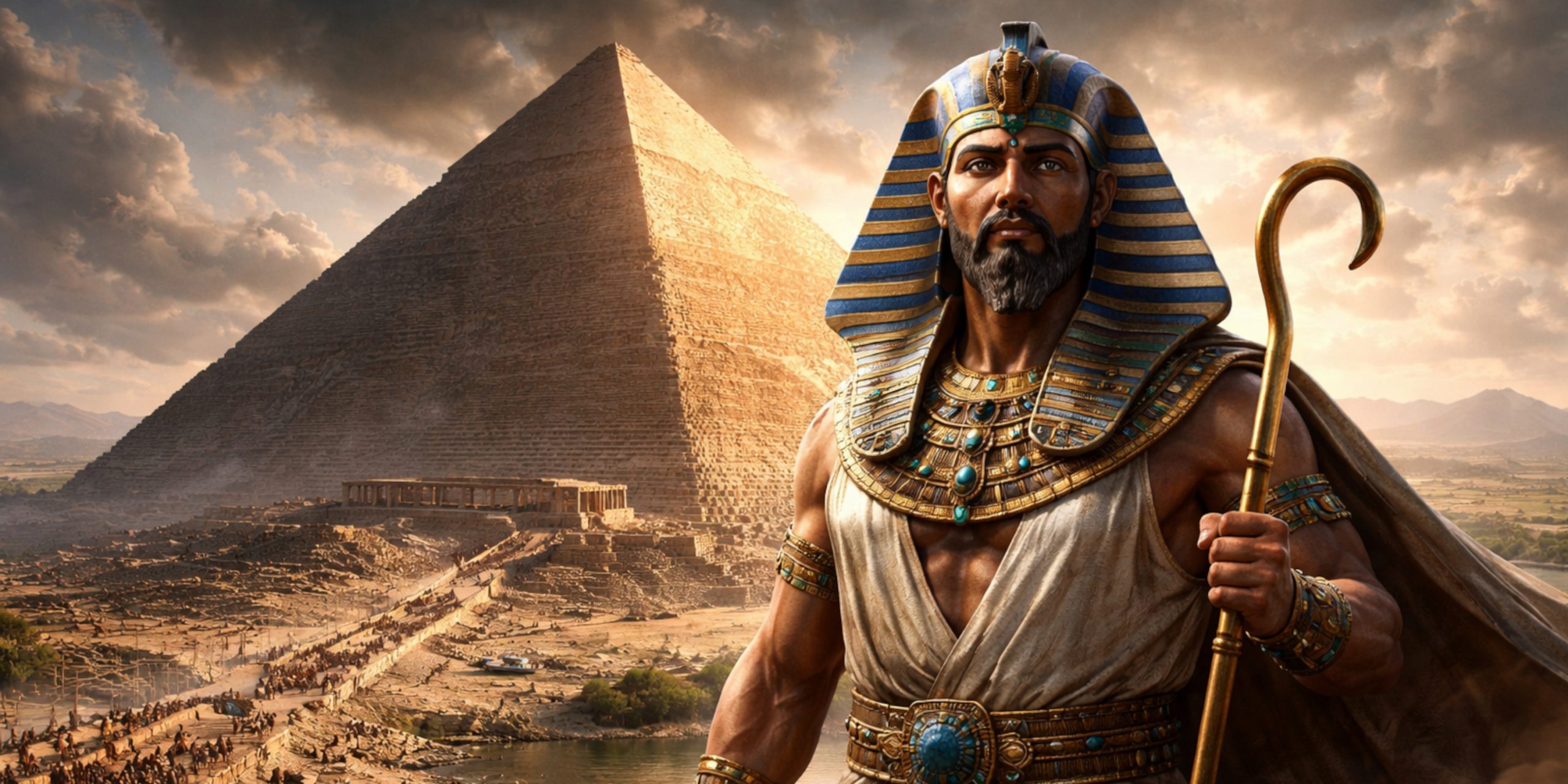
Few rulers in human history have left such a blunt and immovable calling card as Khufu. His Greek name, Cheops, lingers in classical texts, but it is Khufu who still commands the plateau at Giza Plateau. His Great Pyramid is less a tomb than a statement in limestone, a declaration that royal power in the Fourth Dynasty had reached a scale not previously attempted.
As a historian, I often find that Khufu suffers from the paradox of monumentality. We know his pyramid intimately. We know far less about the man who ordered it.
Historical Context and Reign
Khufu ruled during Egypt’s Fourth Dynasty, around the mid third millennium BCE. He was the son of Sneferu, a prolific builder who perfected pyramid construction at Dahshur. Sneferu left his son not only a stable kingdom, but a working blueprint for royal monumentality.
Khufu inherited:
- A centralised administration
- Established trade networks into Sinai and Nubia
- A tradition of pyramid building that had just reached architectural maturity
His reign appears stable, bureaucratically efficient and financially capable of mobilising tens of thousands of labourers. Administrative papyri discovered at Wadi al Jarf have provided rare insight into state logistics, including quarrying and transport operations linked to his pyramid complex.
Ancient later writers such as Herodotus portray Khufu as harsh and impious. Modern Egyptology treats those accounts cautiously. They were written two millennia after his death and reflect Greek storytelling as much as Egyptian memory.
The Great Pyramid and Royal Authority
The Great Pyramid remains the defining monument of Khufu’s reign. Originally standing at roughly 146 metres, it was the tallest man made structure on Earth for almost four thousand years.
The pyramid complex included:
- The main pyramid
- A mortuary temple
- A causeway
- A valley temple
- Boat pits containing dismantled royal vessels
The scale alone speaks to extraordinary administrative control. Quarrying limestone locally, transporting fine Tura limestone across the Nile, coordinating labour crews, feeding them, housing them, recording rations, all of this required a sophisticated bureaucracy.
The pyramid was not built by slaves in chains. Archaeological excavations of workers’ villages near Giza have revealed organised labour forces with medical care, diet provisioning and structured hierarchies. This was state organisation at its peak.
Arms and Armour of Khufu’s Era
The Fourth Dynasty predates the large scale chariot warfare of the New Kingdom. Military organisation was more regional and expeditionary in character.
Typical weaponry during Khufu’s reign included:
- Copper short swords and daggers
- Flint and copper tipped spears
- Simple bows with flint arrowheads
- Maces with stone or copper heads
The short sword of this period was often leaf shaped, cast in copper and primarily suited for thrusting. Shields were likely wooden frames covered with hide. Body armour was minimal or non existent in comparison with later periods. Protection relied on agility, shield use and formation.
The pharaoh himself was symbolically associated with weapons. Ceremonial maces and sceptres appear in reliefs, reinforcing royal dominance. Whether Khufu personally led campaigns is uncertain, but as supreme commander he embodied military authority.
Battles and Military Acumen
There is no detailed battle narrative from Khufu’s reign, which can frustrate modern readers. However, evidence suggests continued expeditions into:
- The Sinai Peninsula for copper and turquoise
- Nubia for gold and control of trade routes
These operations required logistical competence and disciplined troops. Egypt’s early Old Kingdom military was not an empire conquering machine, but it was effective in protecting economic interests.
Khufu’s military acumen may be measured less by battlefield heroics and more by continuity. There are no signs of catastrophic invasion or collapse during his reign. Stability, in this context, is itself a military achievement.
Religion and Kingship
Khufu ruled at a time when divine kingship was becoming increasingly formalised. The pharaoh was seen as the earthly manifestation of Horus and the son of Ra. The pyramid complex reinforced cosmic order, aligning architecture with celestial principles.
The Great Pyramid was both tomb and cosmic device. Its internal chambers and orientation reflect astronomical awareness. Royal authority, theology and architecture fused into a single ideological machine.
Artefacts from Khufu’s Reign
Despite the immensity of his pyramid, surviving personal artefacts of Khufu are surprisingly scarce.
Notable examples include:
- The small ivory statuette of Khufu, discovered at Abydos and now housed in the Egyptian Museum in Cairo. It is only a few centimetres tall, almost comically modest for a king who built the largest pyramid in history.
- The solar boat discovered in a sealed pit beside the Great Pyramid, reconstructed and displayed near Giza.
- Administrative papyri from Wadi al Jarf, including the diary of an official named Merer, which records transport of limestone blocks.
Where to see artefacts today:
- Egyptian Museum, Cairo
- The Grand Egyptian Museum near Giza
- Giza Solar Boat Museum complex
Latest Archaeological Findings
Recent decades have seen renewed investigation of the pyramid using non invasive scanning technologies. Projects such as the ScanPyramids initiative have detected voids within the structure, including a large cavity above the Grand Gallery. The purpose remains debated.
Excavations of workers’ settlements continue to refine our understanding of labour organisation, diet and medical care. Analysis of skeletal remains indicates healed injuries, suggesting state supported treatment rather than expendable labour.
The Wadi al Jarf papyri remain among the most significant discoveries. They provide administrative detail that bridges monument and management, linking Khufu’s name directly to practical construction oversight.
Personality and Historical Reputation
Later Greek writers painted Khufu as a tyrant who closed temples and oppressed his people. Egyptian contemporary evidence does not confirm this image. It is possible that later dynasties shaped memory to suit their own ideological needs.
As a historian, I find Khufu less a villain and more an enigma. He left us a pyramid that dominates the horizon, yet his voice is almost absent from the record. We can measure the stone blocks. We cannot measure the man.
Legacy
Khufu’s Great Pyramid marked the high watermark of Old Kingdom monumentality. His successors built impressive structures, yet none equalled his in scale.
His reign demonstrates:
- Advanced state logistics
- Architectural precision
- Centralised authority
- Economic strength
The pyramid still stands, weathered but intact. That fact alone is an argument for his enduring influence. Few rulers can claim their signature remains visible from space.
Khufu’s life may remain partly obscured, but his ambition is carved into the Egyptian skyline. History often reduces kings to their monuments. In Khufu’s case, the monument is so vast that it has almost swallowed the man whole.