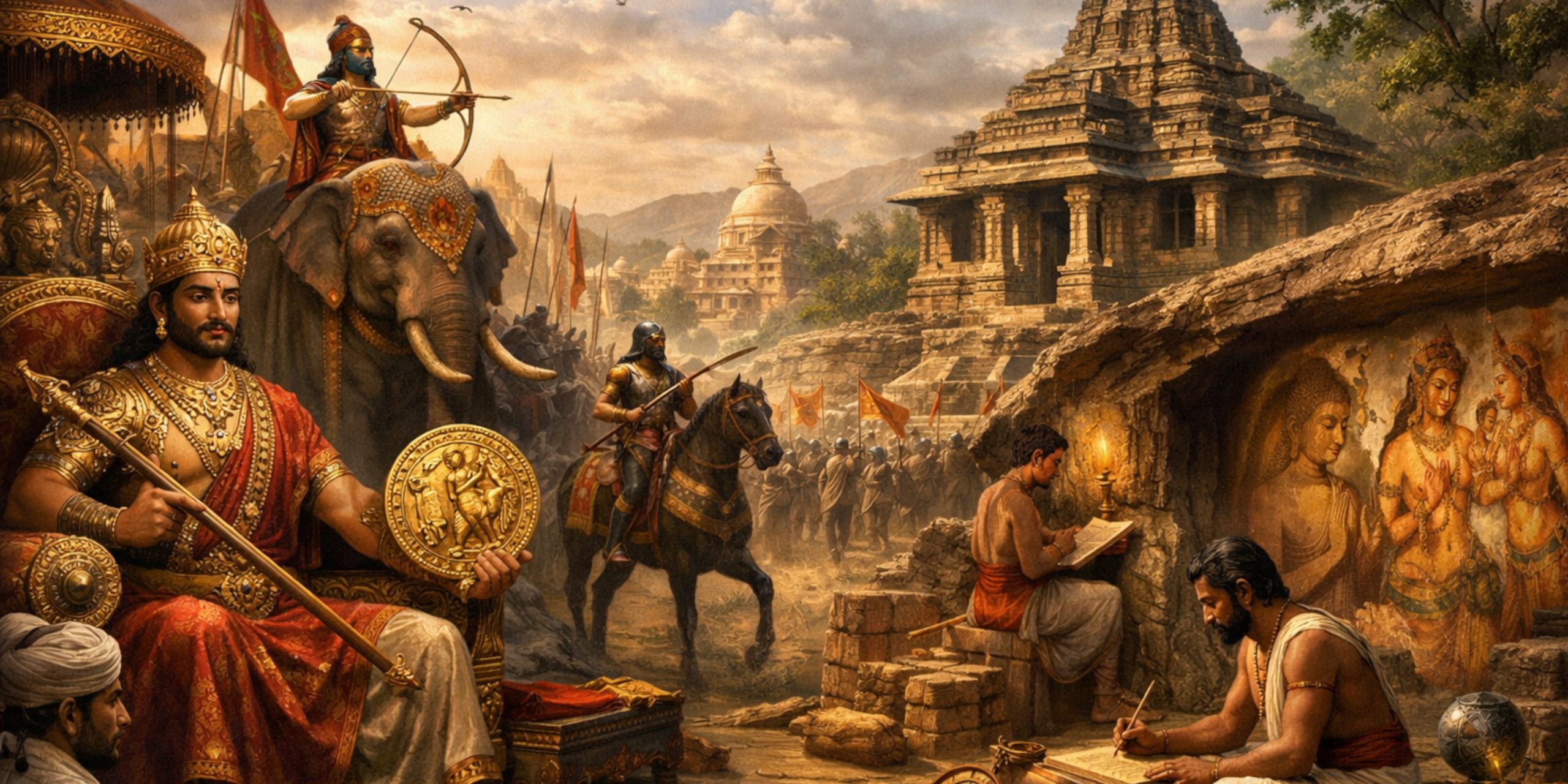
There are periods in history that historians approach with caution, and then there are those we approach with quiet admiration. The Gupta Dynasty falls firmly into the latter category. Flourishing between the fourth and sixth centuries CE, it is often described as a golden age of India. As a historian, I usually treat such labels with suspicion. Golden ages tend to look less golden when you peer closely. Yet the Guptas make a compelling case.
They oversaw political consolidation, artistic refinement, scientific innovation and literary brilliance. Not perfection, certainly. But confidence, ambition and cultural radiance, yes.
Let us examine what we actually know.
Origins and Rise to Power
The dynasty begins somewhat modestly. Our first identifiable ruler is Sri Gupta, probably a local chief in the late third century CE. The family’s real ascent began under Chandragupta I around 320 CE. Through strategic marriage alliances, particularly with the Licchavi clan, he elevated his status and laid the groundwork for imperial ambition.
The dynasty truly expanded under Samudragupta, a ruler whose achievements were recorded in the Allahabad Pillar inscription. This inscription reads less like a dry administrative record and more like a triumphant press release. It lists conquered kings and subdued territories with admirable thoroughness.
Samudragupta extended Gupta influence across much of northern India and into parts of central and southern India. He was not merely a conqueror. He was also a patron of the arts, sometimes depicted playing the veena on his coins. One appreciates a warrior who understands the importance of branding.
Political Structure and Governance
The Gupta Empire was not a rigidly centralised state. It functioned through a network of provincial governors, local rulers and tributary kings. In many regions, conquered rulers were reinstated as vassals. It was practical politics.
Key features of governance included:
- A monarch supported by ministers and court officials
- Provinces administered by governors often drawn from the royal family
- Local councils with some degree of autonomy
- A structured taxation system based on land revenue
This flexibility helped maintain stability across a vast and culturally diverse territory. It also meant that when central authority weakened, the structure could unravel rather quickly. Stability, as ever, depends on personality as much as policy.
Military Power and Expansion
The Gupta army relied on infantry, cavalry and war elephants. Archery played a significant role in battlefield tactics. While detailed accounts of battles are limited, inscriptions suggest swift campaigns and strategic diplomacy.
The empire reached its zenith under Chandragupta II, also known as Vikramaditya. He extended control westward, defeating the Western Kshatrapas and securing valuable trade routes. This expanded access to ports along the Arabian Sea, strengthening commercial connections with the Roman world and beyond.
Military success was therefore not merely about territorial pride. It was about revenue, trade and prestige.
Economy and Trade
Economic prosperity was a defining feature of the Gupta era.
The empire benefited from:
- Agricultural productivity supported by fertile river plains
- Long distance trade with Southeast Asia, the Mediterranean and Central Asia
- Gold coinage of remarkable craftsmanship
Gupta gold coins are particularly telling. They display kings in dynamic poses, sometimes engaged in ritual, sometimes in martial display. They are political messaging in metal. Their abundance suggests strong control over trade networks and access to bullion.
Yet we should note that by the later Gupta period, gold coinage declined in quality and quantity. Economic strain often whispers before it shouts.
Religion and Intellectual Life
The Guptas were primarily patrons of Hinduism, particularly Vaishnavism. However, they demonstrated considerable religious tolerance. Buddhism and Jainism continued to flourish.
This was a period of intellectual vibrancy. The mathematician Aryabhata made significant advances in astronomy and mathematics, including work on the concept of zero and the approximation of pi. The playwright Kalidasa produced works of Sanskrit literature that remain celebrated.
The development of classical Sanskrit as a literary language reached its peak during this era. Courtly culture thrived. If one had to choose a century to attend as an academic, the Gupta court would not be a poor option.
Art and Architecture
Gupta art is characterised by balance, serenity and refined detail. Sculptures from this period show a distinctive softness of form and calm expression. It is difficult to look at a Gupta Buddha without feeling that you have been gently instructed to lower your voice.
Architectural achievements include early Hindu temples with a clear structural plan, such as the Dashavatara Temple at Deogarh. Cave complexes like Udayagiri demonstrate both religious devotion and artistic ambition.
Ajanta’s painted caves, while spanning multiple periods, reflect artistic traditions shaped during the Gupta era. The human figures are elegant and expressive, the narratives intricate.
One senses a culture comfortable in its aesthetic identity.
Society and Daily Life
Society during the Gupta period was hierarchical. The varna system continued to shape social organisation, and inscriptions indicate a stratified order.
Women’s roles varied across class and region. Royal women could wield influence, particularly through marriage alliances. Literary sources suggest educated women existed, yet the overall structure remained patriarchal.
Urban centres flourished, but rural life formed the backbone of the economy. Agriculture, craftsmanship and trade sustained the empire’s prosperity.
As ever, golden ages shine brightest at court. Village life rarely receives equal illumination.
Decline and Fragmentation
By the mid fifth century, pressures mounted.
The empire faced:
- Invasions from the Huna tribes
- Weakening central authority
- Economic strain
- Regional governors asserting independence
The Hunas inflicted significant damage, and although some Gupta rulers managed temporary recoveries, the empire gradually fragmented.
By the sixth century, Gupta political dominance had faded. Yet cultural and intellectual legacies endured far longer than the imperial structure itself.
Legacy
The Gupta period left an enduring imprint on South Asian civilisation.
It shaped:
- Classical Hindu temple architecture
- Sanskrit literary tradition
- Mathematical and astronomical scholarship
- Iconography that influenced Southeast Asia
Calling it a golden age is not mere romanticism. The evidence of artistic and intellectual achievement is tangible. Yet one must remember that prosperity was uneven, and political fragility lay beneath the surface.
Still, when I consider the synthesis of power, culture and intellectual ambition achieved under the Guptas, I cannot help but admire them. They remind us that stability and creativity often travel together, at least for a while.
History rarely offers perfection. The Gupta Dynasty offers something more interesting. A moment when political authority and cultural confidence aligned, and the result was luminous.
And as historians, we are allowed, occasionally, to acknowledge that something truly was rather impressive.