I have a soft spot for Howell Davis. Perhaps it is because he was Welsh, which means he belonged to the same rain-soaked island tradition of ambition and mischief as the rest of us. Or perhaps it is because his career was so absurdly brief, yet so spectacular. He did not carve a decades-long reign across the Atlantic. He burned bright, and then he was shot dead in a botched act of audacity that almost made him a king.
Let us start at the beginning.
Early Life and Background
Howell Davis was born in Milford Haven, Pembrokeshire, around 1690. At the time, Milford Haven was a thriving maritime hub. If you were born there and did not end up at sea, someone would probably ask what went wrong.
Davis began as a merchant sailor. By all accounts he was intelligent, literate and ambitious. He was not a reckless brawler in the mould of some pirates. He was calculating. That distinction matters.
In 1718 he was sailing as a mate aboard the Cadogan, bound for the West African coast. The ship was captured by pirates. Instead of resisting or sulking in irons, Davis joined them. It was a practical decision. There is a lesson there about career mobility, albeit a morally questionable one.
Turn to Piracy
The Cadogan’s pirate crew soon discovered that Davis had leadership qualities. When the captain proved unpopular, Davis manoeuvred himself into command. His rise was swift.
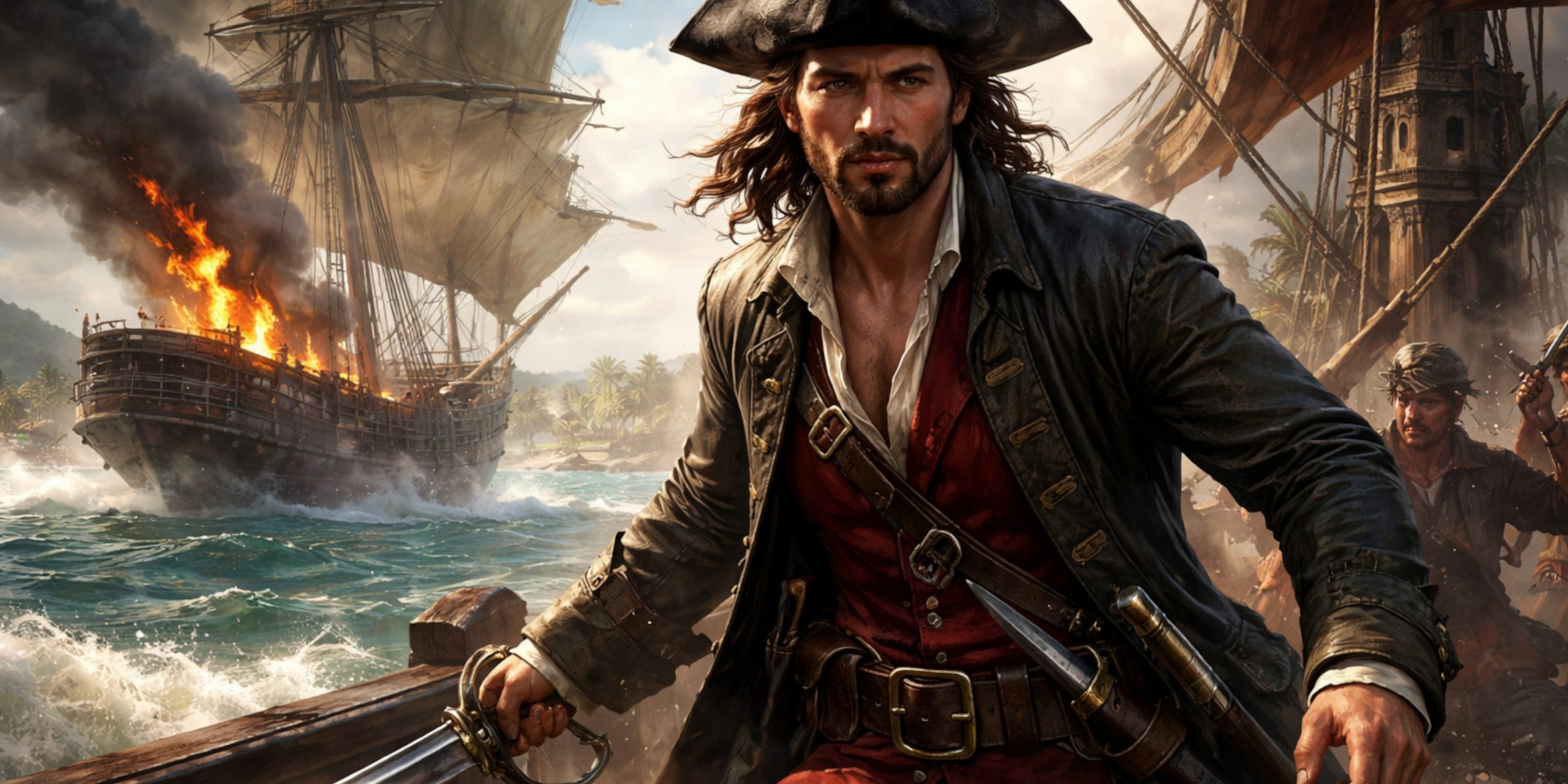
He specialised in deception rather than brute force. Instead of simply attacking ships or settlements, he posed as a legitimate trader, privateer or even royal envoy. He relied on confidence and theatre.
Within months, he was commanding his own vessel and operating along the West African coast and the Cape Verde Islands. His career as a pirate captain lasted less than a year, yet in that time he captured numerous prizes and established a reputation for cunning.
Ships Under His Command
Davis commanded several vessels during his brief career.
Cadogan
Originally a legitimate merchant vessel, it became his first pirate command.
Buck
A larger and more capable ship, often associated with his later exploits off West Africa.
Royal Rover
He briefly commanded vessels under different names as he captured and repurposed ships.
His ships were typically:
- Light, fast brigantines or sloops
- Equipped with 6 to 12 cannon
- Crewed by between 30 and 70 men
- Designed for speed and intimidation rather than line-of-battle combat
Davis preferred manoeuvrability and surprise. He did not seek out warships. He sought opportunities.
Weapons and Equipment
Pirates of this era were not exotic in their armament. They used what was practical and widely available.
Typical weapons aboard Davis’s ships included:
- Flintlock pistols
- Cutlasses
- Boarding axes
- Muskets
- Small cannon loaded with round shot or grapeshot
The cutlass was particularly favoured. It was short, brutal and effective in the close confines of a deck.
Davis himself was described as charismatic and bold rather than physically imposing. His greatest weapon was his ability to persuade enemies that he was something he was not.
Treasure and Bounty
This is the part people always want quantified. Unfortunately, piracy accounting was rarely neat.
Davis captured multiple ships along the West African coast, including vessels belonging to the Royal African Company and Portuguese traders. Cargoes included:
- Gold dust
- Ivory
- Slaves
- Trade goods
- Coin
He also extorted ransoms from colonial governors and merchants.
It is unlikely that he accumulated vast personal treasure in the manner later romanticised by fiction. Pirate profits were distributed among crews according to agreed shares. Captains received a larger portion, but not princely sums.
Still, for a young Welshman from Milford Haven, it was a remarkable ascent.
Notable Exploits and Battles
Davis’s most audacious exploit occurred at Príncipe, an island off the West African coast under Portuguese control.
He devised a scheme to kidnap the island’s governor. Posing as a Royal Navy captain hunting pirates, he gained access to the governor’s residence. The plan was to seize him and demand ransom.
It was bold, theatrical and very nearly brilliant.
But someone raised the alarm.
Portuguese soldiers responded quickly. In the ensuing firefight, Howell Davis was shot dead in 1719. His pirate career had lasted roughly eleven months.
There were no grand naval battles. No epic broadsides against frigates. His engagements were sharp, calculated strikes. His greatest risk was social engineering, and in the end that is what killed him.
Contemporary Accounts and Quotes
Our primary source for Davis comes from Captain Charles Johnson’s A General History of the Pyrates, published in 1724. Though the author’s true identity remains debated, the work remains invaluable.
Johnson wrote of Davis:
“He was a Man of good natural Parts, and had a large Share of Courage and Conduct.”
Another passage describes his method:
“He generally chose rather to surprise than fight.”
That assessment feels accurate. Davis was not obsessed with violence. He preferred advantage.
It is worth noting that Johnson’s work blends fact and embellishment. Yet even allowing for theatrical flourishes, Davis emerges as intelligent and composed rather than chaotic.
Fate and Aftermath
Davis died at Príncipe in 1719, shot during his attempted deception of the governor. He was likely in his late twenties.
His crew did not dissolve. Instead, they elected a new captain.
That captain was Bartholomew Roberts.
Roberts, also Welsh, would become one of the most successful pirates of the entire Golden Age. In a sense, Davis lit the fuse. Roberts became the explosion.
Had Davis survived longer, history might remember him differently. As it stands, he is the intriguing prelude to a far larger story.
Character and Legacy
Howell Davis was not the most feared pirate of his era. He did not amass legendary treasure hoards. He did not terrorise the Caribbean for decades.
What he did demonstrate was that piracy could be strategic. He showed that deception, performance and calculated risk could be as powerful as cannon fire.
There is something distinctly modern about him. He understood perception. He manipulated authority. He weaponised confidence.
From a historian’s perspective, and yes, perhaps with a touch of northern bias, I find him fascinating precisely because he was clever rather than merely violent. His career reminds us that piracy was not simply chaos at sea. It was politics, theatre and economics with a cutlass tucked into the belt.
And sometimes, if one is too clever by half, it ends in a musket ball on a tropical island.
A rather dramatic end for a man from Milford Haven.
Quick Facts
- Born around 1690 in Milford Haven, Wales
- Pirate career from 1718 to 1719
- Operated primarily off West Africa and Cape Verde
- Known for deception and impersonation tactics
- Killed in 1719 at Príncipe
- Predecessor and influence on Bartholomew Roberts
If you are tracing the arc of the Golden Age of Piracy, Howell Davis deserves more than a footnote. He was brief, bold and unexpectedly sophisticated. For eleven months, he made the Atlantic his stage. Then the curtain fell.