The story of the Monomotapa, more accurately the rulers of the Mutapa state, has long been wrapped in myth, misunderstanding and colonial fantasy. Portuguese chroniclers wrote of vast gold mines. European mapmakers imagined an African Ophir. Later colonial writers tried, rather awkwardly, to credit anyone but Africans for the stone cities they could see with their own eyes.
The truth is more interesting and far more grounded. The Mutapa kingdom emerged from a Shona political and cultural world that had already produced complex states, long distance trade networks and monumental architecture. It was neither a fairy tale empire nor a footnote. It was a serious regional power that shaped south eastern Africa for centuries.
As a historian, I find it quietly satisfying when the archaeological record refuses to flatter imperial imagination. The stones at Great Zimbabwe do not lie.
Origins and Political Foundations
The Mutapa state developed in the fifteenth century from the cultural and political legacy of the Zimbabwe Plateau, particularly the earlier centres associated with the rulers of Great Zimbabwe.
The title Mwene Mutapa translates roughly as Lord of the Plundered Lands or Lord of the Conquered Lands. It suggests expansion, authority and tribute. Oral traditions speak of a prince named Nyatsimba Mutota who led a northern migration in search of new sources of salt and trade wealth. From this movement emerged a new capital in the Zambezi valley region and a ruling dynasty that would endure into the seventeenth century and beyond in diminished form.
Key features of the early state included:
- A sacral kingship in which the ruler was both political leader and ritual figure
- A tributary system drawing in regional chiefs
- Control of gold producing zones and trade routes
- Court officials who mediated access to the king
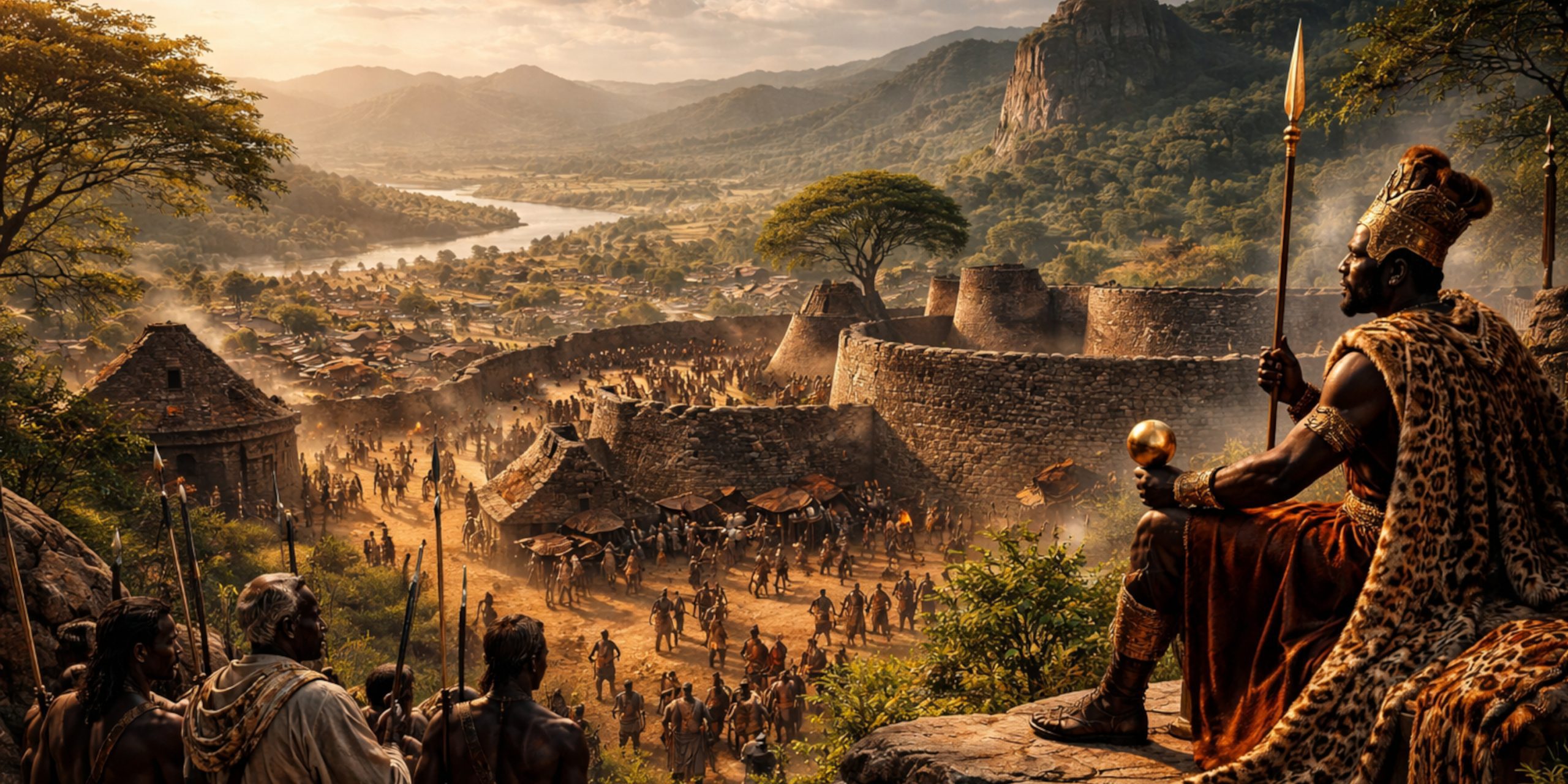
Power rested as much on ritual authority as on military force. The king was not easily accessible. Portuguese accounts repeatedly describe elaborate court protocols, symbolic regalia and ritualised distance. One senses that even European visitors were made to feel small. That, I suspect, was entirely the point.
Territory and Expansion
At its height in the sixteenth century, the Mutapa state extended across large areas of what is now northern Zimbabwe and into Mozambique. It controlled inland trade corridors linking goldfields to the Indian Ocean coast.
Major centres associated with this political world include:
- Great Zimbabwe, earlier but culturally foundational
- Khami, a successor state centre
- The Zambezi valley capitals of the Mutapa rulers
The kingdom did not rule every inch of territory directly. Authority functioned through layered allegiances. Local chiefs acknowledged the Mwene Mutapa and paid tribute. In return, they received recognition and protection. This flexible structure allowed for expansion but also created vulnerabilities when tribute networks frayed.
Economy and the Gold Trade
Gold lay at the heart of Mutapa wealth. The region’s deposits had been exploited for centuries before Portuguese arrival, and gold moved through established trade systems to Swahili coastal cities such as Kilwa and Sofala.
The economy included:
- Gold extraction and processing
- Ivory trade
- Agricultural production, especially sorghum and millet
- Cattle as wealth and status markers
Portuguese merchants arrived in the early sixteenth century seeking direct access to gold. They established a presence along the coast and gradually pushed inland. Their reports describe rich mines and powerful kings, though often with exaggeration designed to impress Lisbon.
What is clear is that Mutapa rulers understood trade politics. They negotiated, restricted access and attempted to manipulate rival factions. They were not passive suppliers. They were players in a competitive Indian Ocean economy.
Society, Religion and Court Culture
Mutapa society was rooted in Shona cosmology. Ancestral spirits, particularly the mhondoro spirit mediums, played a crucial role in legitimising kingship. The ruler’s authority was intertwined with ritual mediation between the living and the ancestral realm.
Court life was highly structured. Portuguese sources describe:
- Officials responsible for tribute collection
- Court messengers and military retainers
- Regalia and symbolic objects associated with royal authority
Material culture included ceramics, iron tools and ornaments, and carved soapstone objects. The famous Zimbabwe Birds, carved in soapstone and found at Great Zimbabwe, predate the Mutapa dynasty but form part of the broader cultural world from which it emerged.
Religion and politics were inseparable. To challenge the king was to disrupt cosmic balance. It is difficult not to admire the elegance of that system.
Encounters with the Portuguese
By the sixteenth century, Portuguese traders and missionaries sought deeper influence within the Mutapa court. Some rulers allowed missionaries to operate. At times, Christian conversion was reported, though often superficially and strategically.
Relations shifted between cooperation and armed conflict. Portuguese forces occasionally intervened in succession disputes, backing rival claimants in hopes of gaining trade concessions.
The result was gradual destabilisation:
- Succession struggles intensified
- Portuguese prazos, land grants along the Zambezi, expanded
- Rival Shona states such as the Rozvi rose in strength
The Mutapa state did not collapse overnight. It fragmented, relocated and adapted. By the seventeenth century its power had significantly declined, though successor polities continued to use the Mutapa title.
It is a familiar pattern. External pressure magnifies internal fractures. The drama lies in how long the structure holds.
Military Organisation
Evidence for Mutapa military structure is less detailed than for some contemporaneous states, but we can infer certain features:
- Levies drawn from subject communities
- Use of spears, bows and possibly iron bladed weapons
- Defensive reliance on terrain and fortified settlements
Portuguese accounts mention armed retainers and organised resistance. There is no evidence of large standing armies in the European sense, but regional mobilisation could be substantial.
Power in this context did not depend on drilled formations. It depended on authority networks, tribute and the capacity to respond to threats swiftly.
Archaeology and Material Evidence
Archaeological work across Zimbabwe and Mozambique has clarified much that early European writers misunderstood.
Key evidence includes:
- Stone built centres such as Great Zimbabwe and Khami
- Gold working debris and trade goods
- Imported ceramics from the Indian Ocean world
- Oral traditions recorded in later centuries
These finds confirm sustained trade connections stretching from inland southern Africa to the Swahili coast and beyond to Arabia and India.
The most satisfying correction to earlier colonial theories is simple. The builders of these stone complexes were African. The rulers who commanded trade and tribute were African. No lost Mediterranean colony is required.
Sometimes history’s greatest drama lies in removing the nonsense.
Decline and Legacy
By the late seventeenth century, the Rozvi state under Changamire Dombo had eclipsed Mutapa authority in many areas. Portuguese influence remained along the Zambezi, but their control was inconsistent and often precarious.
The Mutapa title persisted in diminished form into the eighteenth and nineteenth centuries, though as a regional rather than imperial power.
The dynasty’s legacy includes:
- The political tradition of sacral kingship in the Zimbabwe Plateau
- Participation in long distance Indian Ocean trade
- Monumental stone architecture within the broader Zimbabwe culture
- A historical narrative that challenges simplistic views of pre colonial Africa
For modern Zimbabwe, the memory of Mutapa and Great Zimbabwe remains central to national identity. The very name Zimbabwe derives from dzimba dza mabwe, houses of stone.
As a female historian trained in a field that once sidelined African polities, I cannot help feeling a quiet pride when students encounter this story for the first time. They expect absence. They find complexity. They expect silence. They find diplomacy, ritual, trade, ambition and the occasional political miscalculation.
In short, they find history.
And that is rather the point.