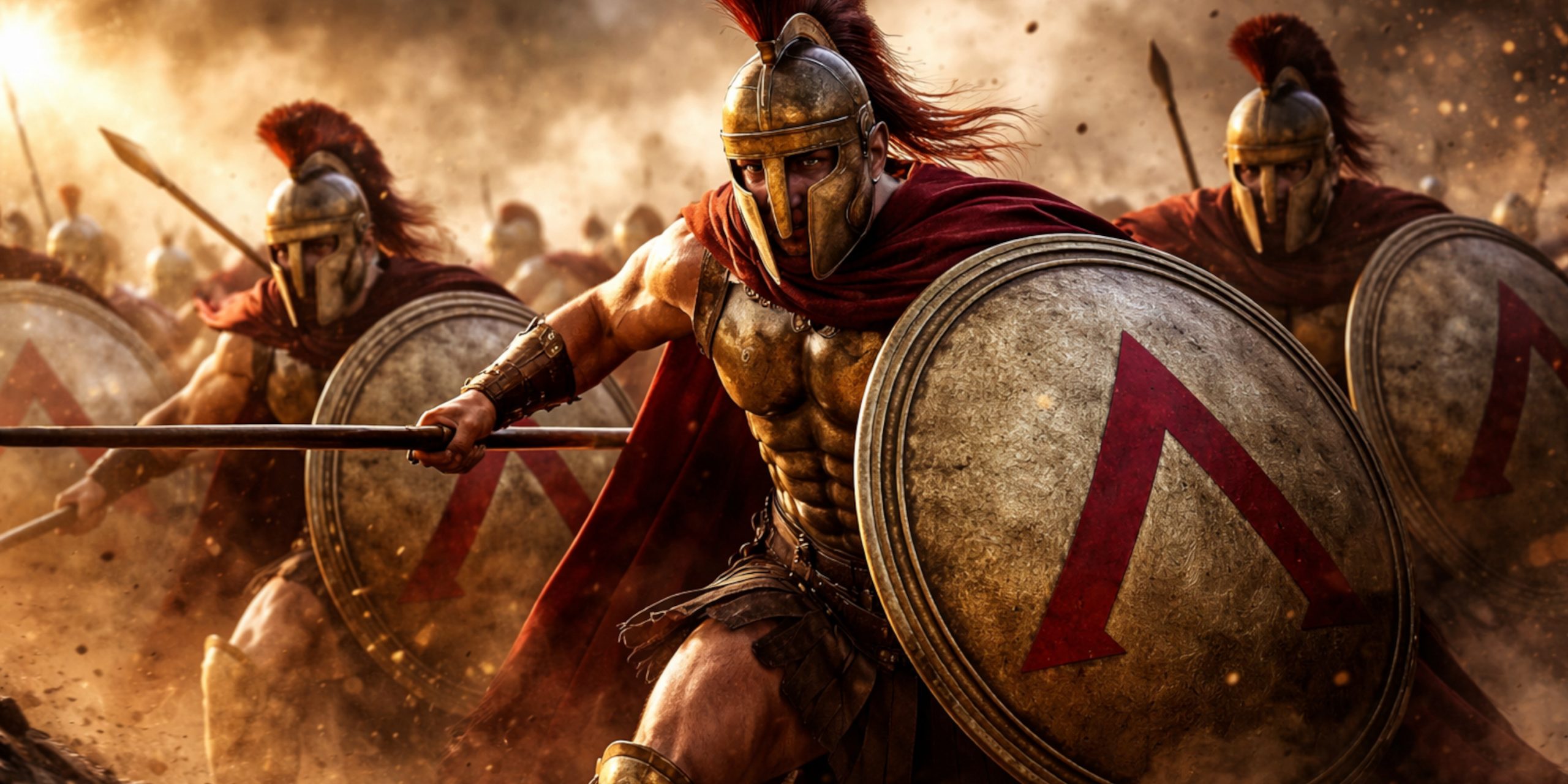
Few soldiers in history enjoy the reputation of the Spartan hoplite. The image is fixed in popular imagination: bronze helmet, scarlet cloak, round shield marked with the lambda, standing immovable against impossible odds. It is compelling, cinematic, and only partly true.
The Spartans left very little written material of their own. What we know comes largely from outsiders, some admiring, some hostile, all writing with agendas. Strip away the myth and what remains is still impressive: a society that engineered itself around war and produced one of the most disciplined infantry systems in the ancient world.
The Spartan System
Sparta was not merely a city. It was a social experiment built around military cohesion.
The citizen elite, known as the Spartiates, were full-time soldiers. From childhood, boys entered the agoge, a state-controlled training system designed to instil endurance, obedience and unity. Literacy was secondary. Silence, pain tolerance and loyalty were not.
By adulthood, the Spartan male citizen was expected to dine with his mess group, train regularly and remain combat ready well into middle age. Military service defined civic identity. Failure in battle was not simply personal shame. It threatened one’s place within society.
This intensity had a purpose. Sparta ruled over a large population of helots, an unfree agricultural class. Military strength was not just for foreign campaigns. It was essential for internal control.
Arms and Armour
The Spartan hoplite was part of the broader Greek heavy infantry tradition. His equipment was not wildly different from that of other poleis, though Spartan discipline made the difference.
Primary Weapons
- Doru spear
A wooden shaft approximately two to three metres in length, tipped with an iron spearhead and balanced by a bronze butt-spike called a sauroter. The spear was the principal killing tool in the phalanx. - Xiphos sword
A short, double-edged leaf-shaped sword, typically around 50 to 60 centimetres in blade length. It served as a secondary weapon once spears broke or formations collapsed. Spartans were reputed to favour relatively short blades, useful in tight formations.
Some hoplites across Greece carried the kopis, a forward-curving blade better suited to slashing. Evidence for widespread Spartan use of the kopis is limited, but it likely appeared in certain contexts.
Defensive Equipment
- Aspis shield
Also known as the hoplon, a large round shield roughly 90 centimetres in diameter. Constructed of layered wood, faced with bronze. It was carried using a central arm band and hand grip system. The Spartan shield often bore the Greek letter lambda, referencing Laconia. - Corinthian helmet
Fully enclosing bronze helmet with narrow eye slits and nasal protection. It offered formidable defence but limited hearing and vision. - Cuirass
Early hoplites wore bronze muscle cuirasses. By the later fifth century BC, many adopted lighter composite or linen armour, known as linothorax. - Greaves
Bronze shin guards moulded to fit the wearer.
The total weight of equipment could exceed 25 kilograms. Marching in Greek summer heat under such load required serious conditioning. Spartan training ensured they could endure it.
Tactics and the Phalanx
The Spartan hoplite fought within the phalanx, a dense formation of overlapping shields and projecting spears. Success depended on cohesion rather than individual heroics.
Each man’s shield protected not only himself but the comrade to his left. To abandon position endangered the entire line. It explains the famous Spartan admonition recorded by Plutarch, that mothers told their sons to return “with your shield or on it.”
In battle, the phalanx advanced steadily. At close range, spears thrust over and under shield rims. The collision of two formations, known as othismos or pushing, remains debated among scholars. Whether literal shoving occurred or whether it symbolised collective pressure, the contest was brutal and intimate.
Spartan reputation rested on discipline. At battles such as Thermopylae and Plataea, their ability to maintain formation under pressure proved decisive.
Contemporary Sources and Quotes
Our knowledge derives largely from authors such as Herodotus, Thucydides and later Plutarch.
Herodotus recounts the Spartan Dienekes at Thermopylae, who upon hearing that Persian arrows would blot out the sun, replied, “So much the better, we shall fight in the shade.” Whether factual or embellished, it reflects how Greeks wished to remember Spartan composure.
Thucydides presents a more sober portrait. He notes Spartan caution and reluctance to engage unless confident of advantage. This is less cinematic but far more credible.
Plutarch, writing centuries later, compiled sayings attributed to Spartans. They are sharp, often laconic, and occasionally suspiciously polished. Still, they reinforce the cultural emphasis on brevity and resolve.
Archaeology
Sparta has disappointed archaeologists seeking grand monuments. Unlike Athens, it did not invest heavily in monumental architecture during its peak.
Excavations at the Sanctuary of Artemis Orthia have revealed votive offerings, including small lead figurines of warriors. These suggest the ritual and martial culture intertwined closely.
Burials provide limited direct evidence of battlefield kit, since many items were reused or deposited elsewhere. However, bronze helmets and fragments of armour from Laconia and wider Greece align with literary descriptions of hoplite equipment.
The battlefield of Plataea has yielded arrowheads and weapon fragments consistent with fifth century warfare. While not exclusively Spartan, they confirm the material culture of the hoplite age.
In short, archaeology supports the existence of the heavily armoured infantry tradition, even if it does not always confirm every dramatic anecdote.
Myth Versus Reality
Spartan hoplites were formidable. They were not invincible.
At Leuctra in 371 BC, Theban forces under Epaminondas shattered Spartan dominance by concentrating force against their elite wing. The Spartan system, built on rigid hierarchy, proved vulnerable to tactical innovation.
Their society also depended on the subjugation of helots. This internal pressure constrained foreign campaigns and contributed to eventual decline.
Yet the core achievement remains striking. For over two centuries, Sparta maintained a citizen army that inspired both fear and admiration across the Greek world.
Legacy
The Spartan hoplite became an archetype of martial virtue in later Western thought. Roman writers admired their austerity. Early modern thinkers romanticised their discipline. Modern culture has often exaggerated their ferocity.
Strip away the spectacle and one finds something arguably more interesting. Sparta was a society that prioritised cohesion over individuality, endurance over comfort, and collective honour over personal ambition.
That model came at a cost, socially and demographically. It was difficult to sustain and ultimately fragile. Still, for a time, it produced infantry who could stand in a line of bronze and hold firm while the world pressed in.
As a historian, I find that reality far more compelling than myth. The Spartan hoplite was not a comic book hero. He was a citizen shaped by a demanding system, armed with spear and shield, advancing in step with his comrades, trusting that the man beside him would not break.
Sometimes, that is enough to change history.
Seven Swords Takeaway
Spartan hoplites combined rigorous training, disciplined formation tactics and standardised heavy infantry equipment to dominate much of classical Greek warfare. Literary sources shape their legend, while archaeology anchors them in material reality. Between the myth and the evidence lies a soldier who was neither superhuman nor ordinary, but the product of one of antiquity’s most uncompromising societies.
Their story endures because it speaks to something elemental about war, community and the tension between freedom and order. Whether admired or criticised, the Spartan hoplite remains one of the defining figures of the ancient battlefield.