The Battle of Hopton Heath, fought on 19 March 1643 near Stafford, rarely enjoys the fame of Edgehill or Marston Moor. Yet it offers something just as revealing, a close and bitter struggle in the Midlands where local loyalties, limited resources, and stubborn commanders shaped events more than grand strategy.
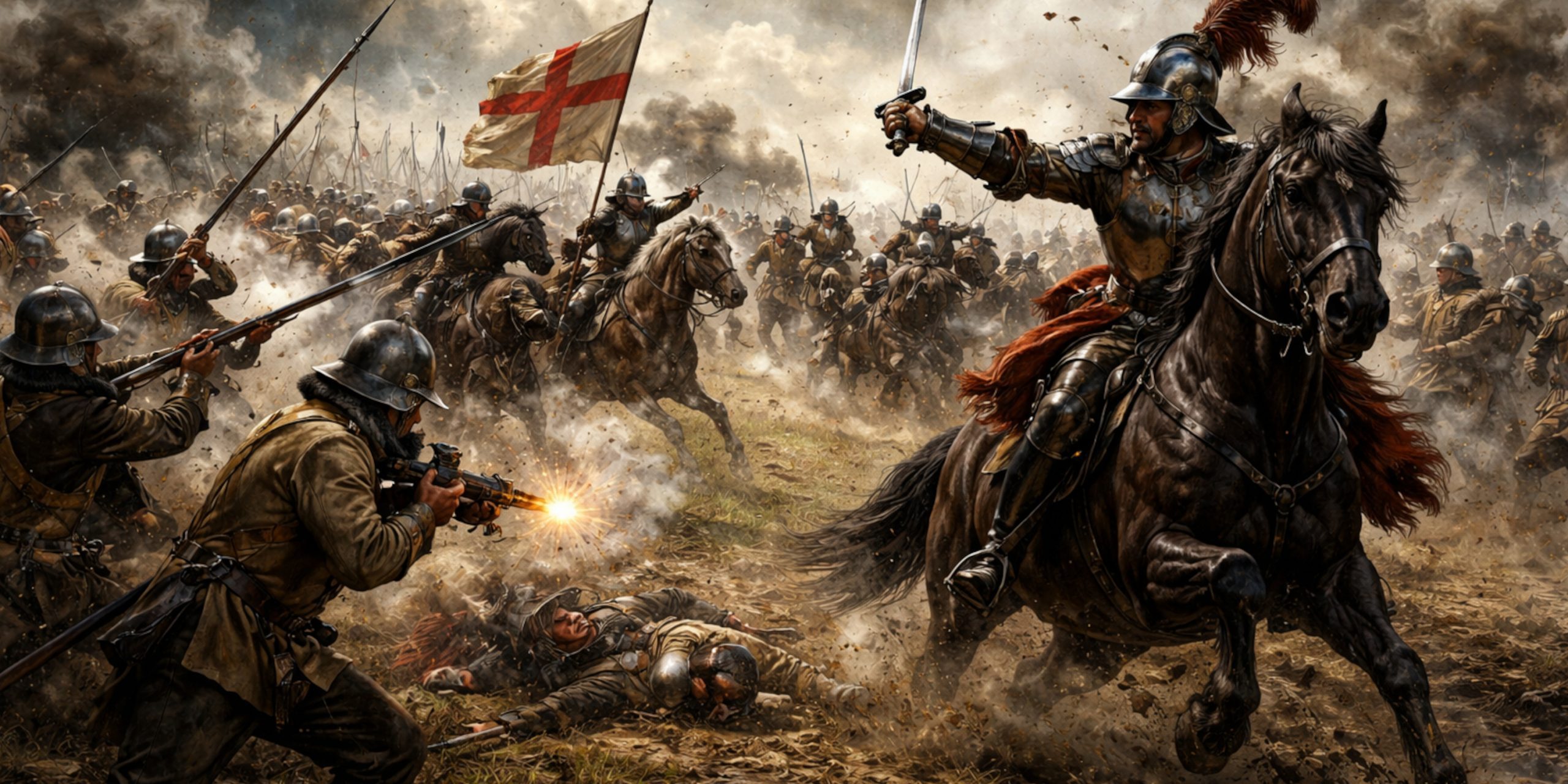
As a historian, I find these lesser known battles strangely compelling. There is no sweeping cavalry masterpiece here, no thunderous artillery duel to rival the Continent. Instead we see confusion, musket smoke hanging low over heathland, and men fighting at close quarters for control of a modest rise in Staffordshire. It is precisely this grounded, almost workmanlike brutality that makes Hopton Heath worth studying.
Strategic Background
By early 1643, the Midlands had become a contested zone between Royalist and Parliamentarian forces. Control of towns such as Stafford and Lichfield carried practical value. They were centres of supply, recruitment, and symbolic authority.
The Royalists aimed to consolidate influence across Staffordshire and protect communications between the north and Oxford, the King’s headquarters. Parliamentarian commanders in Derby and the surrounding counties sought to disrupt that hold and prevent the region becoming a secure Royalist corridor.
Hopton Heath was not chosen for grandeur. It was chosen because two forces happened to converge there, each determined not to yield.
Forces
Estimates vary, but both sides fielded relatively modest armies by Civil War standards.
| Side | Estimated Strength | Composition |
|---|---|---|
| Parliamentarian | 1,200 to 1,500 | Infantry, cavalry, some dragoons |
| Royalist | 1,200 to 1,400 | Infantry, cavalry, artillery |
Neither army was overwhelmingly superior. The battle would hinge on leadership and cohesion rather than numbers alone.
Commanders
Parliamentarian
- Sir John Gell
- Derbyshire commander with experience in local campaigning
- Determined and energetic, though not considered among Parliament’s most brilliant tacticians
- Sir William Brereton
- Active in the Midlands and north-west
- Known for persistence and organisational skill
Royalist
- Spencer Compton, 2nd Earl of Northampton
- Charismatic cavalry leader
- Personally brave to a fault
- Killed during the battle, a loss that overshadowed the tactical outcome
The death of Northampton became the defining feature of the engagement. Tactical victory is one thing. Losing a senior noble in the saddle is quite another.
Arms and Armour
Civil War warfare in 1643 still bore traces of earlier traditions. The battlefield at Hopton Heath would have displayed a mixture of pike and shot formations supported by cavalry armed with swords and pistols.
Infantry Equipment
- Matchlock muskets
- Pikes, often 14 to 16 feet in length
- Buff coats or simple leather jerkins
- Steel morions and simple helmets in some units
Cavalry Equipment
- Pistols for close discharge
- Back and breastplates
- Buff coats
- Riding boots reaching above the knee
Sword Types Used
| Type | Users | Characteristics |
|---|---|---|
| Mortuary Sword | Officers and cavalry | Basket hilted, sturdy blade suitable for cut and thrust |
| Backsword | Cavalry | Single edged, robust, ideal for mounted combat |
| Rapier or Transitional Rapier | Some officers | Narrower blade, more suited to thrusting |
The mortuary sword in particular became associated with Parliamentarian officers, though such distinctions were rarely absolute. In practice, men used what they could obtain. Civil war rarely waits for tidy standardisation.
The Battle Timeline
Morning, 19 March 1643
Parliamentarian forces advance towards Hopton Heath. Royalists position themselves on higher ground.
Late Morning
Initial skirmishing begins. Artillery exchanges are limited but present. Musketeers engage in volleys.
Midday
Cavalry charges intensify. The Royalist horse, led by Northampton, press aggressively.
Afternoon
In the midst of fighting, the Earl of Northampton is unhorsed and killed. Accounts suggest he refused quarter. His death shocks Royalist ranks.
Late Afternoon
Royalists eventually hold the field. Parliamentarian forces withdraw in good order.
Holding the field gave the Royalists a technical victory. The loss of their commander dulled any celebration.
Contemporary Accounts
Civil War sources often blend fact with polemic. Even so, they provide valuable colour.
One Royalist account recorded that Northampton “behaved himself with great valour and resolution”. Parliamentarian pamphlets emphasised his refusal to surrender, portraying his death as a consequence of obstinacy.
A Parliamentarian report described the fighting as “very sharp and hot for a time”, a phrase that, while restrained, likely masks considerable chaos and fear.
Such phrases are typical of the period. Seventeenth century understatement can be oddly eloquent.
Archaeology
Hopton Heath has not yielded the scale of artefacts found at larger Civil War battlefields, yet scattered finds over time have confirmed the intensity of fighting.
Recovered items have included:
- Musket balls
- Fragments of armour
- Possible pistol shot
Distribution patterns of shot suggest close engagement and shifting lines rather than static formations. The battlefield landscape remains largely rural, allowing some preservation of its original character.
Archaeology here does not overwhelm us with spectacle. Instead, it quietly confirms that this was a hard fought and localised struggle.
Outcome and Significance
The Royalists held the field and could claim victory. Yet the death of the Earl of Northampton weakened Royalist command in the Midlands at a critical stage of the war.
For Parliament, withdrawal did not equate to collapse. Their forces remained active in the region. The broader Civil War would continue to ebb and flow, often in similarly ambiguous contests.
Hopton Heath reminds us that not every battle reshapes a kingdom overnight. Some alter momentum subtly, through loss of leadership or morale rather than territory.
Why Hopton Heath Still Matters
In the grand narrative of the English Civil War, Hopton Heath sits in the shadow of more famous encounters. Yet its study offers insight into:
- The importance of local commanders
- The continued role of traditional cavalry charges
- The fragile nature of early war command structures
- The brutal reality of mid level engagements
There is also a human element. Northampton’s death became a Royalist martyr story. Gell’s persistence became part of Parliamentarian resilience in the Midlands. Both narratives shaped how communities remembered the conflict.
History is not only written by victors. It is also written by survivors and pamphleteers.
Takeaway
The Battle of Hopton Heath was neither decisive nor glamorous. It was something more instructive. Two roughly matched forces met on open heathland, fought with determination, and paid a price in blood and leadership.
For those of us who study the period, it offers a clear window into how the war actually felt on the ground. Mud under boots, smoke in the air, shouted commands barely heard above musket fire. No sweeping legend, just hard fighting and a fallen earl.
Sometimes that is enough.