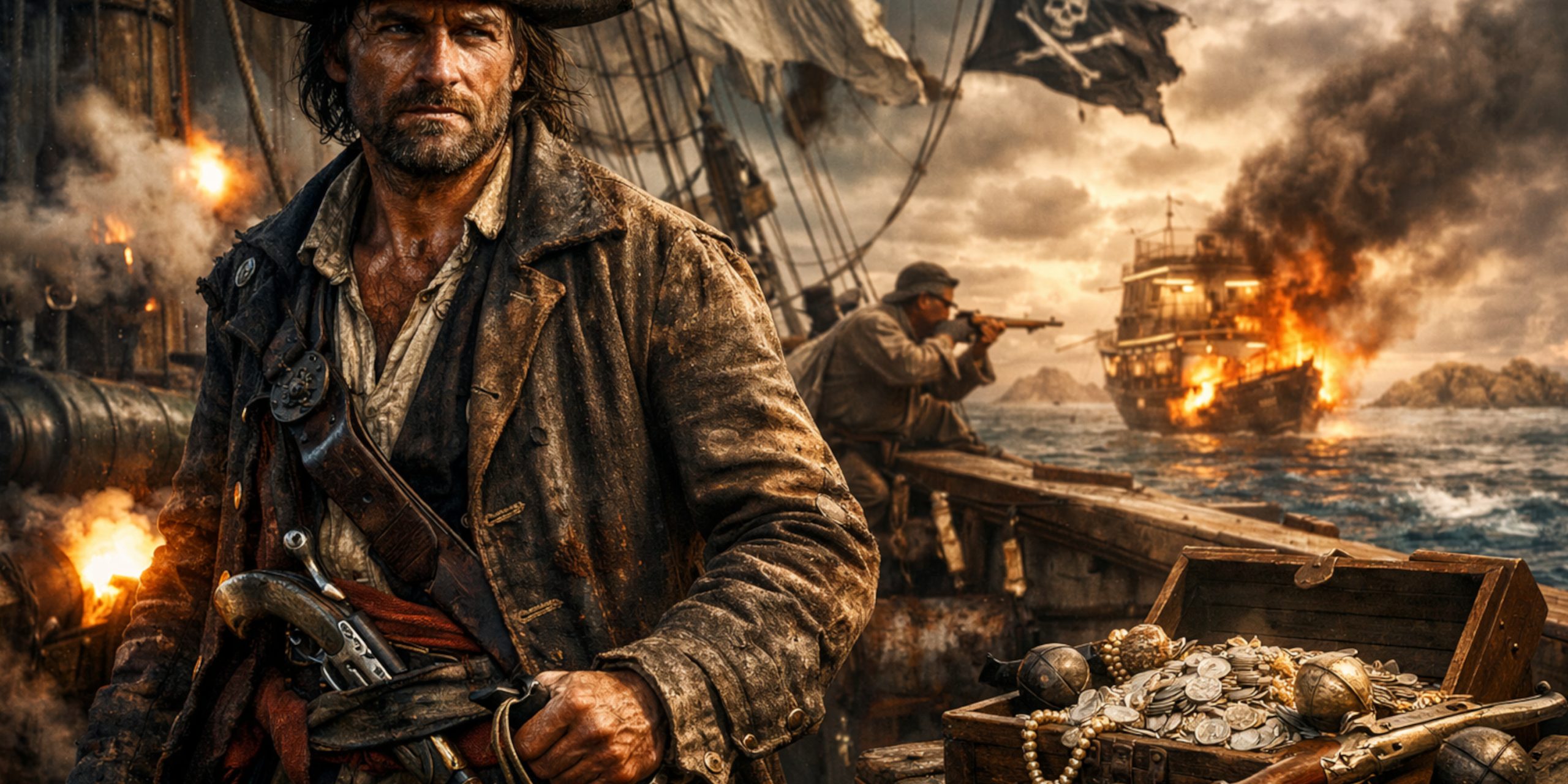
George Lowther is not one of piracy’s grand myth-makers. He did not retire rich, found a pirate republic, or leave behind a trail of legend polished by success. What he left instead is something more interesting. A brief, volatile career that shows how quickly piracy could unravel when authority cracked and morale followed.
Lowther is the sort of historical figure who looks decisive on paper and anxious in practice. His story is less about gold and more about leadership under strain, and how badly things go when a captain loses the confidence of his crew.
Early Life and Background
Lowther appears in the records as a former officer in the merchant service. By 1721 he was serving aboard the Gambia Castle, a Royal African Company ship bound for West Africa. The voyage was brutal, discipline was harsher still, and Lowther’s position placed him between a cruel captain and a resentful crew.
The mutiny that followed was swift and practical. Lowther was elected captain, not because he was charismatic, but because he was present, competent, and willing. Piracy, as so often, was not born of ideology but exhaustion.
Turn to Piracy
Once in command, Lowther renamed the captured ship Happy Delivery. The name suggests optimism. The reality was more fragile.
Lowther issued articles, promised fair shares, and tried to maintain order. For a brief period, it worked. He cruised the Atlantic, targeting lightly defended merchantmen and avoiding major naval attention. His piracy was cautious, almost managerial, and this caution would later be read as weakness.
Ships Commanded
Lowther’s piracy revolved around a single vessel, though he briefly commanded a small fleet.
Happy Delivery
A refitted slave ship armed with roughly ten guns. Sturdy but slow, better suited to intimidation than pursuit.
Captured Prizes
Lowther occasionally took smaller sloops, often stripping them of supplies rather than keeping them. This limited his operational reach and, more importantly, limited opportunities for promotion among his crew, a fatal error in pirate politics.
Weapons and Fighting Style
Lowther’s men carried the standard tools of early eighteenth-century piracy.
- Flintlock pistols, usually in pairs
- Cutlasses, preferred for boarding
- Muskets for intimidation rather than accuracy
- Grenades, used sparingly but theatrically
Lowther himself does not stand out as a duellist or brawler. Contemporary descriptions suggest a man who commanded from the quarterdeck rather than the boarding rail. Effective in calm moments, less so when chaos set in.
Battles and Engagements
Lowther avoided major naval confrontations, which initially kept him alive but slowly eroded his authority.
His most notable engagements involved the capture of merchant vessels in the Caribbean and off the American coast. These were usually bloodless. Resistance was discouraged rather than crushed.
This approach kept casualties low but profits modest. Crews tolerated danger. They did not tolerate boredom.
Bounty and Treasure
Lowther’s total haul was unremarkable by pirate standards.
- Coin, mostly silver, taken from merchant cargoes
- Trade goods such as sugar, rum, and cloth
- Personal valuables stripped from captains and officers
There is no evidence of buried treasure or long-term hoards. Whatever Lowther gained was spent quickly on supplies, drink, and keeping his crew content. When that failed, the money stopped mattering.
Contemporary Quotes
Captain Charles Johnson, writing in A General History of the Pyrates, offers the clearest judgement.
“Lowther was a man of good natural parts, but wanted resolution when it was most necessary.”
Another account notes the growing restlessness aboard Happy Delivery.
“The men grew weary of a commander who feared pursuit more than poverty.”
These are not flattering assessments, but they are precise. Lowther’s failure was not cruelty or greed. It was hesitation.
Edward Low sailed with George Lowther early in Lowther’s pirate career, shortly after the mutiny that created Happy Delivery. Low was not a lieutenant in any formal sense, but he was part of the crew and quickly stood out for all the wrong reasons. Contemporary accounts describe him as violent, unpredictable, and fond of cruelty even by pirate standards, which is saying something.
The relationship ended when Lowther marooned Low on a small island after repeated disputes. This was not a moral stand. It was a leadership calculation. Lowther was trying, rather desperately, to keep order aboard a ship already showing signs of strain. Removing Low was meant to stabilise the crew. In the short term, it worked.
In the longer view, it backfired spectacularly for history’s sense of irony. Low survived, escaped the island, and went on to become one of the most brutal pirates of the period. His later career makes Lowther look cautious to the point of timidity.
Their divergence tells you a great deal about both men. Lowther lacked the appetite for sustained violence and decisive terror, qualities that often kept pirate captains in power. Low had nothing but appetite, and it carried him further, if not more happily.
Decline and Desertion
By 1723, Lowther’s crew had had enough. Leadership drained away as officers defected, men deserted, and discipline collapsed.
Lowther was marooned on a small island, either by his crew or by circumstance, accounts vary. What is clear is that he was left behind with limited supplies and no realistic chance of rescue.
Piracy was a collective enterprise. Once abandoned, a pirate captain was simply a man on a beach with regrets.
Fate and Death
Lowther’s end was quiet. He is believed to have taken his own life, reportedly leaving behind a note expressing despair and self-reproach.
There is no gallows scene, no crowd, no last-minute bravado. His death fits his career. Isolated, reflective, and painfully human.
Legacy
George Lowther matters not because he succeeded, but because he failed in ways that reveal the mechanics of piracy.
He shows us that pirate crews were not anarchic mobs, but political communities with expectations. Leadership required confidence, decisiveness, and a willingness to risk everything. Lowther had the first two only in moderation.
From the safety of York, with solid walls and reliable records, it is easy to judge him. At sea, under pressure, he cracked. History remembers him for that, and perhaps it should.
Not every pirate was Blackbeard. Some were simply men who stepped into command and discovered, too late, that they were not built to hold it.