The Battle of Ellandun stands as one of those moments where the ground quietly shifts beneath English history. Fought in 825, probably near modern Wroughton in Wiltshire, it marked the collapse of Mercian dominance in southern England and the rise of Wessex as the leading Anglo-Saxon kingdom. It does not arrive with grand speeches or epic poetry, but its consequences were decisive and long lasting.
By the early ninth century, Mercia had ruled much of England for generations. That dominance finally cracked when King Egbert of Wessex met and defeated King Beornwulf of Mercia. From this point on, the political map tilted south and never quite recovered its balance.
Background and Causes
Mercia had enjoyed decades of supremacy under kings like Offa, exerting influence over Kent, Sussex, Surrey, and Essex. Wessex had largely been boxed in, its ambitions constrained and its rulers sidelined.
Egbert of Wessex had other ideas. Having spent time in exile on the Continent, likely at the Frankish court, he returned with sharper political instincts and a clear sense of opportunity. When Mercia weakened under Beornwulf of Mercia, Egbert moved quickly. Ellandun was the test of strength that decided everything.
Forces Involved
Kingdom of Wessex
| Element | Details |
|---|---|
| Ruler | Egbert of Wessex |
| Troop type | Fyrd based levy |
| Estimated strength | 3,000 to 5,000 |
| Allies | Likely West Saxon sub kingdoms |
Kingdom of Mercia
| Element | Details |
|---|---|
| Ruler | Beornwulf of Mercia |
| Troop type | Fyrd with household retainers |
| Estimated strength | 4,000 to 6,000 |
| Allies | Mercian client territories |
Numbers remain educated guesses. Anglo-Saxon chroniclers were far more interested in outcomes than headcounts.
Leaders and Command
Egbert appears as a disciplined and patient commander. He chose his moment well and fought close to his power base. Beornwulf, by contrast, was defending a position of fading authority. Leadership mattered, but timing mattered more.
Arms and Armour
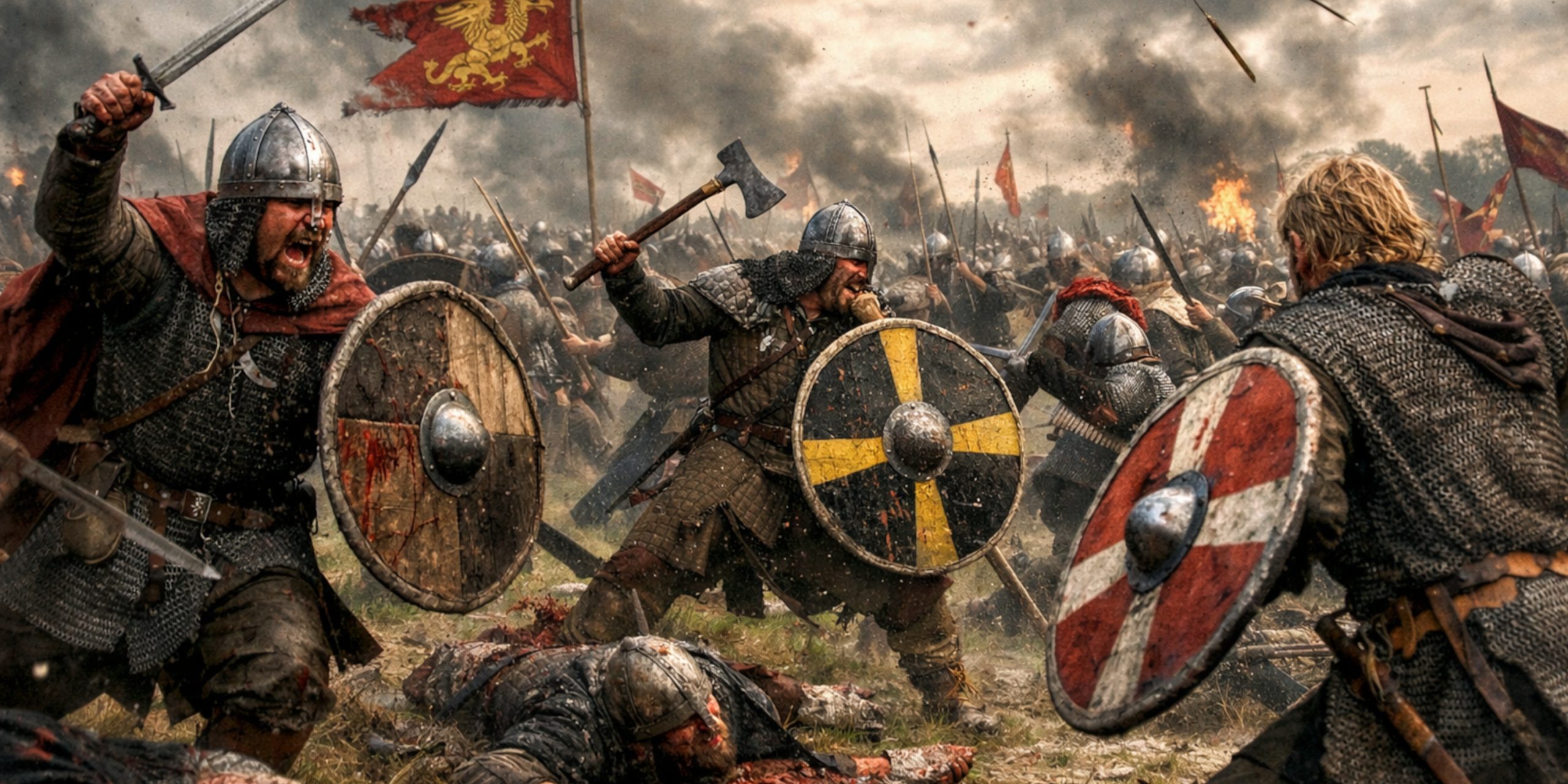
Weapons at Ellandun were typical of early ninth century warfare, practical rather than ornate.
Primary weapons
- Pattern welded Anglo-Saxon swords with broad blades and short guards
- Long spears used for thrusting in shield walls
- Seaxes, especially broken-back seaxes, carried as sidearms
Defensive equipment
- Round wooden shields with iron bosses
- Conical helmets, rare and likely limited to elite warriors
- Quilted or leather armour, with mail restricted to noble retainers
Swords were status symbols rather than common issue. Spears did most of the killing. This is rarely glamorous, but it is honest history.
Battle Timeline
| Phase | Events |
|---|---|
| Initial contact | Shield walls form on gently rising ground |
| Main engagement | Sustained spear fighting and pushing at close quarters |
| Turning point | Mercian line collapses under pressure |
| Rout | Beornwulf’s forces withdraw in disorder |
The battle was likely short, brutal, and decided by morale rather than tactics. Once the Mercian line gave way, the result was settled.
Outcome and Immediate Consequences
Egbert’s victory shattered Mercian control of southern England. Kent, Sussex, Surrey, and Essex quickly transferred their allegiance to Wessex. Beornwulf survived the battle but was killed the following year, trying unsuccessfully to reassert Mercian power.
Ellandun did not make Egbert king of all England overnight, but it made that future possible. The road to a unified kingdom runs straight through this field.
Archaeology and Location
No definitive battlefield has been excavated, though Wroughton remains the strongest candidate based on place name evidence and later tradition. Finds in the region include early medieval weapon fragments, but nothing that shouts Ellandun with certainty.
This absence is typical. Battles of this period leave light footprints, especially when fought with organic materials and promptly scavenged by the victors.
Contemporary and Near Contemporary Sources
The Anglo-Saxon Chronicle records the event with stark brevity:
“In this year King Egbert fought against the king of the Mercians at Ellandun, and gained the victory.”
No flourish, no speeches, no drama. The chronicler knew the audience would understand what this meant.
Later writers expanded its significance, recognising Ellandun as the moment Mercia ceased to be England’s dominant power.
Historical Significance
Ellandun is easy to overlook because it lacks the spectacle of Hastings or Brunanburh. That would be a mistake. It quietly reset the balance of power and set Wessex on the path that would eventually produce Alfred, Athelstan, and a single English crown.
As a historian, I find Ellandun refreshing. No heroic myths, no convenient legends. Just one kingdom beating another at the right time, on the right ground, with lasting consequences. History is often decided this way, even if it rarely gets the credit.
Warch the documentary: