Perseus sitsarrives to us from an interesting corner of Greek myth. He is famous enough to feel inevitable, yet his story keeps slipping between genres, part folktale, part dynastic origin myth, part divine family drama. When people remember him, it is often as the man who killed Medusa. That moment matters, but it is only one act in a longer and surprisingly human story about obligation, luck, and being pushed into danger by other people’s pride.
Origins and Family
Perseus was the son of Danaë and Zeus, conceived after Zeus found his way into a locked tower in the form of golden rain. Acrisius, king of Argos and Danaë’s father, had been warned by an oracle that his grandson would kill him. His solution was containment rather than restraint, which tells you much about how prophecy is usually handled in Greek myth.
When Perseus was born, Acrisius sealed mother and child in a wooden chest and cast them into the sea. It is an unglamorous start for a hero, involving more carpentry than combat. They survived and washed ashore on Seriphos, where Perseus grew up far from royal power, learning to be resourceful rather than grand.
The Medusa Quest
The defining challenge of Perseus’ life came not from fate, but from social pressure. King Polydectes of Seriphos wanted Danaë and needed Perseus out of the way. His demand that Perseus bring back the head of Medusa was meant to be lethal, not heroic.
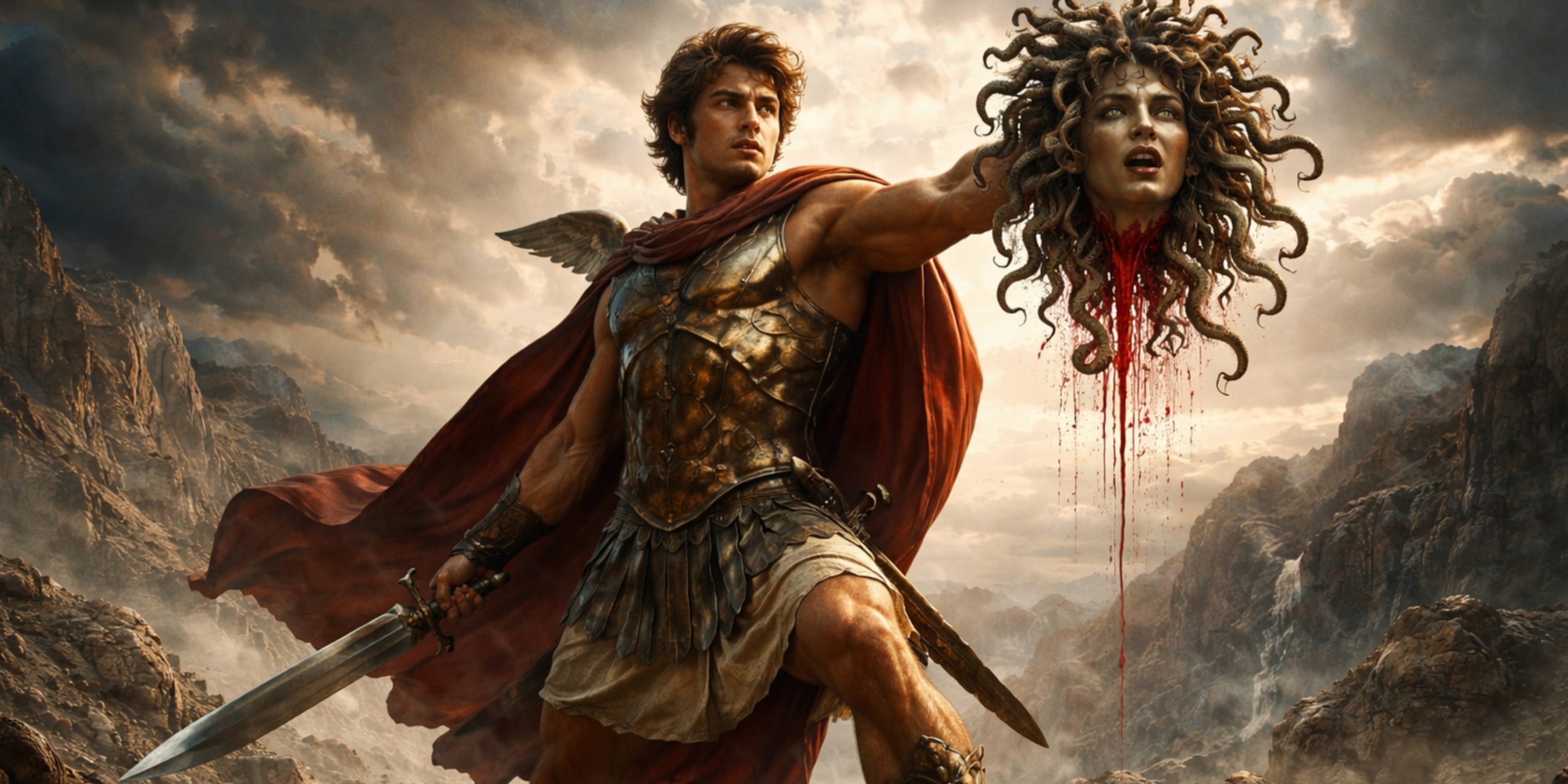
Medusa was one of the Gorgons, a monster whose gaze turned living things to stone. Perseus survived the task only with heavy divine assistance. Athena gave him a polished shield to use as a mirror. Hermes supplied a curved blade and guidance. He also acquired winged sandals, a kibisis to carry the head, and a cap of invisibility from older, stranger beings known as the Graeae and nymphs.
The killing itself was precise rather than glorious. Perseus struck while Medusa slept, looking only at her reflection. It is one of the rare heroic acts in Greek myth that rewards caution instead of bravado.
Weapons, Tools, and Symbols
Perseus’ equipment reads like a catalogue of divine problem-solving. The mirrored shield represents intelligence over force. The sickle-like blade emphasises control rather than raw strength. The cap of invisibility is the ultimate expression of survival instinct.
Medusa’s severed head became his most dangerous possession. Perseus used it sparingly, which is to his credit. Greek heroes are not known for moderation, yet Perseus understood that some tools solve problems at too high a cost.
Andromeda and Further Adventures
On his return journey, Perseus encountered Andromeda, chained to a rock as a sacrifice to a sea monster. He killed the beast and married her, though not without further violence at the wedding. Greek myth rarely allows joy without a fight breaking out nearby.
On Seriphos, Perseus used Medusa’s head to turn Polydectes to stone, freeing his mother at last. The act feels justified, but it also closes a moral circle. The weapon meant to destroy Perseus becomes the instrument that ends the abuse that shaped his life.
The Fulfilment of Prophecy
Despite his efforts, Perseus could not escape fate. During athletic games in Thessaly, he accidentally killed Acrisius with a discus throw. There was no malice, no recognition until too late. The prophecy came true in the most mundane way possible, which may be the point.
Perseus responded not with triumph but with refusal. He declined to rule Argos and instead founded or strengthened other cities, including Mycenae. It is a quiet ending for a hero, more administrative than epic, and strangely fitting.
Perseus as a Hero
Perseus lacks the rage of Achilles or the cunning theatrics of Odysseus. He survives because he listens, plans, and accepts help. From a historian’s point of view, he feels closer to early heroic ideals rooted in survival myths rather than later war epics.
There is also something refreshingly awkward about him. Perseus does not seek glory. Glory keeps finding him, usually because someone else made a poor decision.
Legacy in Art and Culture
Perseus became a favourite subject for Greek and Roman artists, especially the moment after Medusa’s death, when horror and beauty sit uncomfortably close. Renaissance sculptors later embraced him as a symbol of reason conquering chaos, which says more about Renaissance anxieties than Greek ones.
In modern retellings, Perseus often becomes a generic action hero. Something is lost there. His real appeal lies in his restraint and his frequent wish to be anywhere else.
The Seven Swords Takeaway
Perseus endures because he feels plausible within an implausible world. He is brave, but not addicted to it. He succeeds because he prepares, not because he dominates. As myths go, that is a quietly subversive lesson.
If Greek heroes were dinner guests, Perseus would be the one who arrives on time, listens carefully, and leaves before the furniture catches fire. That alone makes him worth remembering.
Watch the documentary: