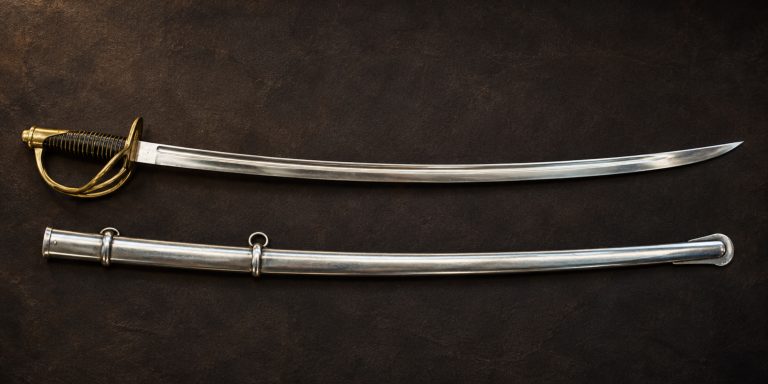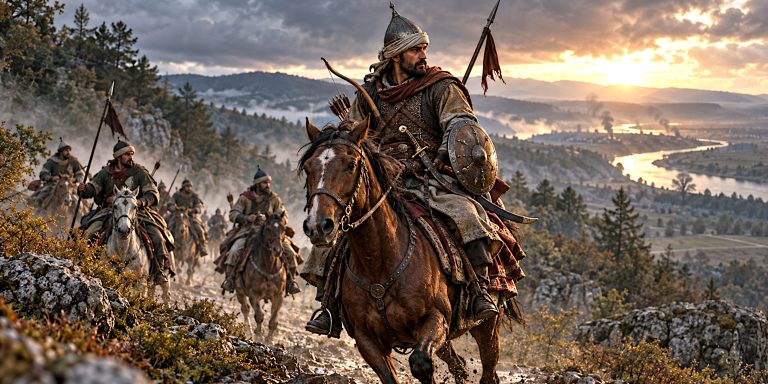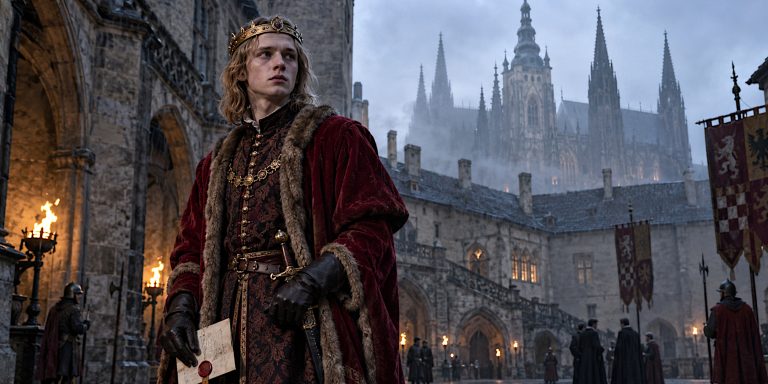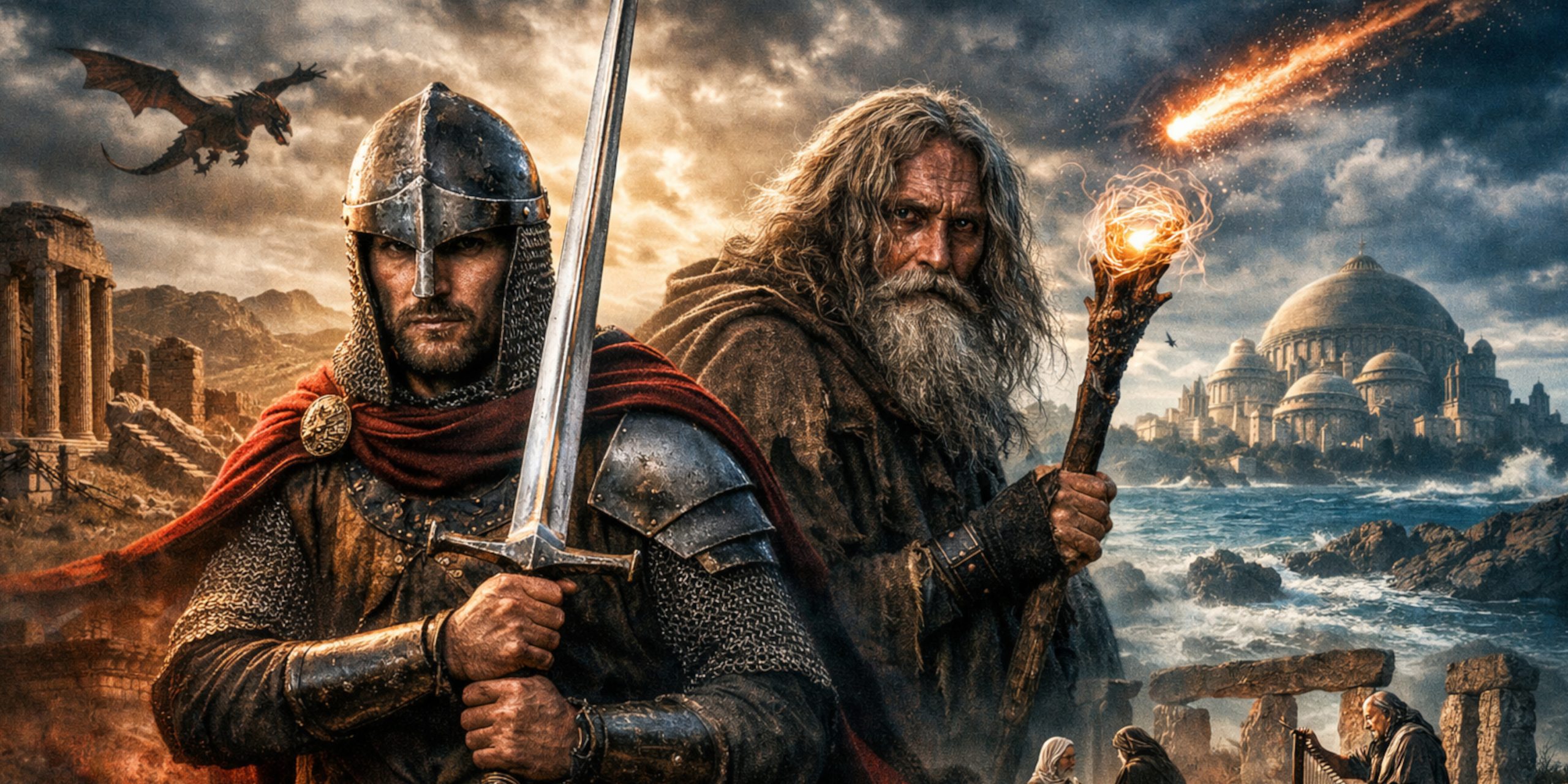
The Pendragon Cycle wears its mythology openly. It does not hide behind vague medieval vibes or generic fantasy fog. These books are stitched together from early Welsh poetry, half-remembered saints’ lives, Roman history, and a surprising amount of theology. Reading them feels less like entering a made-up world and more like stepping into a Britain that cannot quite decide whether it belongs to myth or history. That tension is the point.
Below is a clear-eyed look at the real myths and sources Lawhead pulls from, and how they shape the tone and direction of the series.
Arthur Before the Crown and the Sword
Before Arthur became a shining king with a round table, he was something far rougher. Early Welsh tradition presents King Arthur as a war leader fighting the collapse left behind by Roman Britain. The sources are thin and often contradictory, but that uncertainty gives Lawhead room to work.
Texts like Historia Brittonum and Annales Cambriae describe a commander, not a monarch. There is no Camelot. No pageantry. Just battles, survival, and fragile alliances. Lawhead leans into this version. His Arthur grows into kingship rather than inheriting it, which makes the story feel earned rather than ordained.
This Arthur is less destiny and more responsibility. It suits a Britain that is politically fractured and spiritually unsure, which is exactly the Britain these myths come from.
Merlin, Not a Wizard but a Wound
Merlin’s roots are stranger than most people expect. Merlin descends from the Welsh figure Myrddin, a prophet driven mad by the trauma of battle. Early poetry shows him living wild in the woods, haunted and half broken, speaking truth because he no longer fits into society.
Lawhead keeps that instability. His Merlin is not a fireworks wizard. He is burdened, sometimes frightening, often isolated. The magic feels dangerous and costly, not flashy. When prophecy appears, it is uncomfortable rather than reassuring.
This version feels closer to the original material, where insight comes from suffering and wisdom carries a price tag.
Atlantis, Britain, and the Long Memory of Rome
Atlantis might seem like a wild swing until you realise how medieval writers thought. Plato described Atlantis as a lost civilisation punished for moral decay. Early Christian thinkers loved that idea. It let them talk about fallen worlds without naming Rome directly.
Lawhead uses Atlantis as a symbolic ancestor rather than a literal lost island with lasers. It represents inherited guilt, lost knowledge, and the idea that civilisations collapse from the inside. Linking Atlantis to Britain also reflects a medieval habit of tracing national origins back to legendary survivors.
This is myth doing what it always does, explaining the present by inventing a meaningful past.
Taliesin and the Shape of the Story
Taliesin is one of the deepest cuts in the series. Taliesin appears in medieval Welsh poetry as a shape-shifting bard who claims to remember previous lives. He is wisdom, memory, and identity rolled into one unsettling voice.
Lawhead turns Taliesin into a bridge between eras. He carries myth forward rather than anchoring it to a single moment. This fits the original poems, which treat identity as fluid and memory as sacred.
It also explains why the series feels cyclical rather than linear. History repeats, stories echo, and nothing ever fully disappears.
Christianity, Paganism, and an Awkward Truce
One of the most grounded aspects of the Pendragon Cycle is its refusal to pick a clean winner between belief systems. Early Britain really was a place where Christianity spread unevenly, often sitting beside older Celtic practices.
Lawhead reflects this messiness. Pagan symbols are not dismissed as evil, and Christianity is not presented as an instant solution. Instead, faith evolves through conflict, compromise, and genuine doubt.
This mirrors early medieval texts, where saints argue with druids, miracles coexist with folklore, and nobody seems entirely sure what the rules are yet.
Seven Swords Takeaway
The reason these myths land is simple. They are not tidy. They were never meant to be. They come from a culture trying to understand loss, invasion, faith, and identity all at once.
Lawhead respects that uncertainty. He does not sand it down for comfort. The Pendragon Cycle succeeds because it trusts the old stories enough to let them be strange, incomplete, and sometimes uncomfortable.
That makes the series feel less like escapism and more like a long conversation across centuries. Slightly chaotic, occasionally profound, and still arguing with itself. Which, honestly, feels very on brand for British history.
Watch the documentary: