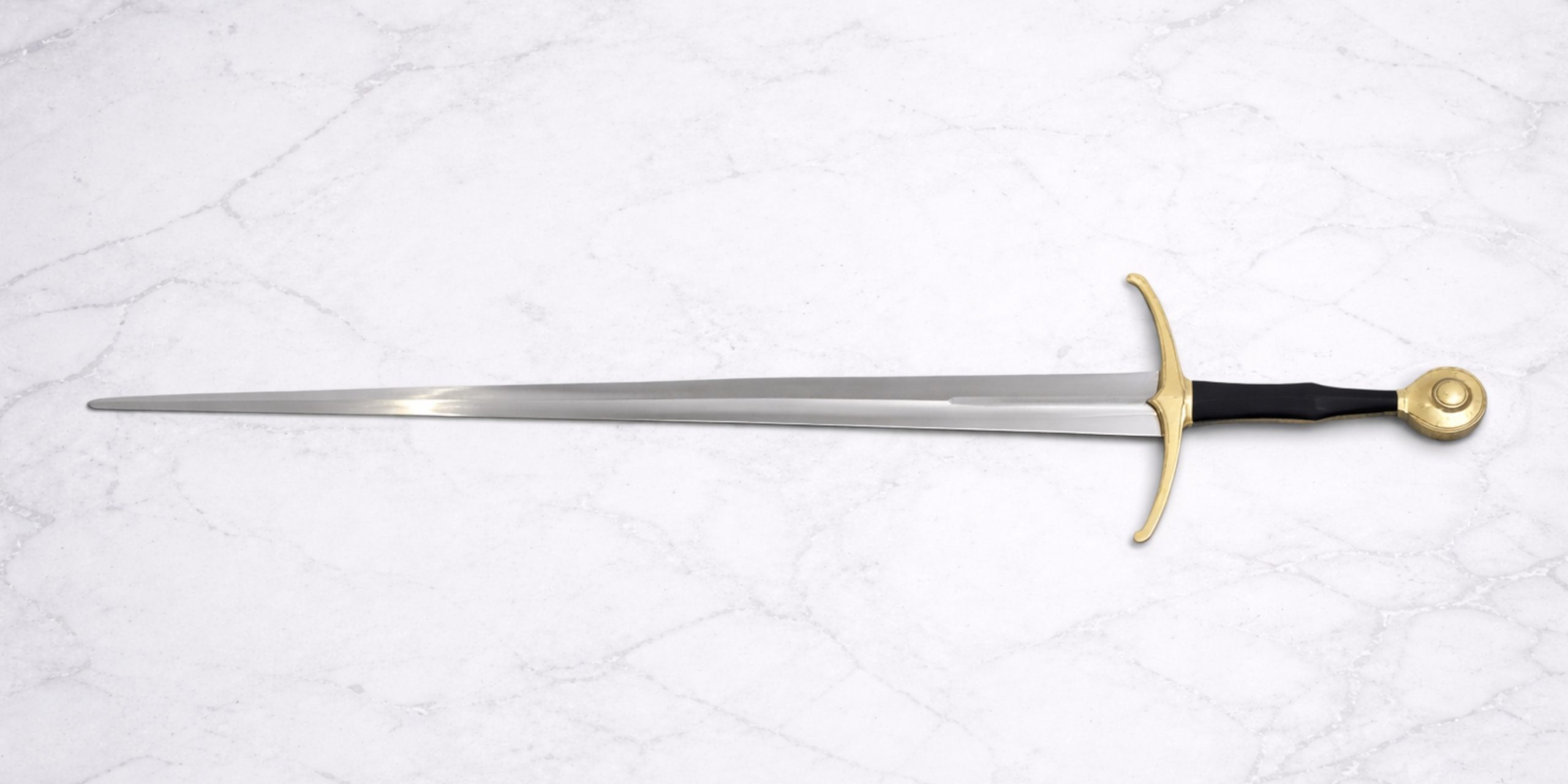
The term Florentine arming sword does not describe a single, officially defined pattern. It is a modern shorthand used for late medieval Italian one handed swords that reflect the styles, proportions, and finishing standards associated with Florence and central Italy. Florence was wealthy, militarised, and proud of its craftsmanship, and that combination shows in the swords linked to the city, whether forged locally or preserved there for centuries.
In practical terms, a Florentine arming sword is best understood as an Italian arming sword with refined lines, balanced handling, and an emphasis on both effectiveness and appearance.
Specifications
Florentine attributed arming swords generally fall within the late 14th to early 16th century range and often align with thrust capable medieval types, particularly those with strong taper and rigid blade sections.
Typical dimensions
| Feature | Common range |
|---|---|
| Overall length | 90 to 100 cm |
| Blade length | 75 to 85 cm |
| Blade width at base | 4 to 5 cm |
| Weight | 1.1 to 1.4 kg |
| Point of balance | 8 to 12 cm from the guard |
Construction features
- Blade
- Noticeable profile taper toward a sharp point
- Often diamond or flattened diamond section for stiffness
- Guard
- Straight or gently down turned quillons are common on Italian examples
- Pommel
- Wheel pommels appear frequently, sometimes thick and slightly dished
- Grip
- Short, one handed grip with wood core and organic covering
These swords are rarely oversized. The design prioritises control, quick recovery, and reliability in both cut and thrust.
History and evolution
During the 14th and 15th centuries, Florence was a city that expected violence but preferred order. The arming sword fit perfectly into that world. It served as a military sidearm, a symbol of civic status, and a practical weapon for men who might fight on campaign one month and walk city streets the next.
Across time, several trends become clear:
- Late 14th century
- Broader cutting blades remain common, but points become more assertive
- 15th century
- Armour improves, and blades become stiffer with more pronounced taper
- Late 15th into early 16th century
- The arming sword overlaps with early sideswords and more complex hilts, especially in civilian contexts
Many swords described as Florentine today earn that label because they survived in Florentine collections, not necessarily because they were forged inside the city walls.
Advantages and disadvantages
Advantages
- Balanced cut and thrust performance
- Effective against lightly armoured opponents and capable of exploiting gaps in armour
- Compact and responsive
- Easy to carry and quick to bring into play
- Works well with off hand equipment
- Particularly effective with a buckler or small shield
Disadvantages
- Limited against full plate on its own
- The sword is a precision tool here, not a brute force solution
- Attribution challenges
- Without solid provenance, Florentine claims can be stylistic rather than factual
- Condition risks for collectors
- Many originals show corrosion, edge wear, or later repairs
Comparison with similar weapons
| Weapon | Similarities | Key differences |
|---|---|---|
| Broad medieval arming sword | Same role as a sidearm | Often more cut focused and less rigid |
| Thrust oriented arming sword types | Similar blade stiffness and point | Can feel less forgiving in the cut |
| Early sidesword | Overlapping civilian use | More hand protection and fencing focus |
| Messer or falchion | Urban and military carry | Single edged, more chop oriented |
The Florentine style tends to sit in the middle ground, not extreme in any single direction.
Legacy
The Florentine arming sword belongs to a transitional moment in European arms history. It reflects a world moving away from the chaos of high medieval warfare and toward more controlled, disciplined combat and personal defence.
Its legacy also survives in collecting culture. These swords look archetypal, handle beautifully, and carry the quiet prestige of Renaissance Italy. They reward close study and punish sloppy assumptions, which keeps them interesting long after the basics are understood.
Where to see examples
Florence remains one of the best cities in Europe for seeing Italian medieval weapons in context.
- Major Florentine museums with arms and armour collections
- British and European national armouries with late medieval Italian swords
- Large private collections occasionally published or exhibited
Seeing several examples side by side is the best way to understand how subtle the differences can be.
Collector’s guide
What affects value
| Factor | Why it matters |
|---|---|
| Provenance | Clear ownership history adds confidence and value |
| Originality | Period blade, hilt, and peen are critical |
| Condition | Cracks, deep pitting, or heavy grinding reduce value |
| Rarity | Unusual forms, marks, or documented examples command premiums |
Common risks
- Composite swords assembled from unrelated old parts
- Heavy cleaning that removes surface history
- Overconfident attributions with no supporting evidence
Buying checklist
- Request precise measurements and weight
- Inspect tang, peen, guard junction, and blade shoulders
- Compare dimensions to known medieval ranges
- Treat the word Florentine as a hypothesis, not a guarantee
Auction price ranges
Prices vary dramatically depending on quality and documentation.
| Category | Typical range |
|---|---|
| Compromised but genuine medieval sword | £4,000 to £8,000 |
| Solid Italian attributed arming sword | £10,000 to £25,000 |
| Published or exceptional example | £30,000 to £50,000+ |
Swords with exceptional provenance or scholarly importance can exceed these figures by a wide margin.