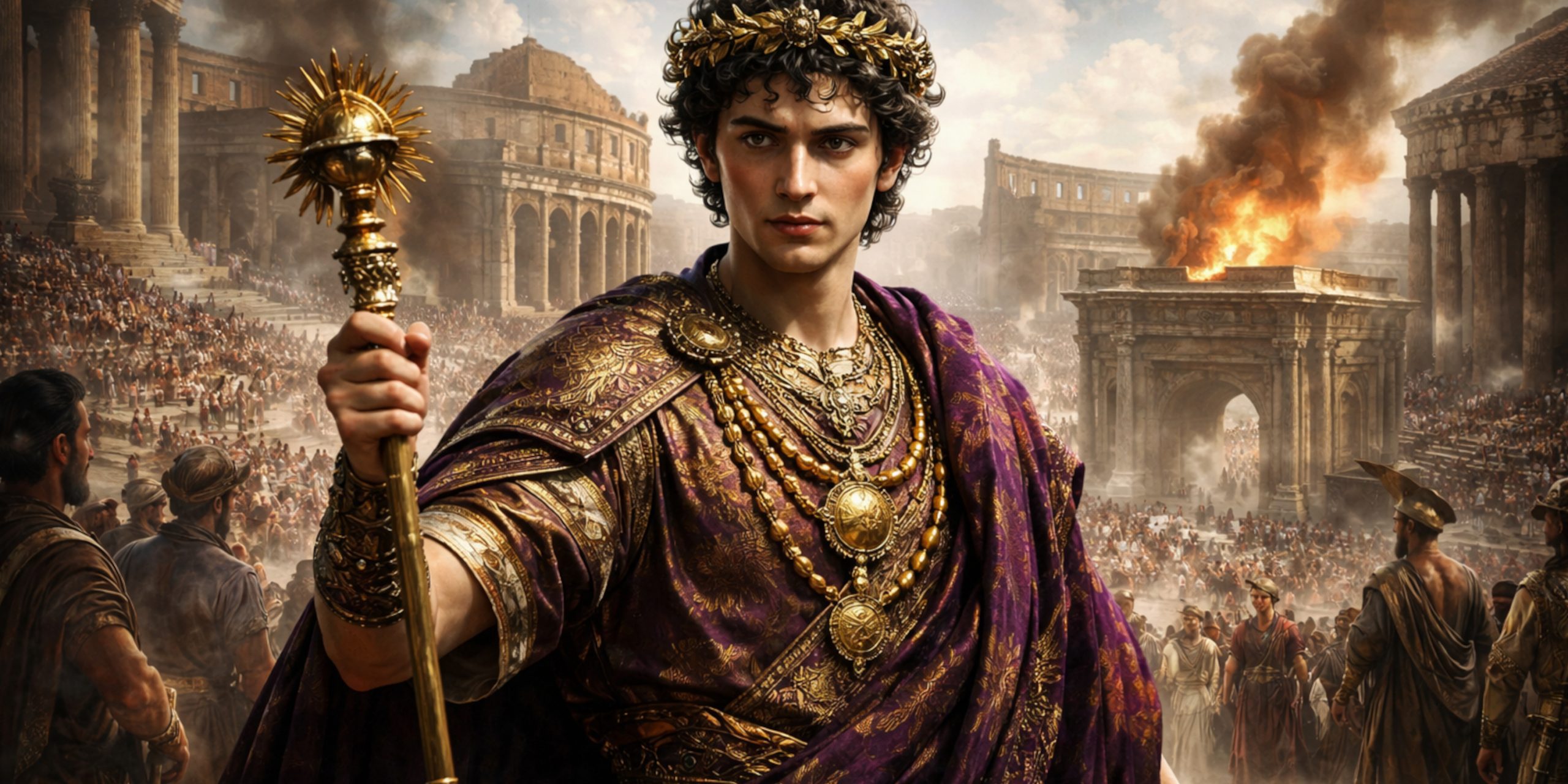
Few Roman emperors generate as much heat and as little calm reflection as Elagabalus. His reign was brief, chaotic, and heavily filtered through hostile sources. He ruled from 218 to 222, ascending the throne as a teenager and dying violently before his twenty-first birthday. What survives is a mix of fact, rumour, political invective, and genuine cultural shock. Sorting one from the other is difficult, but worthwhile.
I approach Elagabalus less as a scandal sheet caricature and more as a young ruler dropped into a brittle empire that had already lost its sense of balance. The Severan world was unstable long before he arrived.
Origins and Rise to Power
Elagabalus was born Varius Avitus Bassianus in Emesa, modern Homs in Syria. His family were powerful local elites tied to the cult of the sun god Elagabal. His mother Julia Soaemias and grandmother Julia Maesa belonged to the extended Severan dynasty, and this connection mattered more than talent or experience.
After the murder of Caracalla in 217, the throne passed to Macrinus, an emperor without dynastic legitimacy. Julia Maesa exploited this weakness. She promoted her teenage grandson as the secret son of Caracalla and used Syrian legions loyal to the Severan name to overthrow Macrinus. Rome accepted the fiction because armies insisted on it.
From the outset, Elagabalus ruled as a symbol rather than a statesman.
Rule in Rome
When Elagabalus arrived in Rome, the cultural collision was immediate. He brought with him the priesthood of Elagabal and attempted to elevate this eastern solar deity above Jupiter himself. A sacred black stone was installed on the Palatine, and senators were compelled to attend unfamiliar rites.
Roman elites were not offended by religion alone. They were unsettled by what felt like a loss of control. Power was increasingly exercised by the imperial household, especially by Julia Soaemias, while the emperor devoted himself to ceremony, spectacle, and personal expression.
Administrative continuity did exist. Bureaucrats continued to collect taxes and govern provinces. The empire did not collapse. Yet the perception of neglect mattered almost as much as reality, especially in a city obsessed with appearances.
Personal Life and Court Culture
Ancient sources fixate on Elagabalus’s sexuality, gender expression, and marriages. He married several times, including to a Vestal Virgin, which was a serious religious violation. He reportedly adopted feminine titles, wore elaborate dress, and sought bodily transformation.
As a historian, I read these accounts cautiously. Much of what we know comes from hostile senators writing after his death, eager to justify his removal. Still, the consistency of certain themes suggests that Elagabalus genuinely challenged Roman norms around gender, ritual, and authority.
Whether we interpret this as deliberate provocation, youthful indifference, or sincere identity expression remains open. What is clear is that Rome lacked the cultural elasticity to absorb it.
War and Military Affairs
Elagabalus did not lead major campaigns. The frontiers held largely due to existing military structures rather than imperial initiative. This absence mattered. Roman emperors were expected to be soldiers first, symbols of martial competence.
The army that placed him on the throne grew restless. His reliance on favourites and his failure to perform the rituals of military leadership eroded loyalty. By 221, his grandmother engineered the adoption of his cousin Severus Alexander, a move designed to stabilise relations with the legions.
This solution merely delayed the inevitable.
Disease and Public Health
The early third century was marked by recurring epidemics, likely continuations or resurgences of the Antonine Plague. Urban density in Rome remained high, sanitation uneven, and medical understanding limited.
There is no evidence that Elagabalus directly addressed public health crises. That silence is telling. Emperors were judged not only on action but on visibility, and plague demanded symbolic reassurance as much as practical response. His disengagement reinforced perceptions of detachment from Roman suffering.
Famine and Economic Pressure
Famine lurked as a constant threat in imperial Rome. Grain supply from North Africa and Egypt was tightly managed, and any disruption risked unrest. While no catastrophic famine is directly attributed to Elagabalus’s reign, economic stress was real.
Extravagant court spending and religious projects strained confidence. Rome tolerated luxury, but not when paired with instability. Even the rumour of mismanagement could spark anger, and Elagabalus inspired plenty of rumour.
Fall and Death
In 222, the Praetorian Guard turned against him. Elagabalus and his mother were murdered, their bodies dragged through the streets and thrown into the Tiber. His memory was officially condemned.
This violence was not exceptional. It was part of a grim pattern in third-century Rome, where emperors were disposable once they ceased to reassure the army.
Assessing the Sources
Cassius Dio, Herodian, and the Historia Augusta shape nearly everything we know. All had reasons to despise Elagabalus. They wrote for audiences that valued restraint, masculinity, and Roman tradition.
As a result, the emperor becomes a moral lesson rather than a person. Yet even through exaggeration, we glimpse a real conflict between centre and periphery, tradition and change, youth and power.
Legacy and Historical Reflection
Elagabalus is often dismissed as a freak interruption. I see him instead as a warning flare. His reign exposed how fragile Roman consensus had become. Religious pluralism existed, but only within boundaries. Personal freedom existed, but not for emperors who embodied the state.
He did not destroy Rome. Rome destroyed him, because it no longer knew how to absorb difference at the top.
That, to me, is the enduring lesson.
Watch the documentary: