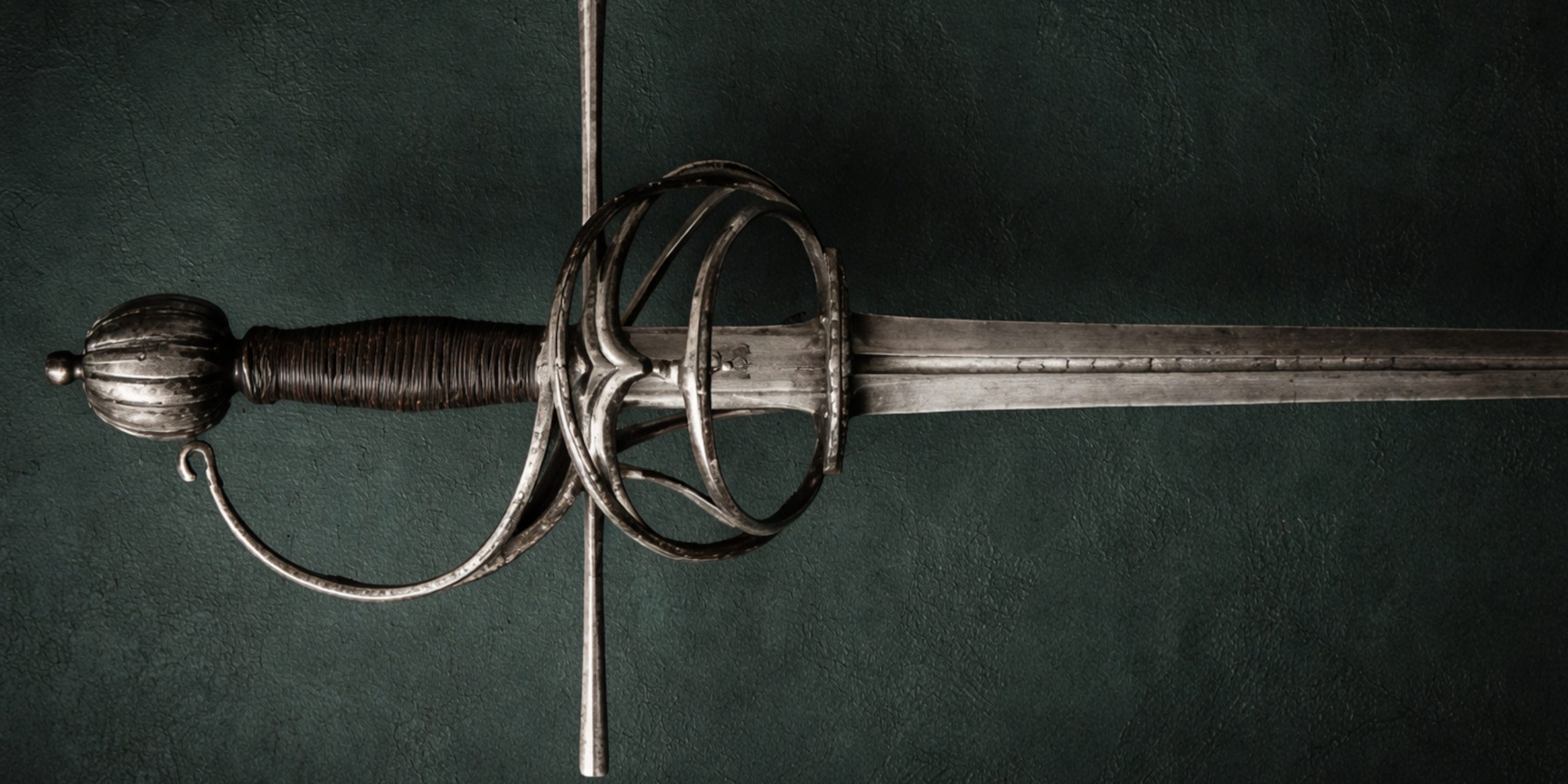
The spada da lato, literally “sword at the side”, is the Italian cut and thrust civilian sword that bridges the gap between the late medieval arming sword and the fully developed rapier. It belongs to the Renaissance moment when civilian violence, personal defence, and formal duelling became codified, taught, and argued over with enthusiasm. In the hand, it feels like a sword that still remembers how to cut properly, while having learned the manners of the thrust.
Specifications
Spada da lato vary widely by region, decade, and individual maker. Duelling-focused examples tend to share a recognisable profile.
Typical physical profile
| Feature | Common range | Notes |
|---|---|---|
| Overall length | 100 to 110 cm | Most fall comfortably within this span |
| Blade length | 85 to 95 cm | Longer blades lean toward early rapier forms |
| Blade type | Double edged, cut and thrust | Diamond or hexagonal section near the point is common |
| Blade width at base | Around 3 to 4 cm | Broader than many rapiers |
| Weight | Approx. 1.0 to 1.4 kg | Enough mass for authority without sluggishness |
| Balance point | Forward of the guard | Supports cutting without losing point control |
Hilt and furniture
- Cross guards with finger rings through to complex swept hilts.
- Side rings and knuckle guards appear increasingly through the 16th century.
- Grips are usually wood, often wire wrapped.
- Pommels range from wheel forms to more sculpted Renaissance shapes.
Typical use
- Worn at the side in civilian contexts.
- Often paired with an off hand dagger, buckler, cloak, or free hand depending on fencing tradition.
History and Evolution
Late 15th to early 16th century
- Civilian swords evolve from arming swords with improved hand protection.
- Blades remain broad enough to cut decisively but develop sharper points.
Mid 16th century
- Italian fencing schools flourish, especially in Bologna.
- Treatises describe systems that expect a sword capable of both cuts and thrusts.
- The spada da lato becomes the default civilian fencing sword.
Late 16th to early 17th century
- Duelling fashion shifts toward longer, more thrust focused rapiers.
- Sideswords continue in use alongside transitional and early rapier forms rather than disappearing overnight.
Advantages and Disadvantages
Advantages
- Genuine cut and thrust capability, without compromise.
- More convincing cutting power than most rapiers.
- Improved hand protection compared to medieval swords.
- Flexible pairing with off hand weapons or empty hand techniques.
- Handles well for practitioners who work across sword traditions.
Disadvantages
- Shorter reach than dedicated rapiers in point focused duels.
- Complex hilts are more vulnerable to damage and costly repairs.
- Terminology is inconsistent, which complicates research and collecting.
- Some later examples sit awkwardly between categories.
Comparison With Similar Weapons
| Weapon | Role | Strengths | Limitations |
|---|---|---|---|
| Medieval arming sword | Predecessor | Strong cuts, simplicity | Limited hand protection |
| Spada da lato | Hybrid | Balanced cut and thrust | Slight reach disadvantage |
| Early rapier | Transitional | Thrust focus with some cutting | Less cutting authority |
| Espada ropera | Iberian cousin | Civilian wear and status | Wide variation in function |
| Later rapier | Specialist | Reach and point control | Reduced cutting effectiveness |
Legacy
The spada da lato represents a turning point in European sword culture. It reflects a society where armour was fading, personal honour mattered, and fencing masters were professionalising violence into something teachable. Its influence survives in fencing theory, in museum collections, and in the way we still think about the shift from battlefield sword to civilian duelling weapon.
Where to See One
Original spada da lato are usually catalogued under broader labels such as cut and thrust swords or early rapiers.
- The Wallace Collection, London, with strong holdings of Renaissance civilian swords.
- Royal Armouries, Leeds, offering well documented examples in their arms and armour galleries.
- The Metropolitan Museum of Art, New York, with a substantial European arms collection accessible through its galleries and archive material.
Collector’s Guide (Including Auction Prices)
Typical market ranges
Prices vary widely depending on condition, attribution, and decoration.
- Plainer or later side swords often fall into the low thousands.
- Well preserved 16th century complex hilt examples commonly reach mid four figures and beyond.
- Highly decorated or strongly attributed pieces can reach five figures or more.
Factors that affect value
- Structural condition of the hilt and guard.
- Blade integrity, especially pitting near the hilt.
- Evidence of heavy polishing or shortening.
- Originality of grip and fittings.
- Presence of identifiable marks or inscriptions.
- Provenance and prior collection history.
Buying checklist
- Request clear blade photographs in angled light.
- Inspect guard joins and stress points closely.
- Confirm blade length and profile against period norms.
- Be cautious of modern replacement grips described as minor restoration.
- Treat mismatched hilts and blades with scepticism.
Practical notes for UK collectors
- Antique swords are subject to specific legal considerations.
- Keep invoices and provenance records.
- Buy through reputable dealers or auction houses familiar with arms and armour.