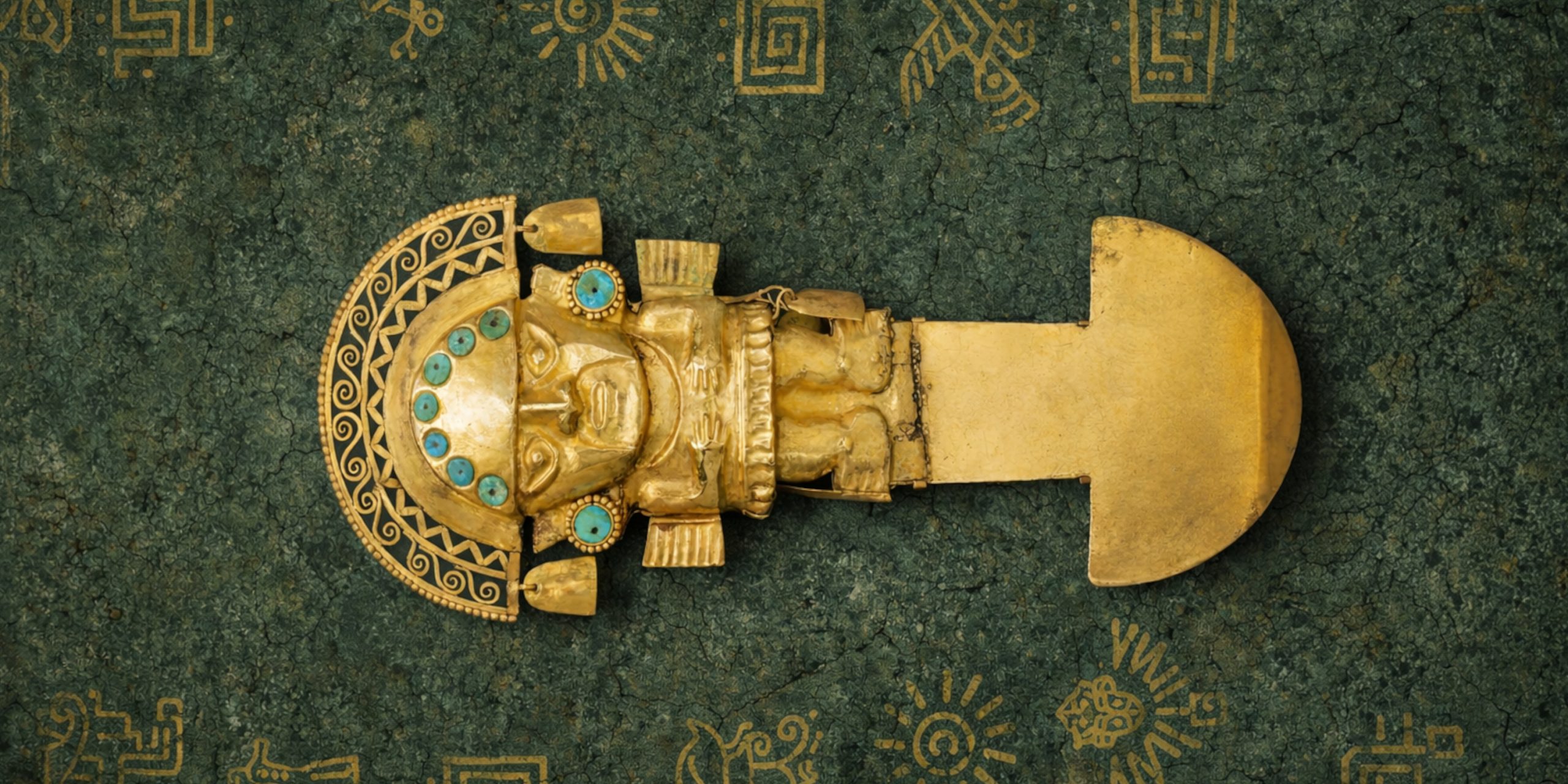
The Inca ceremonial tumi is one of the most recognisable ritual blades from the Andes. Its distinctive semicircular blade and symbolic decoration place it firmly in the realm of ceremony, medicine, and belief rather than the battlefield. While often called a sword, the tumi sits closer to a ritual knife, carrying layers of religious meaning tied to sacrifice, healing, and authority within Inca society.
Specifications
Typical Physical Characteristics
| Feature | Details |
|---|---|
| Overall length | 20 to 40 cm |
| Blade shape | Semicircular or crescent |
| Blade material | Copper, bronze, silver, occasionally gold |
| Handle material | Metal cast as a single piece or fitted |
| Weight | Light to moderate, balanced for controlled cuts |
| Decoration | Deities, geometric motifs, stepped patterns |
Construction Notes
- Usually cast rather than forged
- Many examples made as a single integrated piece
- High status pieces heavily decorated with repoussé work
- Edges often sharp but not optimised for combat durability
History and Evolution
The tumi predates the Inca Empire itself, with roots in earlier Andean cultures such as the Moche and Lambayeque. By the time of the Incas, it had become deeply embedded in state ritual.
Key historical points include:
- Early tumis appear in northern Peru around the first millennium AD
- Inca adoption emphasised religious symbolism and imperial authority
- Used in ceremonial sacrifices, including capacocha rites
- Employed in ritual trepanation, a surgical practice with surprisingly high survival rates
The blade’s form remained consistent over centuries, suggesting symbolic importance outweighed practical redesign.
Advantages and Disadvantages
Advantages
- Highly symbolic and culturally significant
- Excellent for controlled ritual cutting
- Robust casting allowed intricate iconography
- Instantly recognisable form with strong identity
Disadvantages
- Poor combat effectiveness due to blade shape
- Limited reach and cutting mechanics
- Not designed for sustained use or parrying
- Functional sharpness varies widely by example
Comparison With Similar Weapons
Ceremonial Blades of the Americas
| Weapon | Culture | Primary Use | Key Difference |
|---|---|---|---|
| Tumi | Inca and predecessors | Ritual and medical | Crescent blade, symbolic |
| Macuahuitl | Aztec | Warfare and ritual | Obsidian edged club |
| Sacrificial flint knife | Maya | Ritual sacrifice | Straight or leaf shaped blade |
| Copper axe knives | Andean cultures | Status and ritual | Axelike profile |
Compared to the macuahuitl, the tumi lacks battlefield intent. Against Maya flint knives, it trades cutting efficiency for visual and symbolic weight.
Legacy
The tumi has outlived the Inca Empire by centuries, becoming a national symbol of Peru and a shorthand for Andean heritage. Its image appears in:
- Museum branding and cultural institutions
- Modern jewellery and ceremonial replicas
- Medical symbolism in Peru, referencing ancient surgery
Few artefacts capture the blend of ritual, art, and power as cleanly as the tumi.
Where to See Authentic Tumis
Museums and Collections
- Museo Larco, Lima
- Museo Nacional de Arqueología, Antropología e Historia del Perú
- British Museum, London
- Metropolitan Museum of Art, New York
These collections include examples ranging from austere bronze pieces to elaborately worked silver blades with deity figures.
Collector’s Guide
What to Look For
- Provenance with documented excavation history
- Casting marks consistent with pre Columbian techniques
- Appropriate metal composition, often copper based alloys
- Surface patina showing age rather than artificial distress
Warning Signs
- Perfect symmetry and machine smoothness
- Modern tool marks
- Overly sharp or polished edges
- Lack of credible paperwork
Auction Prices
| Type | Typical Price Range |
|---|---|
| Small bronze ceremonial tumi | £2,000 to £6,000 |
| Silver decorated tumi | £8,000 to £25,000 |
| Museum quality with provenance | £30,000 plus |
| Modern replicas | £50 to £500 |
Prices fluctuate heavily based on authenticity, condition, and legal export status. Many countries enforce strict cultural property laws.