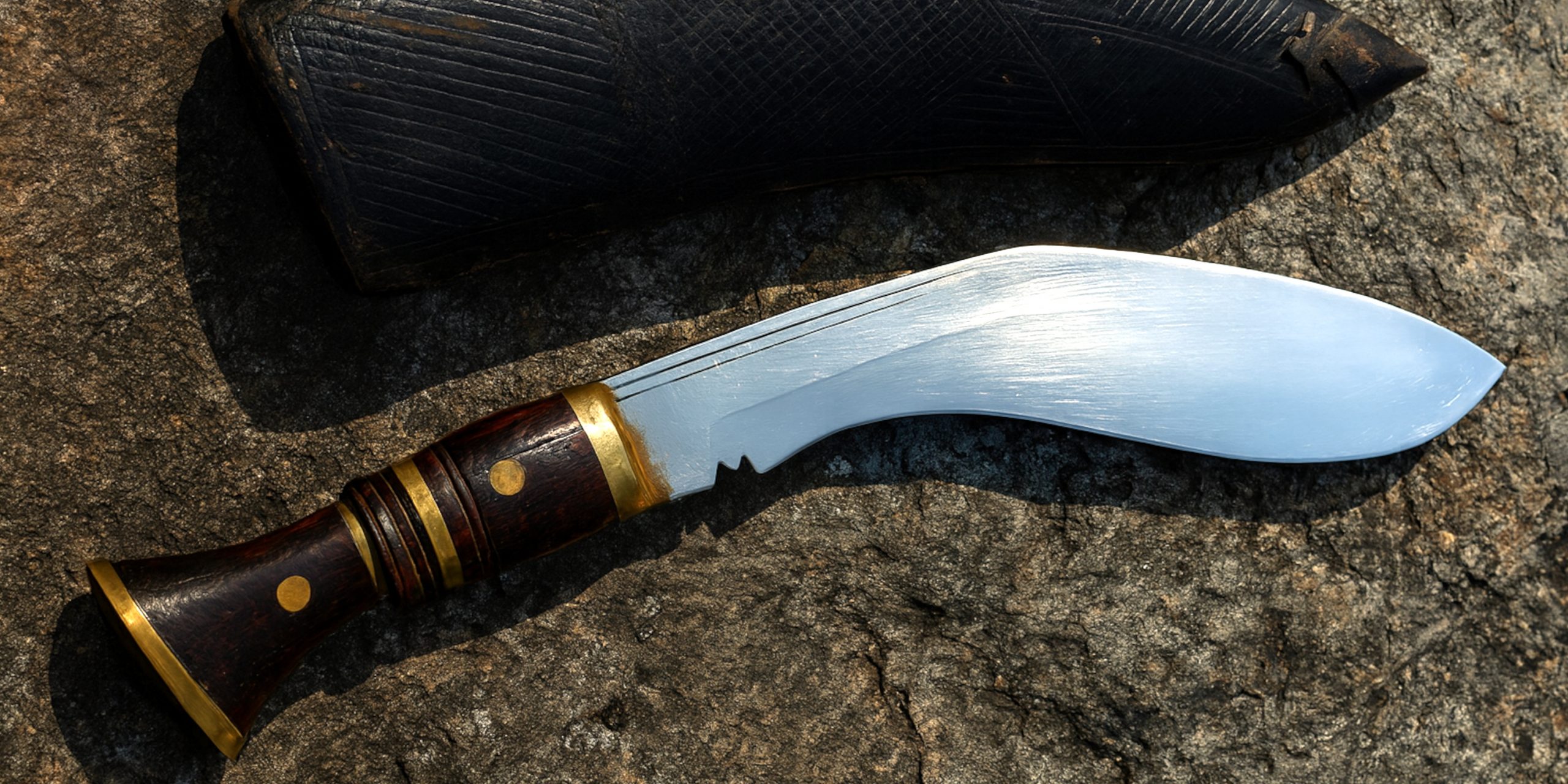
The Kukri is one of the most recognisable blades ever produced. Closely associated with the Gurkhas of Nepal, it serves as both a practical tool and a formidable weapon. Its forward curving blade gives it cutting strength that is out of proportion to its size, which helped cement its reputation across Himalayan cultures and later in global military history. Although often spoken of with awe, the Kukri is also a deeply functional object shaped by everyday needs in rural Nepal.
Specification
| Feature | Details |
|---|---|
| Blade length | 25 to 38 cm typical, longer ceremonial variants exist |
| Overall length | 35 to 50 cm |
| Weight | 450 to 900 g depending on pattern |
| Blade shape | Forward curved, flared belly, thick spine with distal taper |
| Steel | Traditionally layered or high carbon steel, modern versions use spring steel |
| Hilt | Wood, horn or metal with a narrow waist and flared pommel |
| Sheath | Wood core, leather covered, often with pockets for small utility knives (karda and chakmak) |
History and Evolution
The Kukri’s origins sit with the wider family of inward curving blades used across South Asia, though Nepal developed the form into something distinctive. Early depictions appear in local art from the Licchavi period. By the eighteenth century, Gurkha forces had adopted the Kukri as a core fighting weapon.
During the Anglo Nepalese War, British soldiers encountered it at close quarters and noted both its cutting power and the confidence with which Nepalese troops used it. This encounter shaped its future. The British Army soon formed Gurkha regiments, and the Kukri travelled with them across imperial battlefields. Patterns changed slightly over time, with military production creating more standardised spine thickness, blade curvature and material quality. Civilian and village made Kukris continued to follow traditional lines but with more regional variation.
Twentieth century conflicts further elevated its reputation. Gurkha soldiers carried the Kukri in both world wars and later in Malaya, Borneo and the Falklands. Today it remains a working tool in Nepal and a military sidearm for Gurkha units, though its symbolism often overshadows its day to day practicality.
Advantages and Disadvantages
Advantages
- Strong chopping capability for its size.
- Versatile enough for utility tasks, clearing vegetation and close combat.
- Thick spine gives durability and weight forward momentum.
- Simple construction allows for field maintenance and easy sharpening.
- Balanced ergonomics with a grip that fits naturally into the hand.
Disadvantages
- Not ideal for thrusting because of the curvature.
- Forward weight can tire inexperienced users over long periods.
- Traditional horn or wood hilts may become slick in wet conditions.
- Curved shape limits some fine control tasks compared to straight blades.
Comparison with Similar Weapons
Kukri vs Bowie Knife
| Feature | Kukri | Bowie Knife |
|---|---|---|
| Primary strength | Chopping power | Versatile cutting and thrusting |
| Weight distribution | Forward weighted | More neutral |
| Cultural role | Central to Nepali and Gurkha identity | Iconic American frontier knife |
The Kukri excels in raw chopping force, while the Bowie is a generalist with broader use cases in fieldcraft and combat.
Kukri vs Machete
| Feature | Kukri | Machete |
|---|---|---|
| Use | Multi purpose tool and weapon | Primarily vegetation clearing |
| Blade geometry | Thick spine, deep belly | Long, thin, flexible blade |
| Cutting power | Focused and heavy | Swift and sweeping |
A machete covers larger areas quickly. The Kukri delivers more concentrated cutting and greater penetration.
Kukri vs Talwar
| Feature | Kukri | Talwar |
|---|---|---|
| Weapon type | Short curved utility blade | Full length sabre of the Indian subcontinent |
| Reach | Short | Long |
| Function | Close quarters and tasks | Cavalry and infantry combat |
These two blades sit in completely different roles. The Talwar is a battlefield sword while the Kukri is a hybrid tool and weapon.
Legacy
The Kukri’s legacy stretches far beyond Nepal. It is a symbol of Gurkha bravery and discipline, appearing in regimental insignia, memorials and modern military ceremonies. Many veterans recall how Gurkhas could use the Kukri for everything from camp chores to hand to hand fighting. Outside the military sphere, the Kukri remains part of Nepali cultural identity. It features in festivals, rites of passage and gift giving traditions.
Collectors value Kukris for their regional diversity, distinctive craftsmanship and military connections. Older village made examples carry local character, while First and Second World War issue Kukris attract attention from militaria specialists.
Where to See
- National Museum of Nepal, Kathmandu holds historic Kukris from various periods.
- Gurkha Museum, Winchester, UK displays military issue Kukris with regimental history.
- Imperial War Museum, London includes examples used by Gurkha units in both world wars.
- Royal Armouries, Leeds features South Asian edged weapons including Kukris of different patterns.
Collectors Guide and Auction Prices
What Collectors Look For
- Authentic military markings such as date stamps and unit numbers.
- Original scabbards with karda and chakmak included.
- Provenanced items linked to known campaigns.
- Early village made pieces with traditional forging and distinct regional profiles.
- Condition of the blade, edge and hilt materials.
Typical Market Values
| Type of Kukri | Typical Auction Price Range |
|---|---|
| Late nineteenth century village made Kukri | 150 to 350 GBP |
| Early twentieth century military issue (WW1) | 200 to 450 GBP |
| Second World War dated Kukri | 250 to 500 GBP |
| High quality officer’s Kukri with decorated scabbard | 400 to 900 GBP |
| Rare or well documented campaign used examples | 1000 GBP and above |
Prices vary widely depending on condition, provenance and rarity. Military marked pieces with complete scabbards tend to fetch stronger results.